

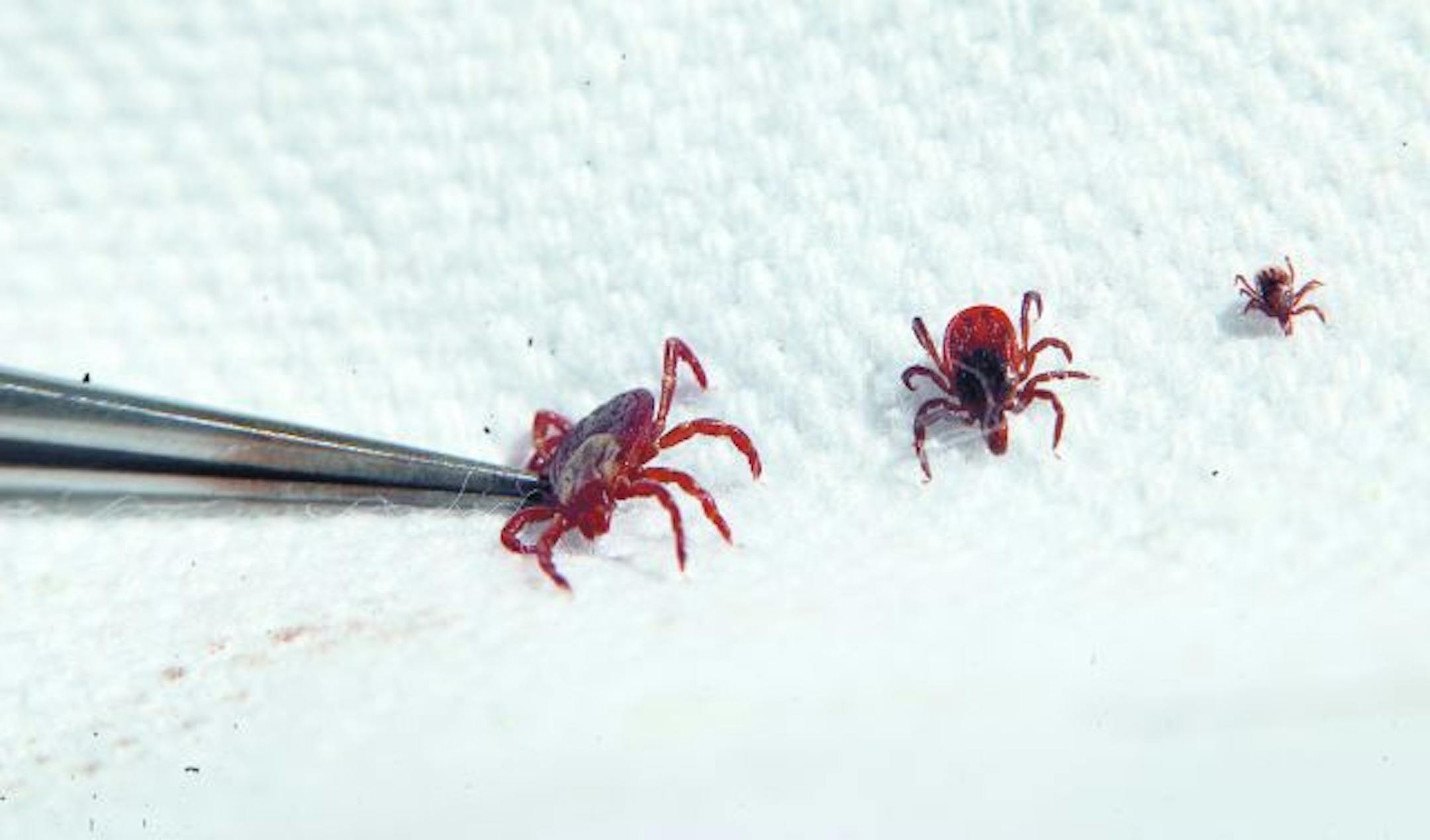
Mike Lee knew about the dangers of ticks and Lyme disease, so he took precautions before heading into the woods last August near Lake Mille Lacs. "I sprayed repellent on my clothes and tucked my pants inside my boots," said Lee, 34, of Isle, Minn. Lee is a Department of Natural Resources conservation officer who was helping sheriff's deputies investigate a marijuana patch in a state wildlife area.
Despite his attentiveness, when he got home, Lee found a small black tick stuck on his thigh. The tick had been there only a few hours, so he wasn't concerned. And there was no rash, which might indicate Lyme disease.
Three days later, he was driving on vacation to Missouri when he felt sick. "I've never been so sick in my life," he said. He stayed in bed several days, then, running a fever of 103 degrees, he got up to take a shower. "I looked down and noticed the spot where the tick bit me was black, the size of my fist. And when I urinated, it was the color of maple syrup."
Lee was subsequently diagnosed as having Lyme disease, one of about 1,043 cases reported in Minnesota in 2008 -- the second-highest tally since health officials began tracking the disease in 1986. A record 1,239 cases were found in 2007, but the state has averaged more than 1,000 the past five years -- a dramatic increase from a decade earlier, when the state averaged 235 cases a year.
Now, in August, as many Minnesota families begin vacations, and with fall hunting seasons in the offing, adult blacklegged ticks renew their threat. "The adult ticks come out to feed in fall and spring," said Dave Neitzel, a Minnesota Department of Health epidemiologist.
The adults replace -- or supplant -- the risk that 2-year-old blacklegged ticks pose in their nymph stage from mid-May to mid-July.
A report last week that two other serious tick-borne diseases have surfaced in Minnesota -- Rocky Mountain spotted fever and Powassan encephalitis -- underscores the health threat ticks pose. Human anaplasmosis is another disease spread by ticks that has infected more than 1,500 people in Minnesota since 1995, including 278 last year.
But Lyme disease is by far the No. 1 tick-borne risk Minnesotans face.


