1:05
1:05As any marathoner knows, covering 26.2 miles on race day is not the hard part — it's getting to the start line that is the challenge. Finding the time to train, dragging out of bed for a Saturday 20-miler, battling illness and injury, and all of this over a two- to three-month stretch — a lot can happen to derail that preparation.
Think about making that journey to the start line every year, without fail, for 34 years. Of the hundreds of thousands who've run the Twin Cities Marathon, only 27 people have run every one since the first marathon in 1982. Though none of the charter club members started out with that intent, eventually, as member Paul Arbisi of Edina put it, "Running all the TCMs becomes part of one's identity; it's who I am."
Organizers eventually decided to honor those hardy souls who had completed all 10 Twin Cities Marathons, so then-vice president of runner services Gloria Jansen searched the records and found 178 runners who'd finished every one. A charter club was born. With each year membership drops and the accomplishment grows. At the race's 15-year anniversary, the club had 106 members; the 20th year, 89; the 25th year, 67; and the 30th year, in 2011, there were 40.

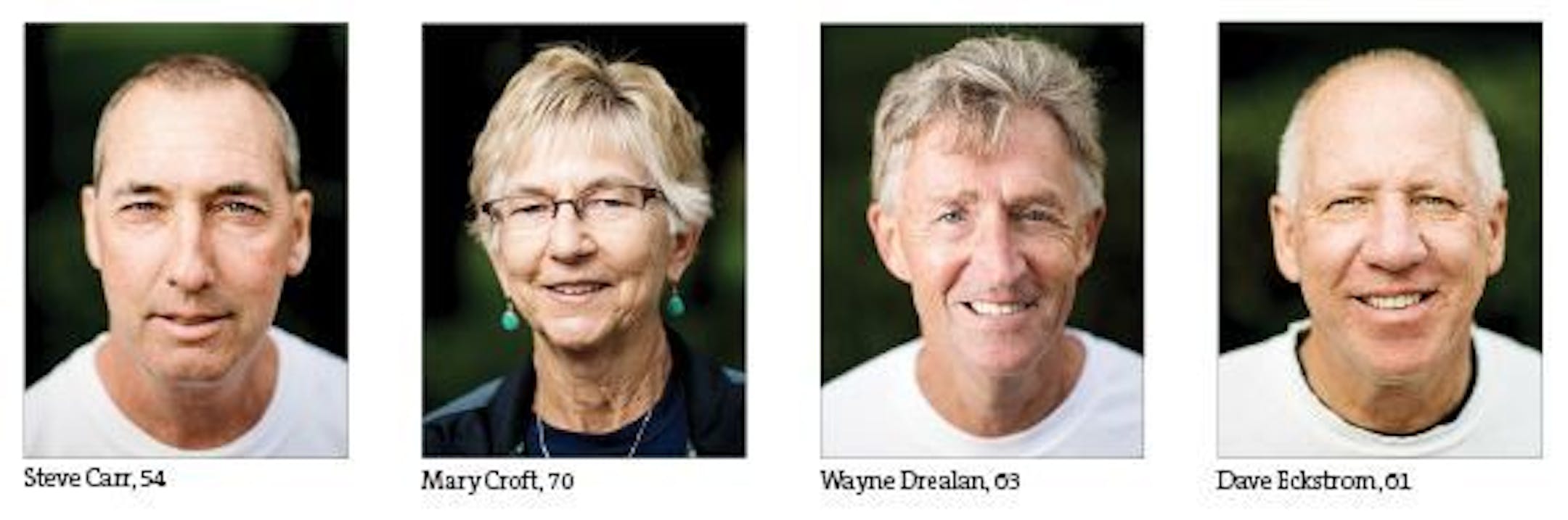
This year's charter clubbers range in age from 54 to 77; four of the 27 are women; all live in Minnesota or practically Minnesota (River Falls, Wis., and Fargo), except one — Rod Brostrom of Huntersville, N.C. We contacted them and asked why the streak, what threatened the streak's continuation, and which race stood out as special.
Strained muscles, broken bones, and surgeries threatened most charter membership, but there were some unusual roadblocks, too.
Bob Tierney, now 67, was having a prerace doughnut and coffee in the physician's lounge of the old Metropolitan Medical Center. "When I stepped outside to get lined up there was no one there. The clock in the lounge was set an hour behind — I started 45 minutes after everyone!"
In 2002, Annette LeDuc, 63, of Minneapolis slipped and fell on a discarded garbage bag in the first mile. "Very demoralizing as I realized I had 25 miles to go and was already banged up from my fall." With the help of an Aleve pain reliever from a course volunteer, LeDuc managed to finish.
In 1994, Arbisi and his wife developed a contingency plan for mid-marathon labor pains — his wife's, that is: "This was back when cellphones were not ubiquitous, so I decided to carry my hospital pager and a quarter in a plastic bag. Should my wife go into labor, she was to call my pager, I would run off the course and call with my location so a designated driver could pick me up. As it happened, my daughter Maria did not make her appearance until 48 hours after I finished."