
Their boat was gone as darkness fell. But two lost divers had a flashlight – and buddies

Michael Sparks and Samuel Ragsdale are alive to recount the July 6 adventure for a couple of reasons.

July 18, 2017 at 8:49PM
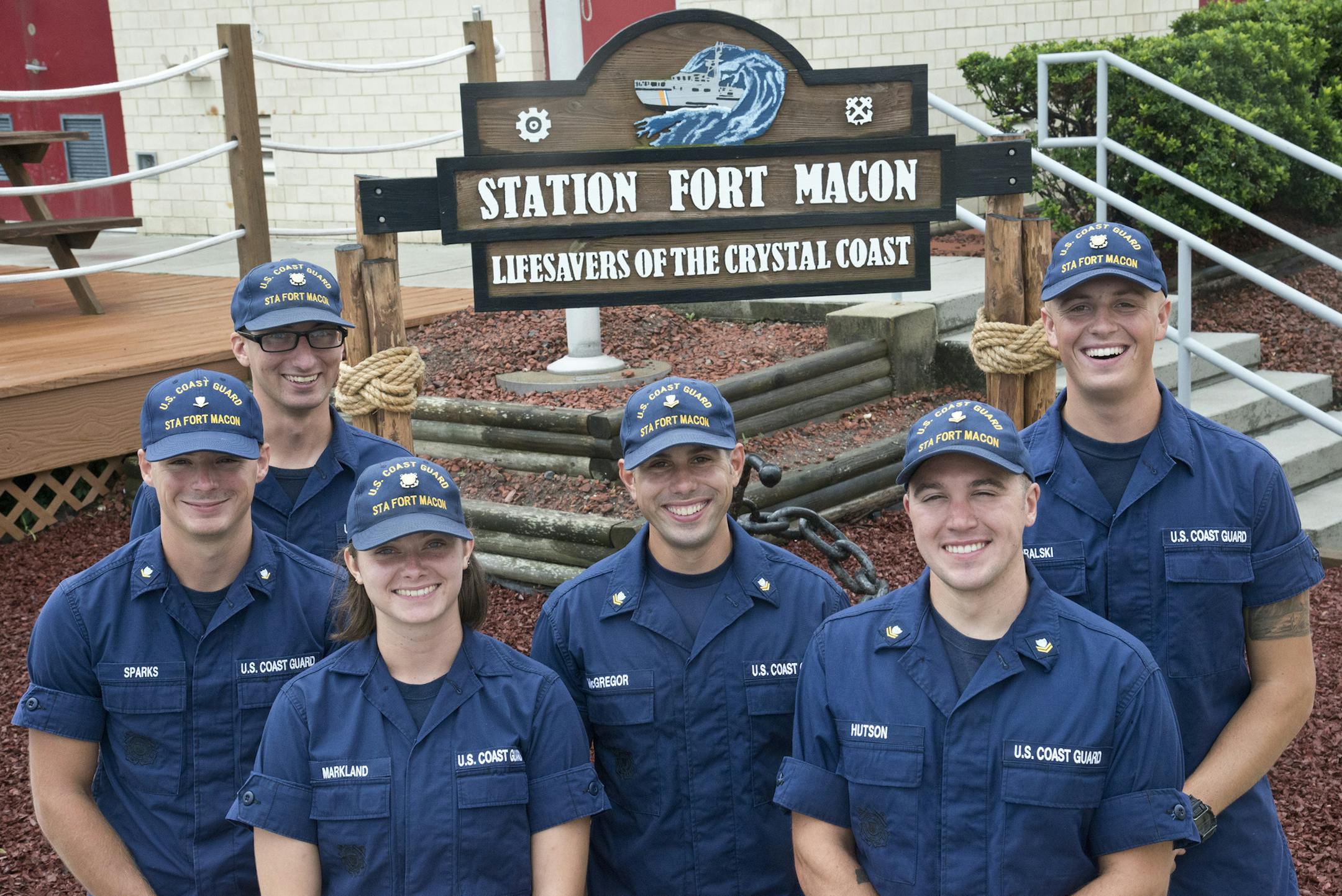
From left, Petty Officer 3rd Class Michael Sparks and Fireman Samuel Ragsdale pose with their rescuers, Fireman Jordan Markland, Petty Officer 2nd Class Tyler McGregor, Petty Officer 2nd Class Zane Hutson and Seaman Crewe Goralski, days after an incident in which two divers were stranded eight miles off Atlantic Beach. (Petty Officer 2nd Class Nate Littlejohn/U.S. Coast Guard)
Petty Officer 3rd Class Michael Sparks and Fireman Samuel Ragsdale, at left, with their rescuers, Fireman Jordan Markland, Petty Officer 2nd Class Tyler McGregor, Petty Officer 2nd Class Zane Hutson and Seaman Crewe Goralski, days after the two divers were stranded miles off Atlantic Beach. (The Minnesota Star Tribune)

CHARLOTTE, N.C. — Even 50 feet underwater, a pair of scuba divers exploring a wreck eight miles off Atlantic Beach heard the loud pop.

Only later did they find the frayed, broken end of their boat's anchor line. Divers Michael Sparks and Samuel Ragsdale shot to the ocean's surface to see the 17-foot Seadoo riding a wave three miles away.

With the drifting boat went the divers' cellphones and the boat's radio beacon and marine radio.

"At this point the gravity of our situation really hit me," Sparks said. "We decided to drop our dive weights because they prevented us from floating properly."

Sparks and Ragsdale are alive to recount the July 6 adventure for a couple of reasons. Both are in the Coast Guard, stationed at Fort Macon. And they had told Ragsdale's roommate, and other colleagues, the coordinates of their dive and their plan to return by dark.

As night fell and swells began to crash over their heads, the divers clung to a 3-foot "safety sausage," an orange, tubular device that could help them be spotted in the water, the Coast Guard reported in an account of the event.

Buoyancy compensators, diving equipment with inflatable air bladders, kept them afloat and wet suits helped maintain their body temperatures. They also had knives and a high-powered flashlight.

But even in 81-degree water, both began to get cold.

"The adrenaline wore off after awhile," Ragsdale, a Coast Guard fireman, said in the service's account. "We both clung to that safety sausage in order to stay together. We tried to figure out where we were and if there was a chance we'd be drifting past a buoy we might be able to cling to."

The divers feared that they would drift southeast, around Cape Lookout and into the Atlantic, where their chances of being found would drop.

On shore, the Coast Guard set out to save two of their own.

Sellers' roommate contacted the Fort Macon station when darkness fell and the pair hadn't returned. Officials launched a search plan to involve multiple boats, cutters, beach patrols and aircraft.

"Around midnight, we stopped talking and our hopes of getting rescued before dawn grew faint," said Sparks, a petty officer third class. "We were exhausted."

Sometime later he saw the running lights of a Coast Guard boat and pointed his flashlight toward it. Soon the boat's blue light began to flash — they'd been spotted from three miles away.

"I'd be lying if I said I wasn't worried," said Petty Officer 2nd Class Tyler McGregor, whose crew saw the flashlight beam. "The sea was rough, 8- to 10-foot swells. Searching for two people in the water during the day is the equivalent to searching for two coconuts bobbing in the waves — a near-impossible feat in the light that becomes unthinkable in the dark."

Their colleagues pulled Sparks and Ragsdale from the water after they had drifted more than four miles in seven hours. Sparks went below decks to find two body bags, prepared for bad news.

Sparks said he's glad the two filed their float plan and had the flashlight. But he'll use two anchors in the future and buy a radio beacon he can dive with.

"The ocean," he said, "doesn't care if you're in the Coast Guard."

about the writer

about the writer

Bruce Henderson, Charlotte Observer

More from No Section

See More
FILE -- A rent deposit slot at an apartment complex in Tucker, Ga., on July 21, 2020. As an eviction crisis has seemed increasingly likely this summer, everyone in the housing market has made the same plea to Washington: Send money — lots of it — that would keep renters in their homes and landlords afloat. (Melissa Golden/The New York Times) ORG XMIT: XNYT58
Melissa Golden/The New York Times

It’s too soon to tell how much the immigration crackdown is to blame.