The zen of ice climbing on the outskirts of Yellowstone

On a trip to Wyoming, a novice learns to climb a frozen waterfall, an activity that takes focus, fearlessness and a good ice ax.

The New York Times
February 5, 2026 at 12:00PM
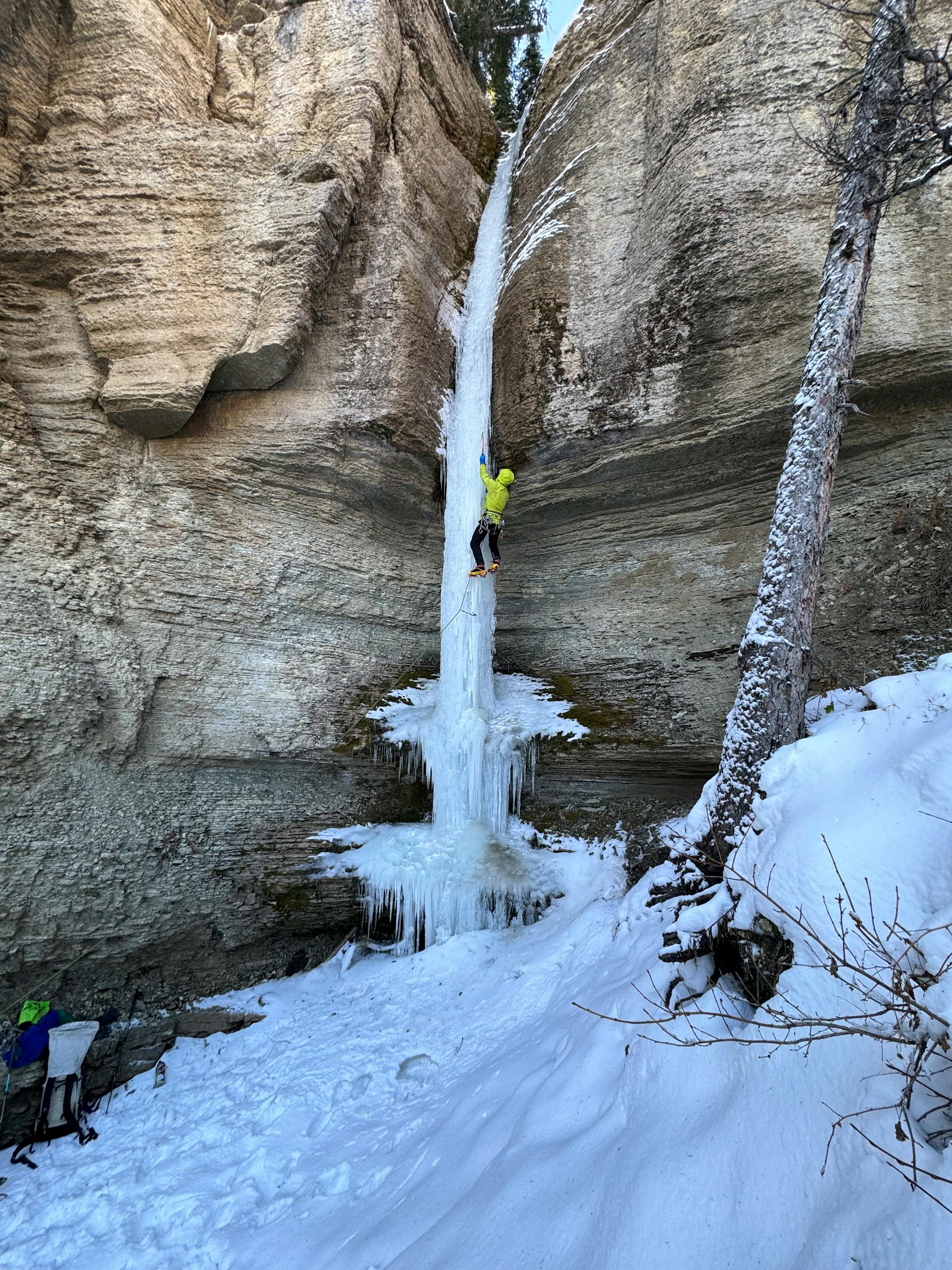
Zach Lentsch, the owner and lead guide of Wyoming Mountain Guides, climbs a frozen waterfall known as "the Slide" in Shoshone National Forest near Cody, Wyo. (ELAINE GLUSAC/The New York Times)

As I inched up a frozen waterfall on the outskirts of Yellowstone National Park, kicking my crampon spikes into milky columns of ice and swinging an ax above my head, I heard just one thing over my own breathing: The tapping of a woodpecker that matched my cadence.

Sweating in 40-degree weather, clinging to the vertical pitch and feeling time stand still, I took the sound as Morse-code encouragement.

In March, I traveled to Cody in northwestern Wyoming, and then drove 90 minutes with my instructor, Zach Lentsch, the owner and lead guide of Wyoming Mountain Guides, to this site in the Shoshone National Forest. Here, I would try my hand — and legs — at climbing a 70-foot-tall curtain of ice that curled over a stone ledge.

A winter enthusiast, I’ll try any sport that allows me to spend time in the snow without shivering. Compared with activities like cross-country skiing, snowshoeing and skating, ice climbing requires a greater investment, given the gear and the conditions required. On the promise of wild ice and wilderness, I enrolled in a one-day, private ice-climbing lesson with Wyoming Mountain Guides ($346.50).

“Anyone with an appreciation for winter will love it,” said Aaron Mulkey, a professional ice climber based in Cody with nearly 300 first ascents to his name. “Every ice fall forms differently each winter.”

In North America, ice-climbing routes may open in fall, when sparse snow makes it easier to reach ice. By March, deep snowpack and rising daytime temperatures add to the adventure.

Ice-climbing destinations can range from human-made parks, like the one in Ouray, Colo., to natural climbs, like a frozen waterfall near downtown Quebec City. I chose Cody, an adventure town and cultural hub some 50 miles from Yellowstone’s eastern entrance, after talking to Mulkey, who moved there in 1997 to explore the many climbs in the area, including those in the South Fork of the Shoshone River Valley.

“Ouray is like going to the ski resort,” he said. “The South Fork is like going backcountry skiing.”
The vertical world

Lentsch suggested the backcountry closer to Yellowstone when we met at 7 a.m. at Sitti’s Table in Cody to grab coffee for the commute in his Toyota Tacoma. En route, he said that about half of the beginners he teaches have some rock-climbing experience. For the other half, “ice climbing is their first foray into the vertical world.”

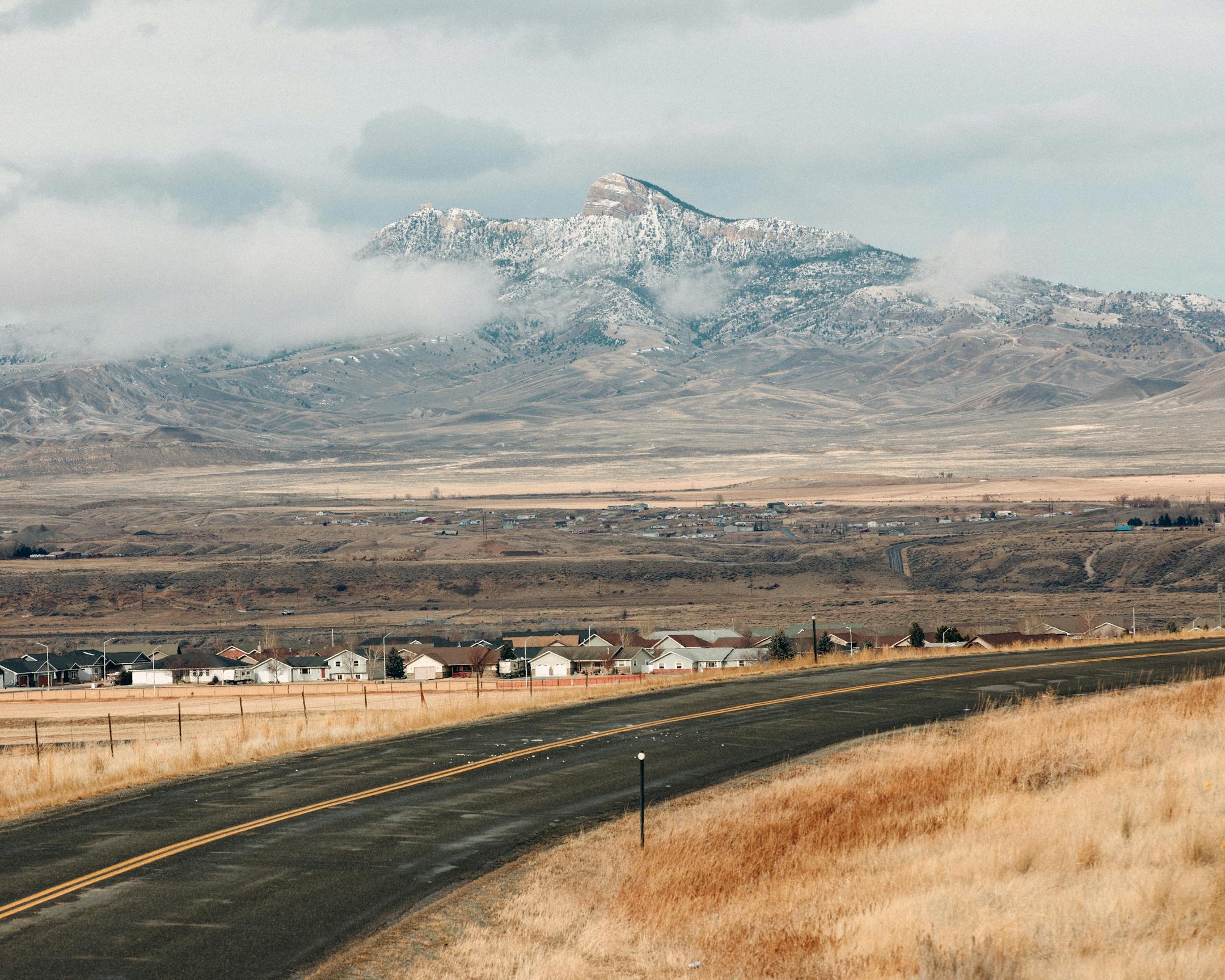
The outskirts of Cody, Wyo., with Heart Mountain looming on the horizon. (Elliot Ross/The New York Times)

I have rock climbed — painfully — in the past, confounded by routes dictated by walls with hand holds the width of a pencil. With ice, climbers have more control, creating their own routes with tools, while using their legs for stability and holding onto bigger things such as ax handles.

Tendon strength, which is necessary in rock climbing, “is harder to acquire,” Lentsch said. “You use big muscles in ice climbing.”

Our drive took us over plateaus in view of snowcapped mountains and down into river canyons and pine forests. Herds of deer grazed close to the road where the snow had receded to reveal muddy grass.

“There’s more wildlife than people here and the geology is very rugged,” he said. “It’s a great place to come and get away from the crowds.”

Learning the ropes

We picked up a snowmobile for the last third of a mile as we headed into the wilderness on a seasonal road that is closed to wheeled traffic in winter.

After a short commute, we left the sled beside the trail, grabbed our backpacks and hiked up a snowy hill into the forest. I followed Lentsch’s steps precisely for fear of falling into a tree well or another hole hidden under the knee-deep snow.

After 15 minutes, we turned a corner to find a blemish-free drape of north-facing ice, pale blue in the shade, and dropped down to its base to begin gearing up for the ascent.

Required gear included crampons, helmet, harness, ice axes and La Sportiva climbing boots with rigid ankle support and stiff soles to withstand kicking into ice.

To learn to use the equipment, we ducked behind the ice into a cave between the falls and the rock wall that would become our practice chamber. Jamming his toes into the ice, Lentsch demonstrated proper body placement, which is roughly a triangle with feet evenly distributed at the base and one hand on an ax driven into the ice overhead. Climbers first move one foot up by kicking their crampons into the ice, and then bringing their other foot roughly to parallel before swinging the ax in their free hand overhead.

Climbers throw their axes with force at concave depressions in the ice, which tend to be strong. As we discussed ice composition, Lentsch suggested looking for air pockets in the concavities, which would be easier to penetrate. He compared the kind of animal knowledge that hunters develop to the understanding of ice that climbers acquire.

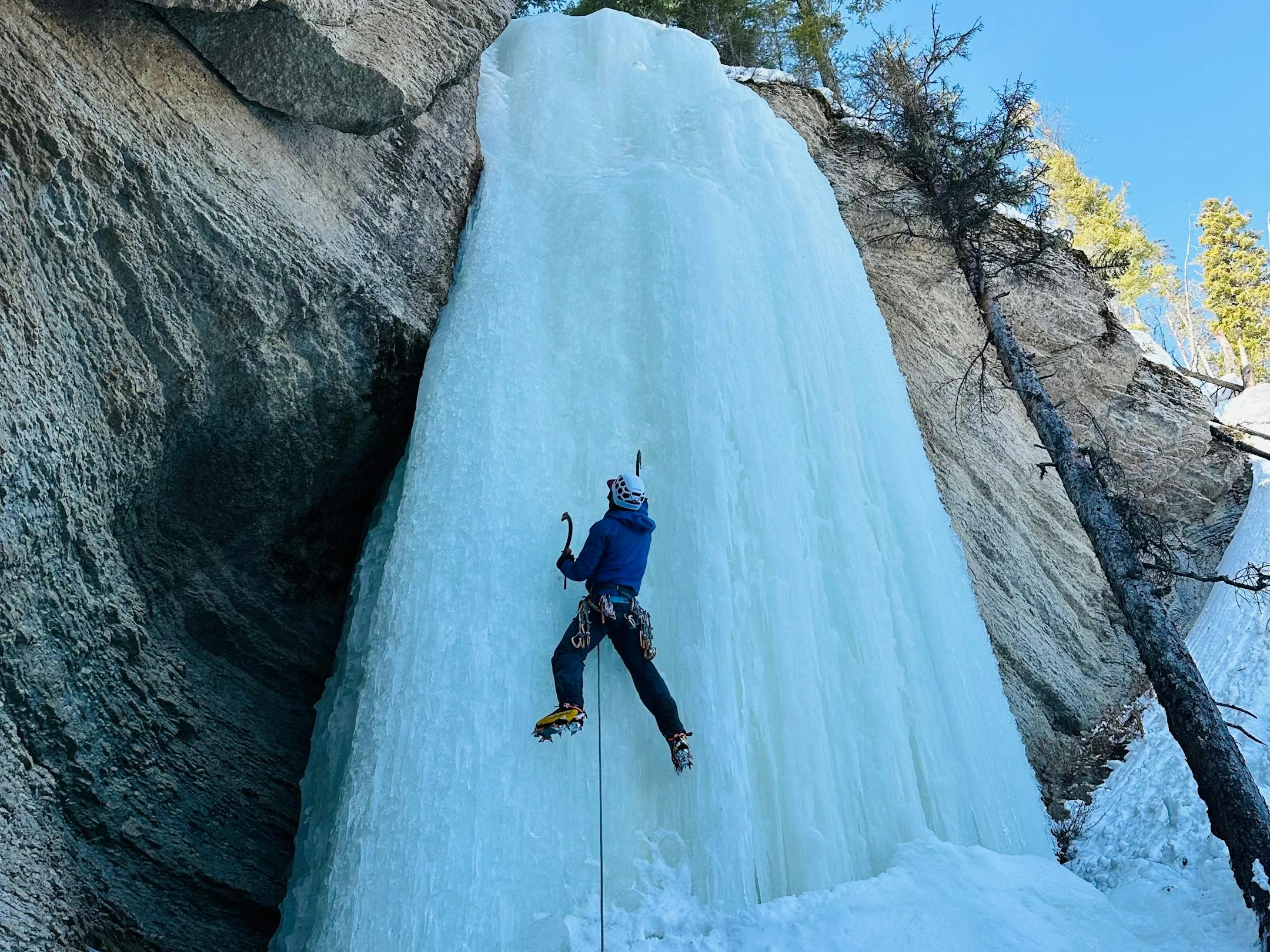
A climber tackles a frozen waterfall at the beginning of the climbing season, when the ice is less thick. (Zach Lentsch /The New York Times)

Zen on ice

Introductory ice climbing does not delve deeply into the ice screws, ropes and carabiners required to set a route, which Lentsch handled, securing a rope to a tree at the top of the climb. We used a top-rope belay system in which, as a climber ascends, the partner on the ground gathers the slack in the rope, which is threaded through a simple piece of hardware called a belay device to create friction. Putting downward pressure on the rope stops a climber’s fall.

Demonstrating the ascent, Lentsch moved smoothly up the ice face, leaving ax holes I could jab into if my own attempts to find solid targets failed.

When it was my turn, my focus on the vast outdoor landscape shrank to the workspace just a foot before me. I felt comfortable kicking the ice, but was surprised how often I couldn’t find purchase and had to kick harder. Swinging the axes above my head grew tougher with every tap and heave as ice shards rained down onto my face.

I can’t tell you how long it took, but by the time I took a break to look down, I realized I was closer to the end than the beginning. I would have to finish.

With the last percussive push up and onto the top of the frozen river in tempo with the unseen woodpecker, I felt exhilarated with achievement. As I rappelled down, Lentsch congratulated me on climbing what turned out to be intermediate ice.

But I can’t take full credit. According to Lentsch, “It just speaks to the accessibility of ice climbing.”

about the writer

about the writer

Elaine Glusac

The New York Times

More from Travel

See More
card image
ELAINE GLUSAC/The New York Times

On a trip to Wyoming, a novice learns to climb a frozen waterfall, an activity that takes focus, fearlessness and a good ice ax.

card image
card image