

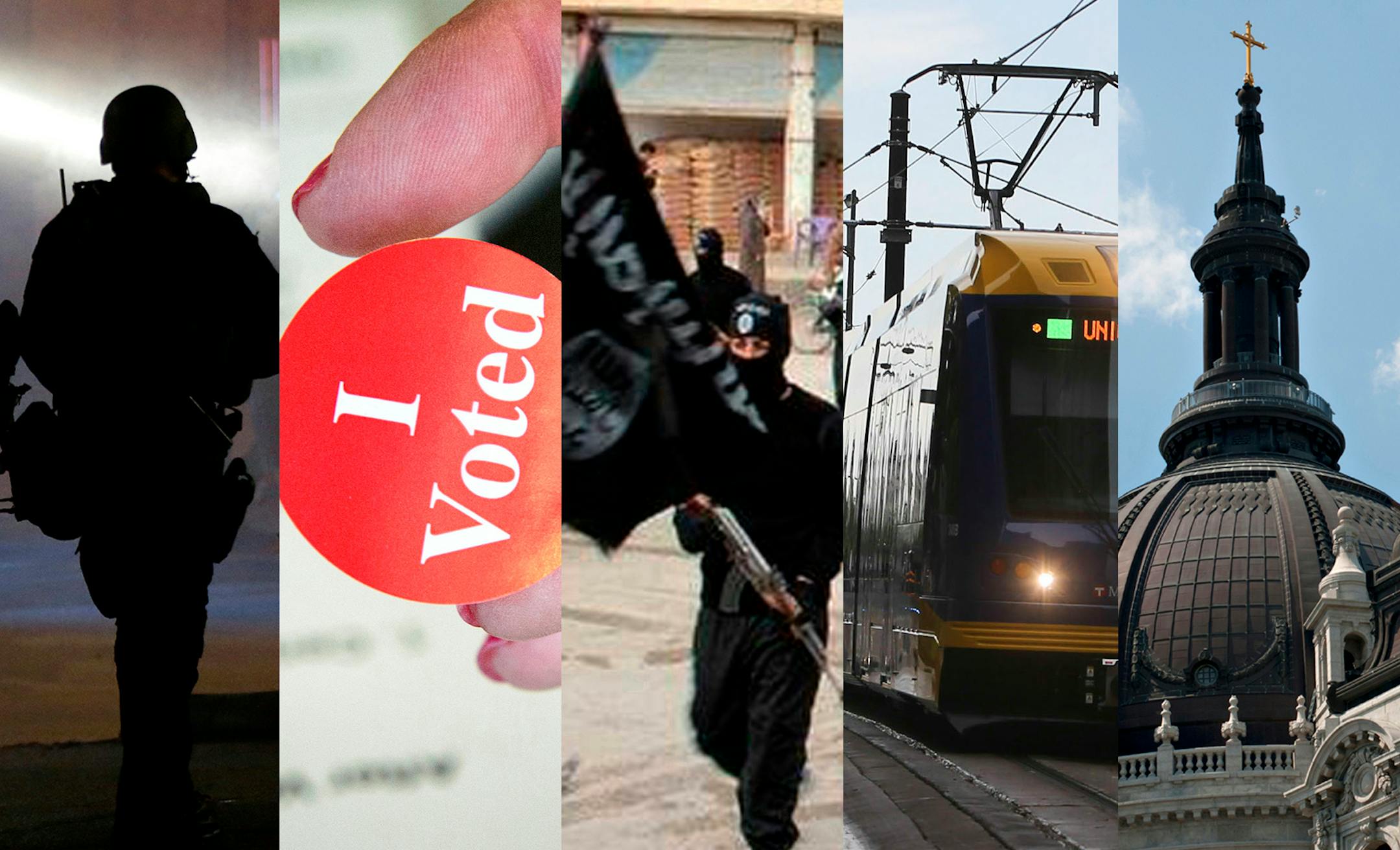
With the help of news researchers Sandy Date and John Wareham, we've compiled excerpts of letters to the editor on topics that drew the most response. Enjoy, and keep sharing — in 250 words or fewer. Use the "Submit a letter or commentary" link at startribune.com/opinion or e-mail opinion@startribune.com.
RACE AND POLICE
We must change the system
As a white man, I am horrified that less than two weeks after the grand jury failed to recommend an indictment against the officer who shot and killed Michael Brown, another grand jury did not indict a white cop in the death of another African-American, Eric Garner. Michael Brown, unarmed, shot dead; Eric Garner, unarmed, choked to death. These are the latest examples of a justice system that is stacked against people of color, especially black males, who have been scapegoated and vilified. We have a justice system that routinely preys on young black males, and constantly tells them that they are both dangerous and expendable. The white power structure of which the police are perhaps the most visible component will continue to perpetuate these myths until they are met with contrasting voices of reason, fairness and justice. We need to begin now, before further lives are lost and before more families grieve for their lost sons or brothers.
CHRIS ROSS-BROWN, Fridley
Look to law, not the media
Following the grand jury decisions not to indict police officers in New York City and Ferguson, Mo., there has been talk in the media of a miscarriage of justice. It should be pointed out that, per the Fifth Amendment, "No person shall be held to answer for a capital, or otherwise infamous crime, unless on a presentment or indictment of a grand jury." The members of these grand juries were ordinary citizens chosen from the general populace of their respective cities. They heard evidence against these police officers presented by prosecutors. And based on that information, they were unable to issue an indictment. We are a nation of laws and indictments, and justice is carried out based on those laws, and not by media reports.
LARRY BEDARD, Minneapolis
Many reasons to protest
As a grandparent of two black children, I am extremely concerned. Over the years, repeated episodes of police overreaction and brutality visited upon black people have been well-documented. Overprotective laws, stonewalling police unions, weak and unrepresentative city governments, and repeated failures of the criminal justice system should move all of us to demand corrective action.
BRUCE D. SNYDER, Mendota Heights
Police have no easy task
Speaking as a lifelong antiracism activist, and as a friend of police, here is what I saw: No police officer is paid enough to perform to required standards. They are expected to always get it right. I listened to the police officer explain his actions. I felt very sorry for him. I think that it's true that we need high-quality body cameras for such an important public service. All citizens must respect and obey demands of police officers, and officers need daily reminders that all the people are their boss in the end.
ROBERT PERSCHMANN, Chaska
So many invisible victims
The events in Ferguson, Mo., demonstrate once again the strange phenomenon that seems to permeate our social conscience: We seem to care about the lives of innocent people only when their deaths come at the hands of some group that we don't like. This phenomenon was apparent in the coverage of the deaths of Palestinian civilians caught in the middle of the war between Israel and Hamas in Gaza, which merited 24-hour-a-day coverage, demonstrations and protests, while the slaughter of hundreds of thousands in other countries in the Middle East received little or no attention. Similarly, the tragic killing of Michael Brown in Ferguson is given wall-to-wall media coverage, demonstrations and protests and a presidential news conference, while the killings of dozens of inner-city kids last weekend in Chicago, Detroit, L.A. and Philadelphia goes unnoticed.
RONALD HASKVITZ, St. Louis Park
Understand history of racism
We have, in America, a long history of both blatant and institutionalized racism so prolific that it has become indistinguishable from political rhetoric, and we refuse to examine it honestly and openly. The riots and the unrest are a direct result of this. I don't think people should be rioting, and I won't absolve rioters of their actions or the subsequent consequences. But to view it solely in the vacuum of this verdict, especially to condemn it without qualification, is to not understand the true issue of race here, and to be complicit, in some regards, in the very cause that allows it to proliferate.
JONATHAN PALMER, Minneapolis
Protect the protectors
Unfortunately, police have become the scapegoat of a racial-discrimination problem that stems much further than law enforcement. Discrimination is a societal problem that has been placed on police following horrible events in Missouri and New York. In light of those events, it is no longer politically correct, nor are people willing, to fight for the rights of those who work so hard to protect ours. This all comes at a cost. Simply put, we cannot expect our law enforcement officers to protect us if we cannot protect them.


