

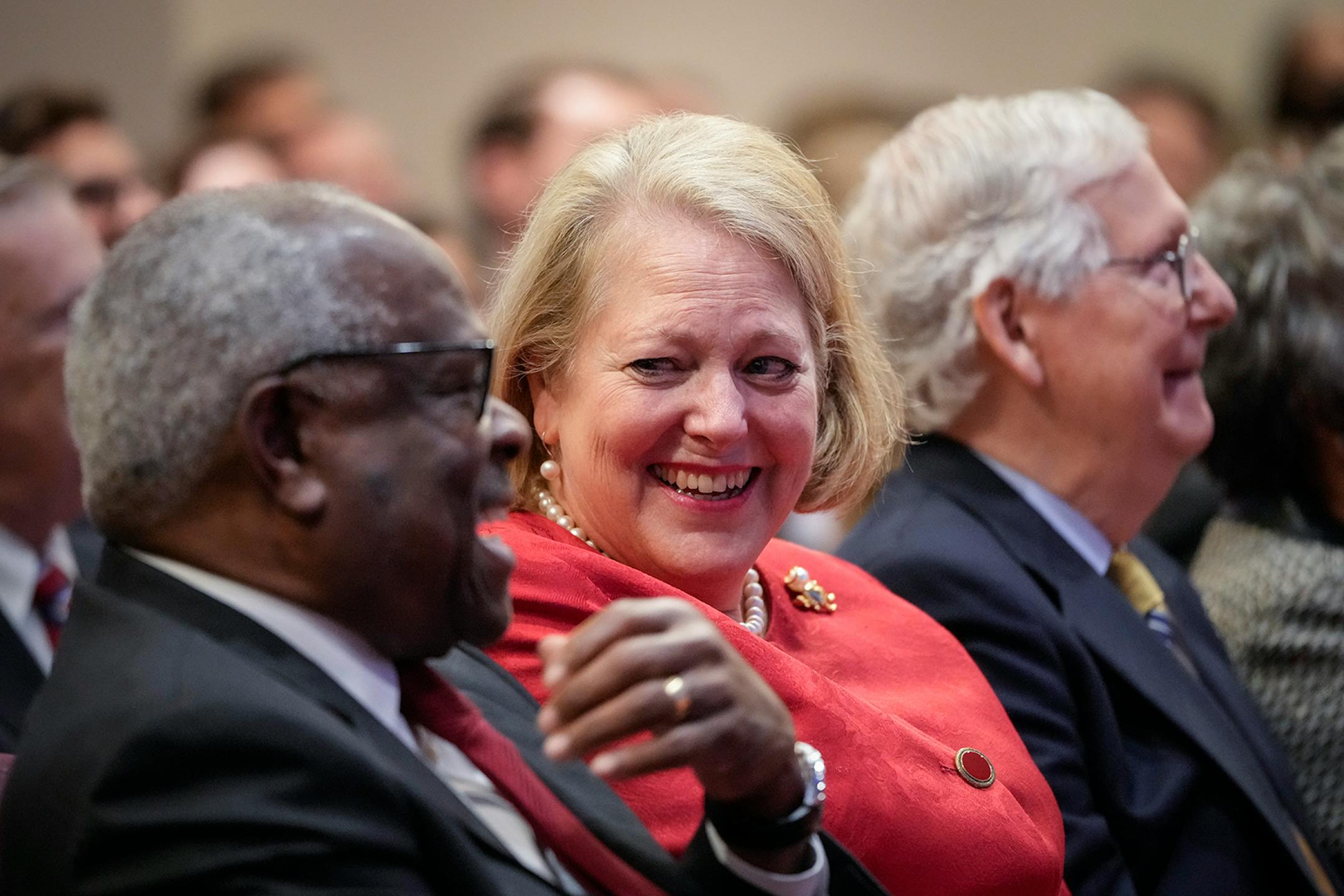
What did Justice Clarence Thomas know, and when did he know it?
The question usually gets directed at politicians, not judges, but it's a fair one in light of the revelation Thursday that Thomas' wife, Ginni, was working feverishly behind the scenes — and to a far greater degree than she previously admitted — in a high-level effort to overturn the 2020 presidential election.
As the Washington Post and CBS News first reported, Ginni Thomas, a supremely well-connected right-wing agitator, was in constant communication with the White House in the weeks following the election, strategizing over how to keep Donald Trump in office despite his incontrovertible loss. "Do not concede," she texted to Mark Meadows, Trump's chief of staff, on Nov. 6, the day before the major news networks called the election for Joe Biden. "It takes time for the army who is gathering for his back." (To date, Trump has not conceded.)
Thomas had already acknowledged some involvement in the fight over the 2020 election count, recently confirming that she attended the Jan. 6 Stop the Steal rally in Washington, but she said she went home before Trump spoke to the crowd and before a mob of hundreds stormed the Capitol in a violent attempt to block the certification of Biden's Electoral College victory. The texts reveal that her efforts to subvert the election were far more serious than we knew.
Now recall that in January, the Supreme Court rejected Trump's request to block the release of White House records relating to the Jan. 6 Capitol attack. Meadows had submitted a brief in the case supporting Trump. The court's ruling came as an unsigned order, with only one noted dissent: from Justice Thomas.
Perhaps Justice Thomas was not aware of his wife's text-message campaign to Meadows at the time. But it sure makes you wonder, doesn't it?
And that's precisely the problem: We shouldn't have to wonder. The Supreme Court is the most powerful judicial body in the country, and yet, as Alexander Hamilton reminded us, it has neither the sword nor the purse as a means to enforce its rulings. It depends instead on the American people's acceptance of its legitimacy, which is why the justices must make every possible effort to appear fair, unbiased and beyond reproach.
The most obvious way for justices to demonstrate their independence in practice, of course, is to recuse themselves from any case in which their impartiality might reasonably be questioned. It does not matter whether there is, in fact, a conflict of interest; the mere appearance of bias or conflict should be enough to compel Thomas or any other member of the court to step aside.


