
The Spotify imbroglio, playing on repeat

Slight progress on misinformation, but are any of the players fully embracing their responsibilities?

February 9, 2022 at 11:45PM
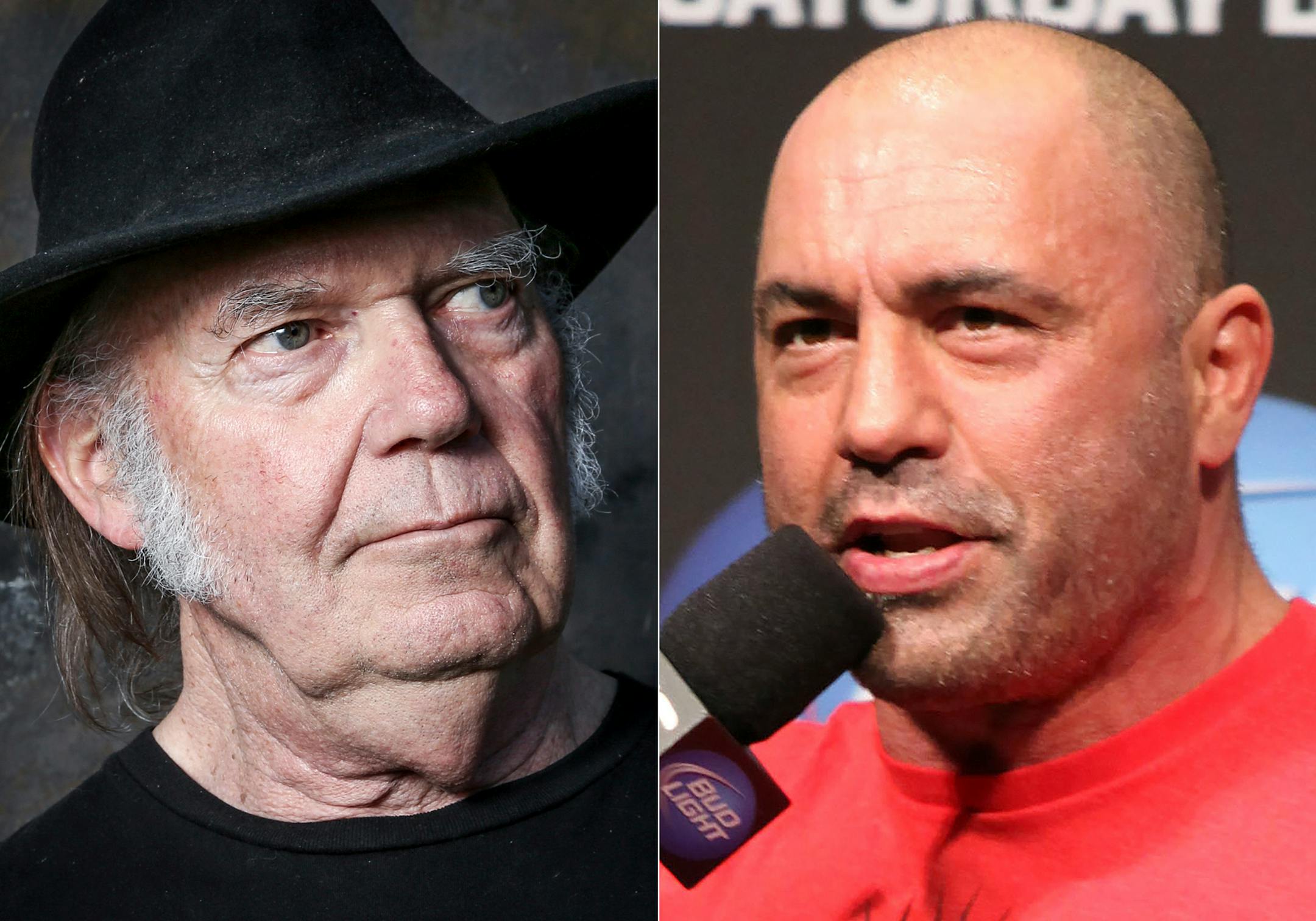
This combination photo shows musician Neil Young and podcaster Joe Rogan, who are at the center of a controversy involving the streaming platform Spotify. (Associated Press/The Minnesota Star Tribune)

The deplatformapalooza centering on podcaster Joe Rogan, musician Neil Young and the streaming company Spotify has moved the needle in the right direction on the subject of misinformation. Not by much, but anything helps.

Yet given the nature of those involved — performers all — it's unsurprising how much of it has been, well, performative. Or worse, self-dealing. It's possible for consumers of music and information to be both gratified and annoyed at how events have played out.

Rogan is to podcasting as Howard Stern is to satellite radio, as Rush Limbaugh was to AM radio and as Tucker Carlson is to cable TV. A cult of personality drives the traffic. Stylistically, Rogan is more in the Stern camp — interested, by his own admission, in freewheeling conversation with a variety of guests.

It's not necessarily a bad impulse. But Rogan, also by his own admission, is not much for preparation. That leaves him unequipped to smartly frame the conversation if guests make controversial assertions, as two did recently on the subject of COVID-19.

That's how he ended up under Neil Young's glare. Calling out the "fake information" on Rogan's podcast, Young told Spotify: It's him or me. Spotify choose "him," and Young pulled as much of his music as his licensing rights allowed.

Young is like an erratic clock that was, in this case, contemporaneously correct. It's difficult to ascertain his full motivations. He has a history of spreading his own dubious claims — for instance, in opposition to genetically modified foods. And he's long had a beef with the way his music sounds on 21st-century formats, especially Spotify's.

As he was leaving Spotify, he assured fans that they could instead find his music on Amazon. That would be the Amazon.com that — as the recent Star Tribune online commentary "Joe Rogan is a drop in the ocean of medical misinformation" details — is far from a treasure trove of credibility. Not a concern to Young. Amazon, however, streams music at high bitrates. Very much a concern to Young.

Rogan, chastened, took to Instagram to explain his style and promise better research. He mentioned how much he liked Young and other performers who followed him off Spotify, such as Joni Mitchell. He then praised Mitchell for her song "Chuck E.'s in Love," which was in fact written and sung by Rickie Lee Jones. Buyer beware with Rogan's research.

He could have just checked on Spotify. It's a broad platform. You can hear anything from Renaissance-era lute music to this year's pop stars to a multitude of other podcasts without ever encountering the likes of Joe Rogan if you don't want to.

While Rogan has learned that you can't get big and important without assuming some responsibility for what you put out into the world, Spotify — a company with more than 80 million users in the U.S., about the same number who voted for Joe Biden in 2020 — has learned that you can't aggregate the world's output without assuming some responsibility for its quality. CEO Daniel Ek has met that partway, promising that the company will create a COVID-19 information hub and label controversial content but maintaining that "canceling voices is a slippery slope."

Rogan would be a particularly tough voice for Spotify to cancel, since it paid $100 million to be the only platform with his podcasts. As most streaming companies have learned, the business model doesn't work very well without star personalities or franchises.

But Ek might not be able to hold out forever. A deeper dig into Rogan's mountain of words has found that it also includes racial slurs. Cue another apology, along with competing centimillion-dollar offers for Rogan's brand of attention-getting.

Ek has a point about cancel culture, however. Today's consumers of information have an abundance of options and bear their own burden of responsibility — for what they choose to take in and how seriously they choose to take it.

An inherent thing about knowledge is that it evolves. The heterodox might be hogwash — or ahead of its time. It takes ongoing work from everybody to sort it out. This is the fundamental basis of the free exchange of ideas. Society cannot afford to lose faith in that.

William Carlos Williams wrote of poems that "men die miserably every day for lack of what is found there." It could be said of unrestrained discourse that people can die — and not just metaphorically — because of what is found there. They would for the lack of it also.

about the writer

about the writer

Editorial Board

See Moreicon