

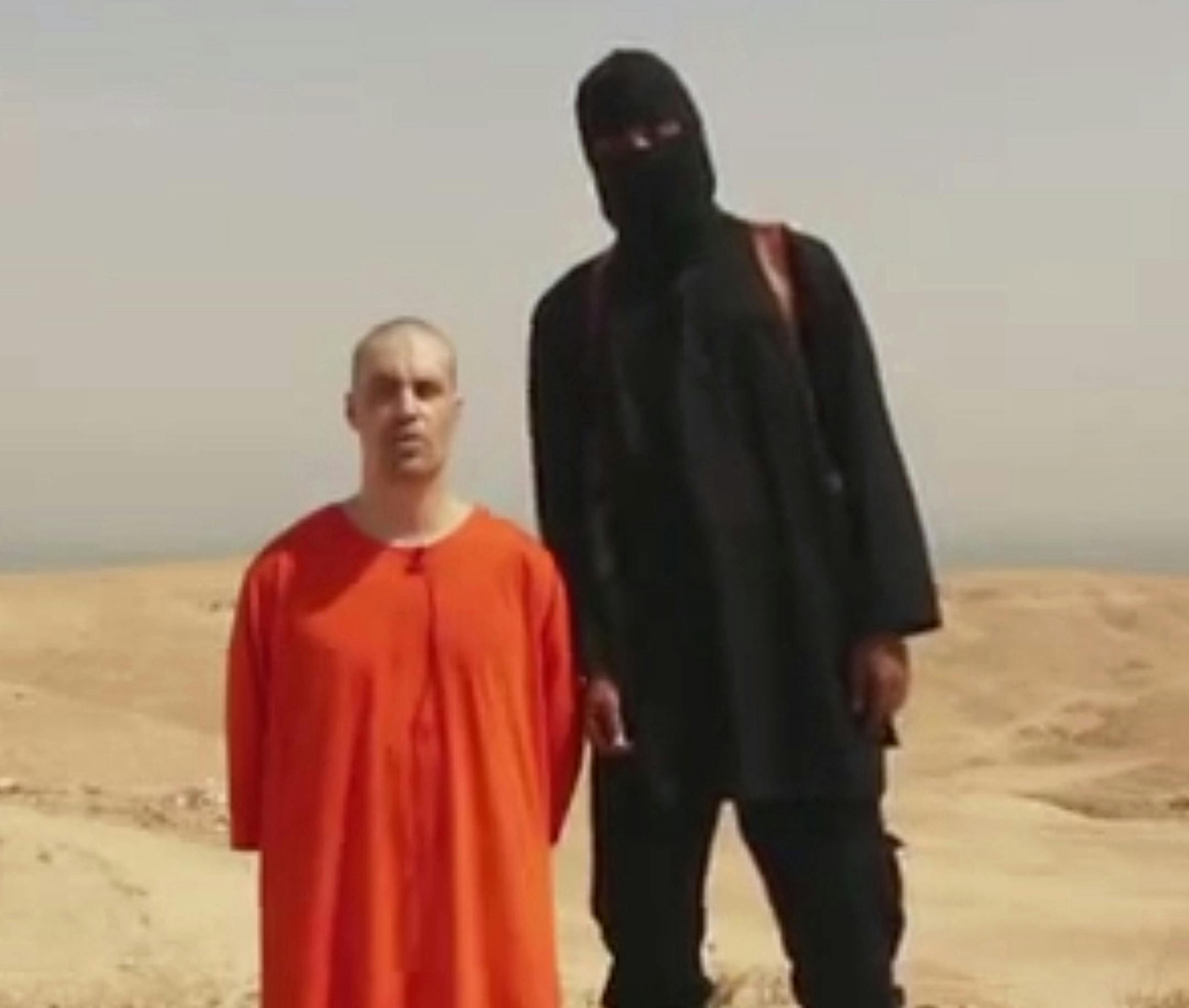
He is "Jailer John" to his prisoners but "Jihadi John" to London's tabloid newspapers, and right now, he might just be the most wanted man in the world. "He" is the jihadist seen beheading the captured American journalist James Foley in Syria. He is British. He is our problem. Worse still, he is not alone.
If Foley's executioner were a rogue radical or "lone wolf," it would be easier to dismiss him as a lunatic extremist of the sort with which all countries are afflicted. But he is not a one-off. The jihadist who executed Foley is one of, it is estimated, at least 500 British citizens likely to be fighting with the Islamic State in Iraq and the Levant. He is believed to be the head jailer, responsible for guarding a number of foreign hostages in ISIL's de facto capital of Raqqa in northern Syria. He and his British colleagues, it is reported, are nicknamed the "Beatles" by their murderous colleagues, a nod to their country of origin.
But it's also a nod to something else. It speaks to the fact that, far from being products of an austere and rigorous religious fundamentalism, today's jihadists are just as likely to come from Western backgrounds that would ordinarily be considered utterly unremarkable.
Across Europe, from France to Belgium to Sweden, there are reckoned to be several hundred Islamic extremists fighting with ISIL in the Middle East. And the United States isn't immune to the phenomenon, either. But Foley's murder has returned the spotlight to Britain's particular — and acute — problem with homegrown Islamic radicalism.
As Prime Minister David Cameron, writing in the Daily Telegraph this week, put it: "We are in the middle of a generational struggle against a poisonous and extremist ideology, which I believe we will be fighting for the rest of my political lifetime. We face in ISIL a new threat that is single-minded, determined and unflinching in pursuit of its objectives." The threat, he insisted — just days before "Jihadi John" littered YouTube with his bloody act — is domestic as well as foreign. "[I]f we do not act to stem the onslaught of this exceptionally dangerous terrorist movement, it will only grow stronger until it can target us on the streets of Britain. We already know that it has the murderous intent. Indeed, the first ISIL-inspired terrorist acts on the continent of Europe have already taken place."
Foley's executioner is not even the first British jihadist to orchestrate the beheading of an American journalist. The kidnapping and subsequent execution of the Wall Street Journal's Daniel Pearl was organized by Omar Sheikh, a 28-year-old radical from north London. In other words, this is a long-standing problem and one that resists easy solution.
Last summer, for instance, two Muslim converts — Michael Adebolajo and Michael Adebowale — stabbed, killed, then attempted to decapitate Lee Rigby, a member of the Royal Regiment of Fusiliers, on a south London street in broad daylight. In a video taken at the scene of the crime, Adebolajo explained that "the only reason we have killed this man today is because Muslims are dying daily by [sic] British soldiers. And this British soldier is one. … By Allah, we swear by the almighty Allah we will never stop fighting you until you leave us alone. … You people will never be safe."
Not all of Britain's jihadists are motivated by religious passions.


