

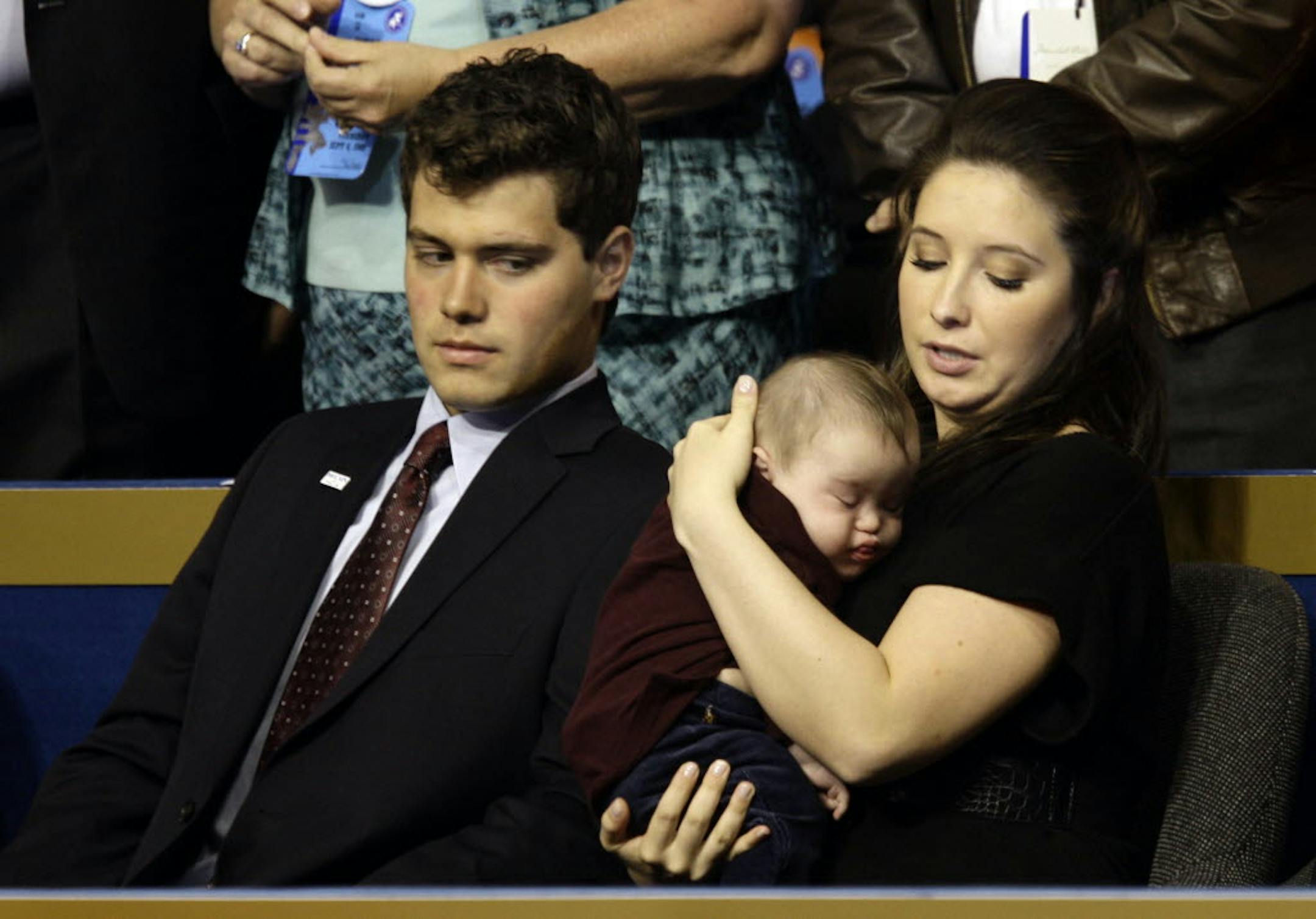
Dominique Hines has been following media coverage of 17-year-old Bristol Palin's pregnancy with great interest. Dominique, 16, is the single mother of a 3-month-old son, Da'Marion. She's also a high school student with big dreams.
But similarities between the two teenagers pretty much end there. Many professionals who work with pregnant girls and teen mothers are happy to see this issue placed center stage. But they worry that the Palin story glosses over an essential truth: Most teenagers, like Dominique, don't have nearly the resources and support that vice presidential candidate Sarah Palin's daughter has.
"It isn't a question of love, ability or hard work," said Mary Pat Sigurdson, program coordinator for Broadway High School, a Minneapolis alternative school for pregnant teens and mothers ages 12 to 21. The school offers on-site child care and Hennepin County social worker services.
"These girls have the same aspirations. It's a question of resources. This is an important discussion to have, but not if you leave that part out. What do other young moms need to have the same advantages as Sarah Palin's daughter?"
Although pregnancy and birth rates among girls ages 15 to 19 have declined nationwide 34 percent since 1991, according to the Centers for Disease Control and Prevention (CDC), birth rates increased for the first time in 2006. Abortion rates have held steady, although a slight increase was noted among 18- to 19-year-olds from 2006 to 2007. It is unclear whether these are trends or one-time fluctuations, researchers said.
And it is the rare pregnant teen who marries. In 2006, according to Census figures, just 2.1 percent of males ages 18 to 19 were married; for girls of the same ages, it was 4.8 percent. This could be good news. Nearly half of marriages in which the bride is 18 or younger end in separation or divorce within 10 years, according to the National Center for Health Statistics.
A sea change: few adoptions
But Bristol Palin's decision to keep her baby is right in line with cultural norms. Today, fewer than 1 percent of babies born to never-married U.S. women, including teens, are placed for adoption, according to the CDC. That's a sea change from the 1950s to early 1970s, when most pregnant girls mysteriously disappeared to give birth at homes for unwed mothers, their babies adopted out in closed adoptions.


