

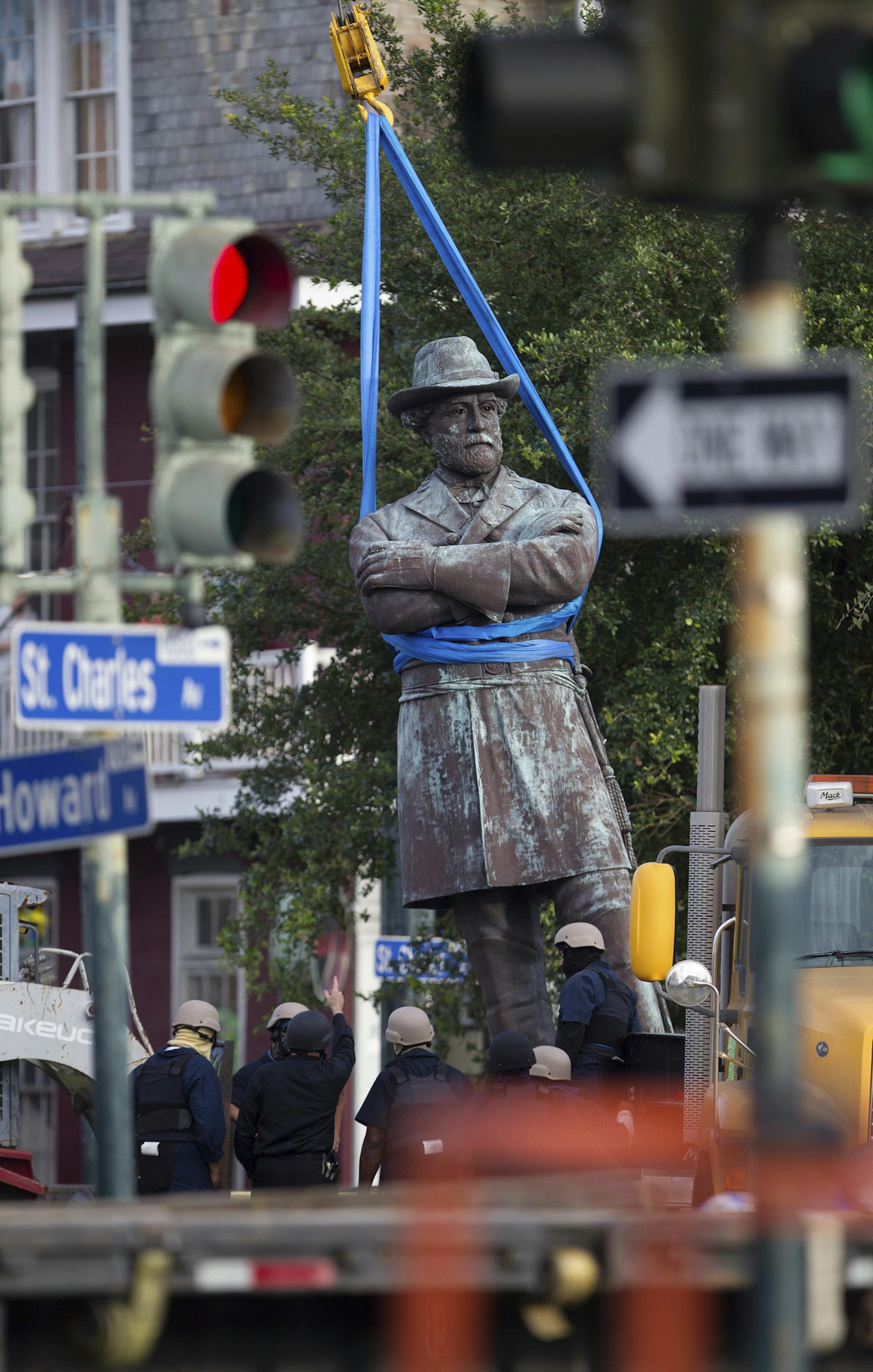
In 1869, the president of Washington College was invited to Gettysburg to help erect granite memorials to mark the "positions and movements of the armies" during the great Civil War battle of six years before.
Robert E. Lee declined.
"I think it wiser ... not to keep open the sores of war," he wrote, "but to ... obliterate the marks of civil strife and ... the feelings it engendered."
New Orleans has come around to the general's point of view. The City Council voted in December 2015 to take down three statues of Confederate heroes — Lee, President Jefferson Davis, and Gen. P.G.T. Beauregard — and an obelisk that honored an 1874 uprising by the Crescent City White League against the Reconstruction-era state government. Lee was the last to be removed, plucked by a crane on May 19 from his 68-foot pedestal.
"The Civil War is over; the Confederacy lost, and we are better for it," Mayor Mitch Landrieu was quoted as saying in the New Orleans Advocate. "To literally put the Confederacy on a pedestal in our most prominent places of honor is an inaccurate recitation of our full past, it is an affront to our present, and it is a bad prescription for our future."
The few who protested argued that the city was trying to erase history or their heritage. But New Orleans is right on the history the statues represent. Whatever the individual virtues of Lee or Confederate soldiers, whatever their sacrifices, they took up arms against their country — to perpetuate slavery. Whether that was why they enlisted, whether or not they owned slaves, that's what they were defending. On this point the Confederacy's founders were unequivocal.
Their vice president, Alexander Stephens, declared in his infamous "Cornerstone" speech of March 1861: "Our new government is founded ..., its cornerstone rests, upon the great truth that the negro is not equal to the white man; that slavery ... is his natural and normal condition. ..."
There is nothing to defend or celebrate there. How, then, were Lee, Davis, and countless other Confederates honored in hundreds of places across the country they tried to destroy? David W. Blight wrote of the postwar drive for unity among whites North and South, and how that took precedence over hopes for a new birth of freedom, in his 2001 book, "Race and Reunion: The Civil War in American Memory."


