

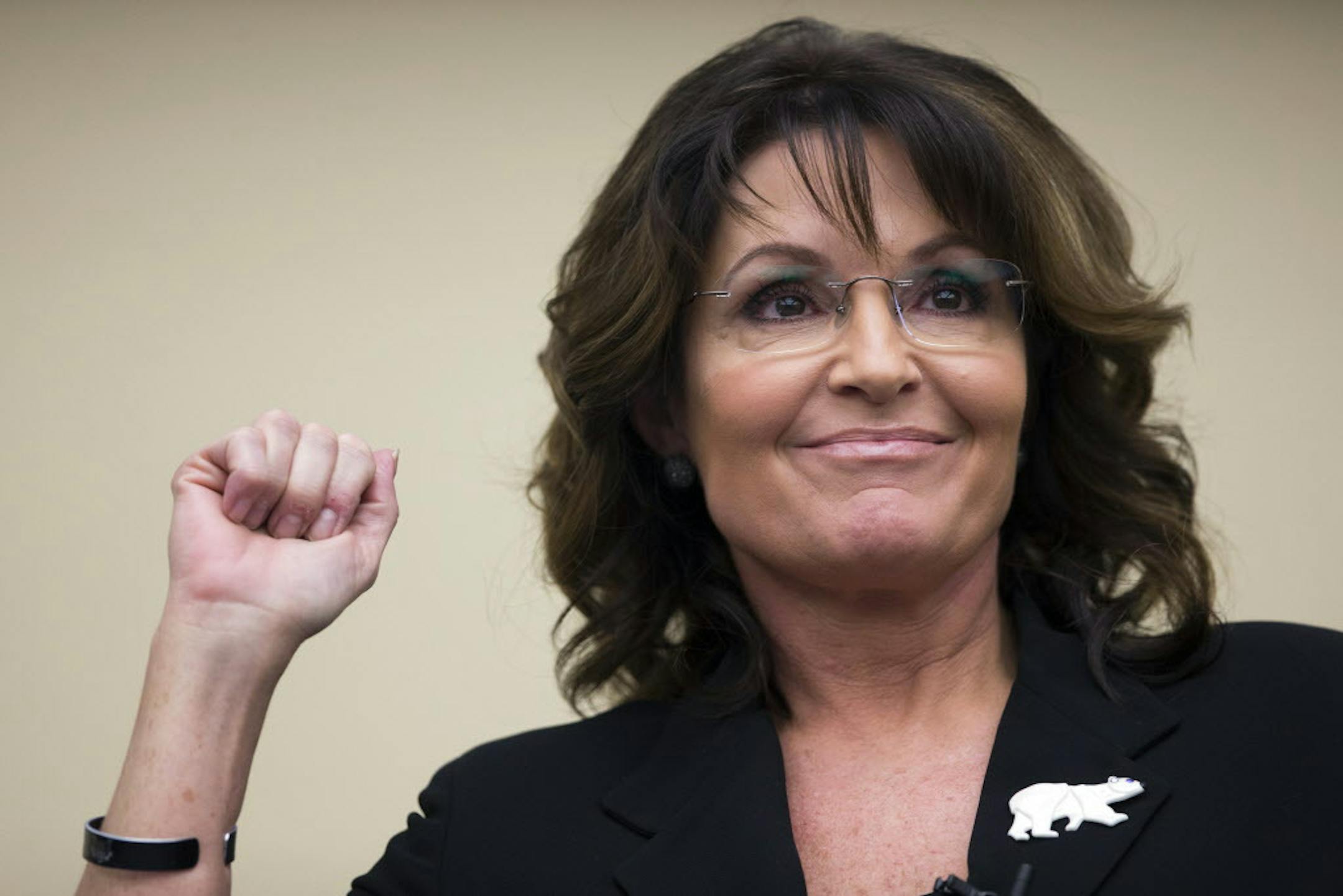
The New York Times pronounced itself "delighted" that federal judge Jed S. Rakoff threw out Sarah Palin's lawsuit against the newspaper for a June 14 editorial that came in the immediate aftermath of the shooting at a congressional baseball practice in Alexandria, Virginia. "Judge Rakoff's opinion is an important reminder of the country's deep commitment to a free press and the important role that journalism plays in our democracy. We regret the errors we made in the editorial," noted, in part, a statement from the New York Times.
In his ruling, Rakoff said that the Times may be guilty of negligence but not defamation of a public figure. The editorial in question posited a link between an ad promoted by Palin's political action committee and the tragic rampage of Jared Lee Loughner near Tucson, Arizona, in 2011. No link had ever been established, a point reported by the news media in the aftermath of the event.
In reaching his determination, Rakoff found that Palin's lawyers had failed to establish that the New York Times had acted with knowledge of the falsity of the link or at least with reckless disregard thereof - the test for establishing "actual malice" toward a public figure such as Palin. "The complaint fails on its face to adequately allege actual malice, because it fails to identify any individual who possessed the requisite knowledge and intent and, instead, attributes it to the Times in general. This will not suffice," wrote Rakoff.
That the New York Times wrote corrections intended to clean up its factual mess worked in its favor, as it should. "Such behavior is much more plausibly consistent with making an unintended mistake and then correcting it than with acting with actual malice," argued Rakoff.
It's a well-argued ruling, one that leaves this writer a bit embarrassed for having called the complaint "convincing" back in June. Never again should anyone sell short jurisprudence that protects journalists when writing about public figures. These protections are so powerful that an editor, without doing any research to speak of, can insert language in an editorial accusing a politician of inciting murder - and secure a quick and unequivocal bouncing of the case. As Rakoff wrote, "Nowhere is political journalism so free, so robust, or perhaps so rowdy as in the United States. In the exercise of that freedom, mistakes will be made, some of which will be hurtful to others."
Dismissal, however, is less than a full-throated victory for the New York Times. For starters, the false charge cost the newspaper some unknown level of trust with its readers, especially conservative ones. It had to engage high-priced attorneys to handle the case. And it endured an embarrassing hearing in which editorial page editor James Bennet gave testimony on the editorial's provenance; he inserted the objectionable passages after receiving a draft from D.C.-based editorial writer Elizabeth Williamson. His defense can best be summarized as: I didn't read any articles disavowing the Palin-Loughner link and I didn't mean to suggest one in the editorial. "I wasn't - what I wasn't trying to say was that there was a causal link between - a direct causal link between this map and the shooting," Bennet told Rakoff in the hearing.
The lingering lesson of the case is that the New York Times could well have saved itself the hassle of even a short-lived court proceeding, though doing so would have required it to shed its institutional arrogance for a day or two. Consider that the paper's response to learning of the falsehood was sufficient to satisfy a judge ruling on a lawsuit, but not sufficient to satisfy any standard of decency and respect. The immediate correction, after all, didn't even mention Palin's name: "An earlier version of this editorial incorrectly stated that a link existed between political incitement and and the 2011 shooting of Representative Gabby Giffords. In fact, no such link was established." Nor did a second correction:
"Correction: June 16, 2017


