

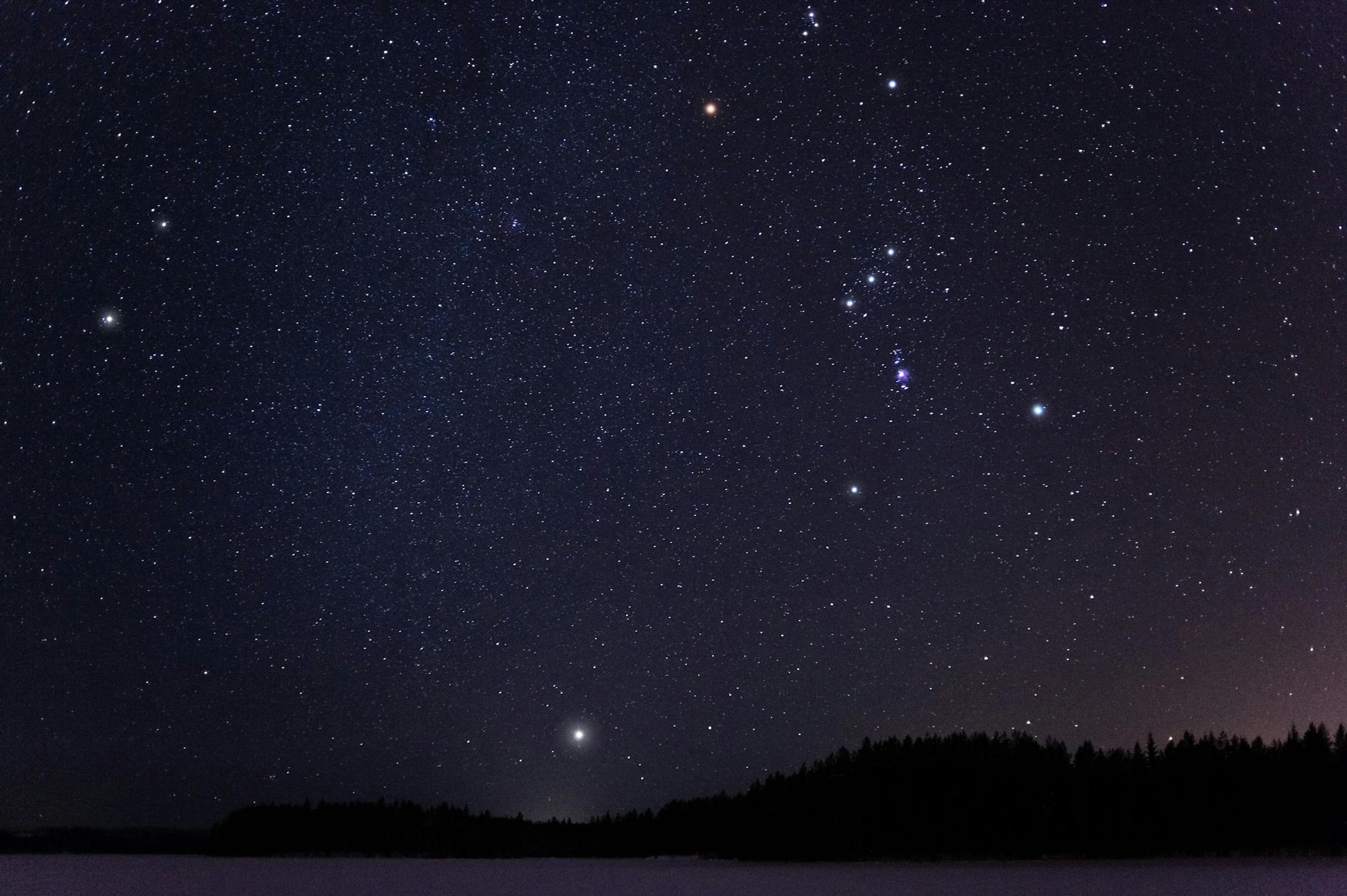
A few years ago, in the fall, I went camping in the Boundary Waters Canoe Area Wilderness on a string of clear nights. When the sun set, there was no moon and the stars came alive in the sky, billions of them stretching from one horizon to the other. In the dark, I lay on a warm rock near the water for a long time, watching meteors flare and satellites circle the earth before turning in.
Later, I got up in the night, stepped out of my tent and looked north. The big dipper still hung there, only it had spun, like someone reached down and turned it with a giant hand. For a few seconds I stood there, struck by the palpable sense of being on a planet spinning through space.
A few days later, I was back in Minneapolis, where I would look at the night sky and think of all the stars I couldn't see. Instead, there I saw a bluish haze with a few bright points. This is what's known as the "skyglow" and it's something that increases every year, blocking more of the cosmos from our view.
According to a 2017 study published in the journal Science Advances, nighttime artificial light increased at a rate of 2.2 percent each year from 2012 to 2016 — a 9.1 percent overall increase worldwide.
"It's a growing problem," said writer Paul Bogard, author of "The End of Night: Searching for Natural Darkness in an Age of Artificial Light." "Pretty much everywhere is getting brighter, and almost nowhere is getting darker. That's true in Minnesota, in the United States, and all over the world."
And it has been truer since the advent of LED streetlights, which tend to be on the higher end of Kelvin — initially around 6000K — with a lot of blue light in their spectrum. Kelvin is the scale used to describe the "color temperature" of a light source. The highest Kelvin temperature lights (5000K and higher) have a blue hue, while lights with a lower temperature (2000K-3000K) tend to be yellowish.
Blue light travels more easily through the atmosphere than the yellow of the old sodium light, causing more skyglow. It can also have serious effects on humans and wildlife.
"Pretty much every organism that's at or near the surface of the earth is sensitive to artificial light at night in a way that tends to be bad for them," said John Barentine, director of Public Policy for the International Dark-Sky Association. "And when you consider food webs, I think there's something going on here that has been underestimated in terms of the seriousness of its effects."


