It's an hour before sunrise on the banks of the Boise River. The valley bends southeast, and that's a fortunate angle for my mission. The due eastern horizon is blockaded by the surge of foothills, still black against the vanguard glow of daybreak, but southeast is where I need to see.
The ground is hardened by frost, the spoor of a late November chill of 19 degrees. A tenuous mist wafts off the river as it purls northwest toward the Snake, the Columbia, and the Pacific. That's good. Dense fog would spoil my chances. I find it pleasing that less than a mile away you can still see wagon wheel ruts from the old Oregon Trail, but I'm on a more ephemeral quest.
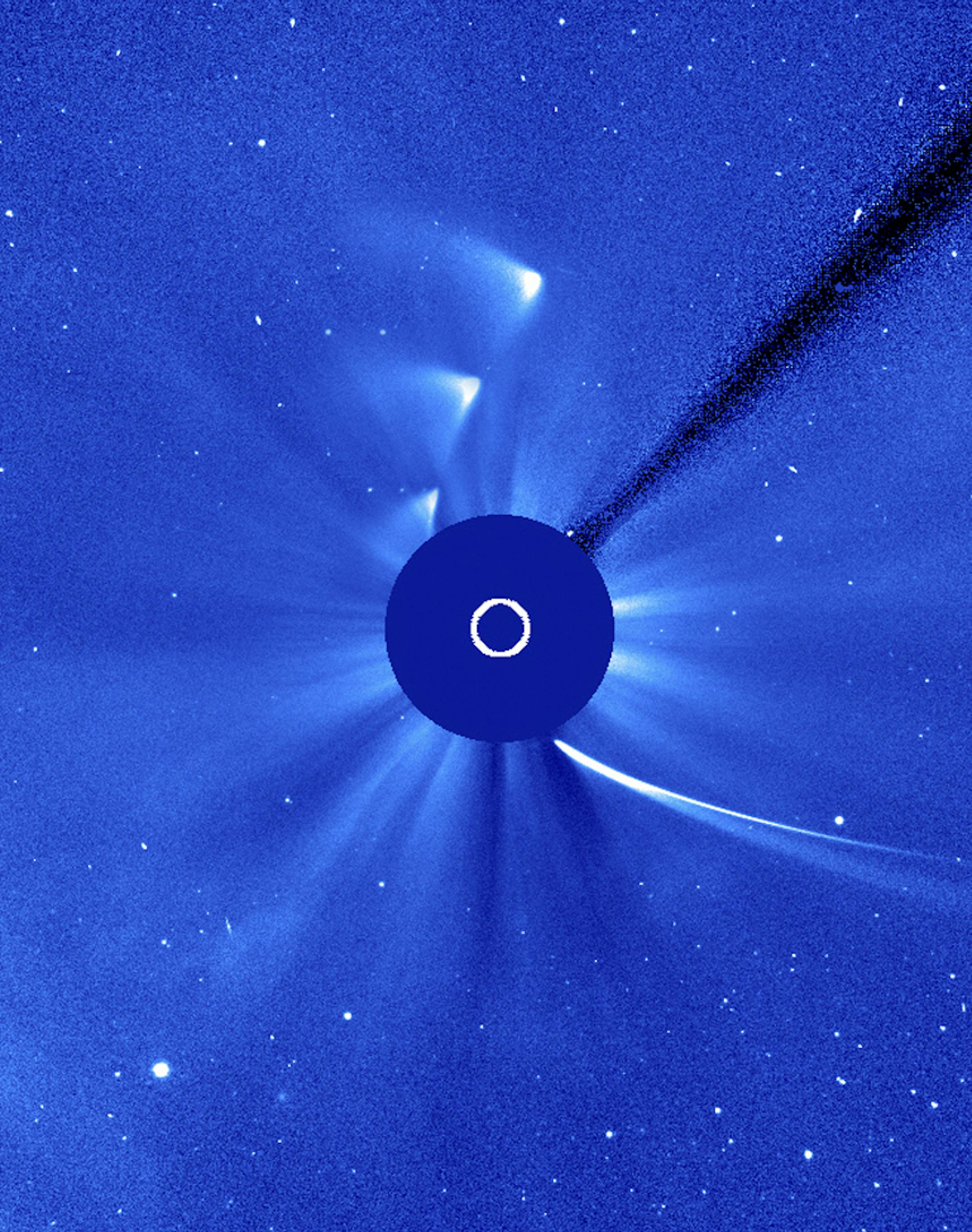
A waning gibbous moon is glaring near the zenith, almost blotting out the stars of Orion. More darkness would be better, but I'm hoping the light-gathering power of my 7x50 binoculars will coax Comet ISON out of the dawn sky where it is plunging in from deep space to graze the sun.
It was discovered several months ago, and when astronomers calculated its trajectory, many became excited about the potential. Sun-grazers tend to mount spectacular shows for earthlings, and the hype began. I've ventured out to see for myself.
Two of my guides have not yet risen, the planets Mercury and Saturn. A third, the bright star Spica, is about 15 degrees above the horizon. I hope to spot the comet a few degrees west of Mercury and 10 degrees or so below Spica. When Saturn appears, the comet and the two planets should form a small equilateral triangle. This celestial blazonry is motive enough to look.
I've kept the binoculars inside my vest to warm the focusing mechanism and make it easy to spin, though I only need to focus once. I draw out the 7x50s, aim at Spica, and resolve it to a glittering bluish sparkle. From the charts I've seen, I expect the comet to rise just a little ahead of Mercury, so I begin to scan the southeast horizon.
I see a faint object almost immediately, but it looks like a star. "Comet" derives from a Latin phrase meaning "hairy star," and ISON won't show as a point, but as a tiny fuzzy ball — with a tail, if I'm lucky. I look away for a few moments, to "reset" my eyes; closing them, then looking around at the cottonwoods. As any astronomer knows, you can wish phenomena into existence if you stare long enough at a dim object with preconceptions in place. That's one reason people used to believe there were canals on Mars.
When I swing the binoculars back to the distant hills, my lips release a hiss of appreciation. Mercury has popped into view. It's a brilliant beacon just above midslope, and tinted orange. The air is so crisp and still that I detect no wavering in the image — "tack sharp," as they say in the optics trade. I pan west, then up to Spica and slowly back down, occasionally slipping into averted vision, employing the extra sensitivity of the rod cells in my retinas. When I spy Saturn, it's already a degree above the ridgeline, forming a dazzling pair with Mercury. I shift the binoculars to the third vertex of the imaginary triangle, and the faint object is still in view. The comet? That's precisely where it should be, but I'm not certain. The sky is quickly brightening, and the object will soon be invisible. No matter; it's a lovely twilight, graced with planets, and worth the chilly awakening.