

A dog is staring at me. He's seeking a cue that I know what he knows: It's time for his dinner. So far as I can tell, dogs live mostly in the moment. They are present, and in that sense, mindful. We label them Canis lupus, but perhaps it should be Canis buddha. They are awake.
So far as I can also tell, dogs are unaware of their mortality, and why should they be if they are ever-present? But they do feel loss. A year ago, this dog before me — Oscar — had a companion, Max, an older dog. For eight years — since he was a puppy — Oscar had played and slept with Max; they were inseparable. Max died. Oscar sniffed at the body, but didn't display anything recognizable as grief.
Nevertheless, a few days later I returned home to find that Oscar had a new companion. Next to him on his rug was a stuffed toy frog that years before, on a playful whim, I'd perched on a jade tree in the living room. Oscar had plucked the frog from a branch and was curled up beside it. I returned the frog to the limb. It became Oscar's habit to retrieve the toy whenever I left him alone in the house. He'd never done so while Max lived. He didn't chew the frog, merely slept with it like a child cuddling a teddy bear. Such behavior is a reason I hear the phrase "dumb animal" less than I used to. Though human superiority to other mammals remains evident — insofar as we measure and esteem it — the general attitude is not as cavalier as it was even a couple generations ago.
A decade ago, the Human Genome Project provided a hard numerical basis for understanding that we are more closely related to other life than our forbears imagined. Never mind apes or dogs — we share about half our genes with bananas.
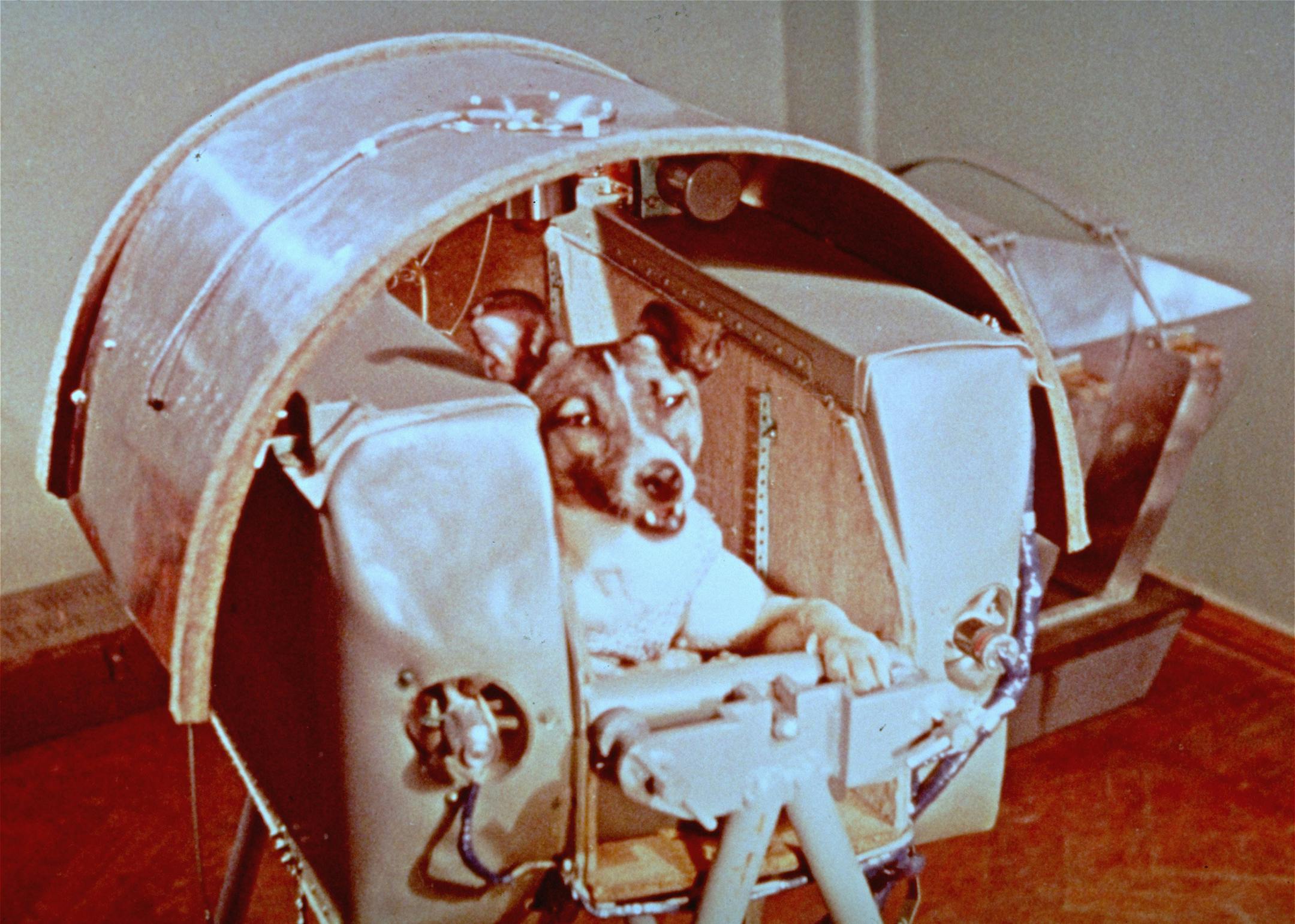
I remember being intrigued in 1957 — at age 6 — when the first earthling sent into orbit was Laika, a Russian dog. I don't recall if understood it was a one-way trip. Laika was probably born in 1954, and was picked up as a Moscow stray. She was a mongrel, an apparent mix of husky and terrier, with the space-traveling benefit of weighing only about 12 pounds. Soviet scientists selected strays for training because they thought such dogs might be inured to hunger and cold. Dr. Vladimir Yazdovsky, overseer of the test dogs, noted that "Laika was quiet and charming."
The dawn of the Space Age highlighted uncertainty about the impact of a rocket launch and subsequent zero gravity on living beings, so Laika and other dogs were assigned as true pioneers. To accustom them to confinement in the tiny compartment of a Sputnik, the Soviets housed them in smaller and smaller cages for up to 20 days. In the end they could sit, stand or lie down, but could not turn around. They went through centrifuge training to mimic the G-forces of a rocket blastoff, were exposed to noises they might expect, and were served a formulated gel intended as their ration in orbit.
On Oct. 31, 1957, three days ahead of launch, Laika was inserted into Sputnik 2, the second satellite ever launched, and connected to sensors for pulse, blood pressure and respiration. Before the trip to the Baikonur Cosmodrome, Yazdovsky had taken Laika to play with his children. "I wanted to do something nice for her," he later wrote. A technician readying Sputnik for the mission recorded that, "After placing Laika in the container and before closing the hatch, we kissed her nose and wished her bon voyage, knowing that she would not survive the flight." Nevertheless, there was an agenda.
The satellite was incapable of retrieval, and Laika was supposed to be euthanized by a poisoned dose of the food gel prior to her oxygen running out. Instead, she apparently expired about six hours into the journey (the fourth orbit) due to overheating of the capsule. Scientists blamed the system failure on political pressure from Nikita Krushchev to launch a living creature into space while the West was still reeling from the October surprise of Sputnik 1. In a 2002 paper, Dimitri Malashenkov, one of those responsible for Sputnik 2, wrote that it was "practically impossible to create a reliable temperature control system in such limited time constraints."


