

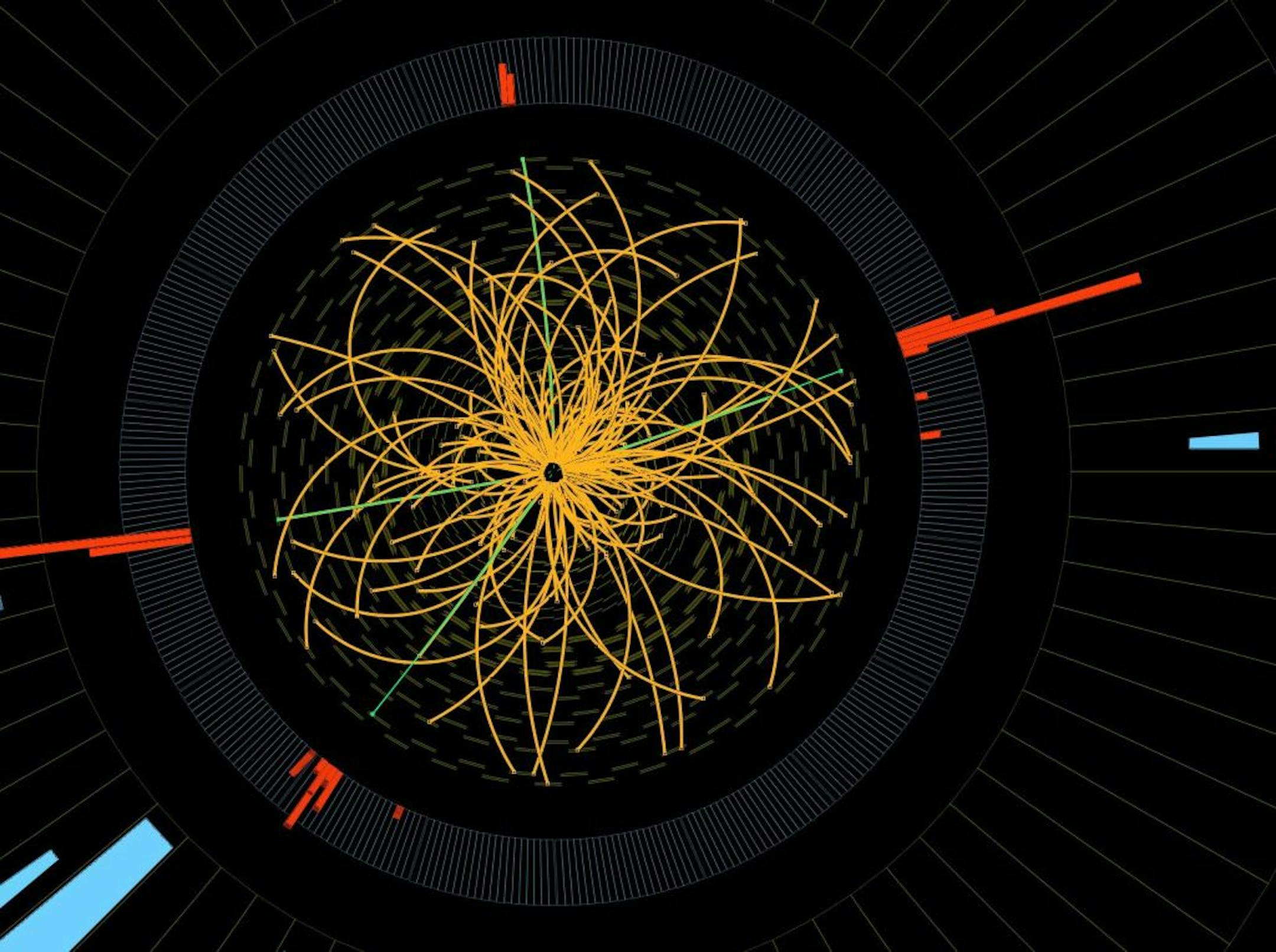
Through the magic of Internet streaming, I got to watch most of the presentation from Switzerland about the evidence for the Higgs boson. Unless I missed it, none of the scientists used the popular moniker of "God particle." Closest I heard was Fabiola Gianotti thanking "nature" for apparently making the Higgs just the right size for her detector to best detect it.
But most of the media coverage included at least a nod to the popular name for the putative particle: 'God particle' unveiled? Super-collider scientists declare victory. 'God particle' likely exists. God particle's discovery 'biggest leap in physics'.
And so on. The way the Higgs got the divine title is something of a joke in the world of physics. Originally, the story goes, they called it the "goddamn" particle because it was so freakin' hard to find. But then there was this book, written by Nobel Prize laureate physicist Leon Lederman. His publishers balked at the blasphemy. So the future bestseller was titled "The God Particle" -- and the public bit bigtime.
The name had its value because of how important the Higgs is to modern physics theory. You can find plenty of highly detailed official explanations elsewhere. I'll offer my best version before getting back to the confluence of the language of the godly and high-level physics.
Why is there mass? Likely not a question you've wondered about. But it is a topic that's bedeviled physicists for many decades. Without mass, there'd be no gravity, no matter, no us. Pretty fundamental.
If you move a piece of iron near a magnet, you feel a force acting on the iron. Scientists can explain some of that: an unseen magnetic field affects some kinds of things in particular ways. Lots of experiments can probe and measure that sort of field and the stuff it affects.
Almost 50 years ago, a young Scottish physicist named Peter Higgs suggested a field a little bit like the one around a magnet. Except this one is the same everywhere in the universe and explains mass. What does it do? If you've ever walked in shallow water, you know the water seems to grab you. But fish seem to be less grabbed as they squirt through. And waterstriders skate across the top with no effect on them at all.
Higgs' field would operate something like that on subatomic particles, and the effect is what we call mass. But the field can't be directly measured or perceived in any way. Back to the water: if you splash hard enough, droplets fly off. And if the Higgs field is whacked hard enough, "droplets" of a very specific size should pop out: the Higgs boson.


