

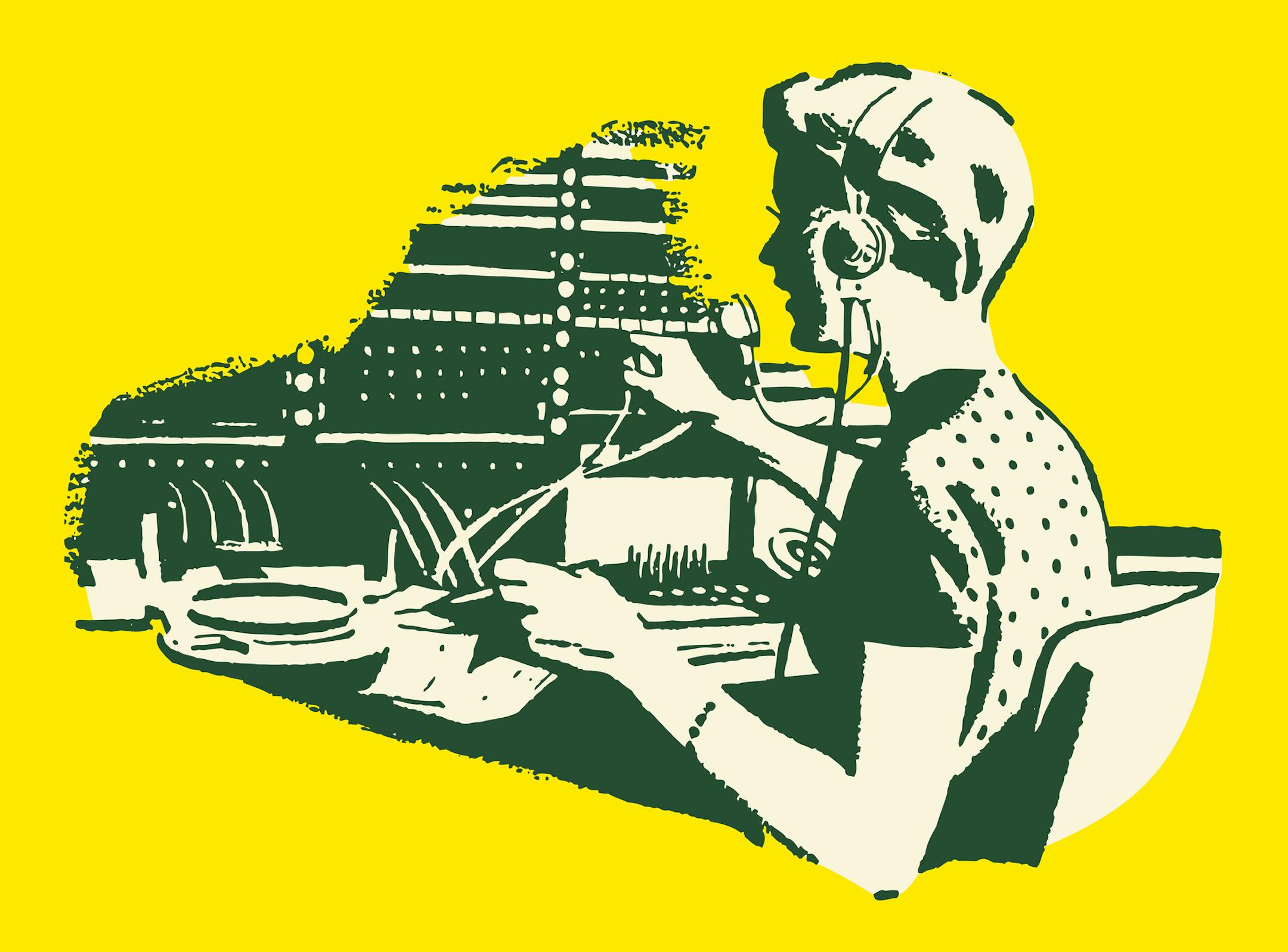
Whenever I find myself stranded on a far branch of a prerecorded phone tree, or shouting to a recorded voice that I would like to speak to a human being, I think of Bernadine (Honey) Winkelman, the telephone operator in the small Iowa town where I grew up. In my earliest transactions with her, our telephone — we had only one in the whole house — was a wooden box that hung on the kitchen wall. At the top of the box, like eyes, were two round black bells; at the bottom a morning-glory mouthpiece; on the left side a crank, and on the right, hanging on its hook, the earpiece, shaped like the bell of a little black trumpet.
When a caller — a 7-year-old boy, let us say, who wished to call his grandmother — placed a call, he would lift the earpiece from its hook and turn the crank vigorously once or twice, occasionally three times at peak calling hours. Sooner or later, there would be a click on the line, and a familiar, rather deep female voice would say, "Numberrr please."
"135, Honey," the boy would say in his squeaky voice (he wasn't being fresh; everybody called Bernadine "Honey." If her semiretired mother had been tending the switchboard, the boy, being properly brought up, would have addressed her as "Mrs. Winkelman.")
'Thank you, Michael," Honey would say, and then, after another click, he would hear the whirr of his grandmother's telephone ringing — unless, of course, his grandmother was talking on the phone to someone else, as she often was, in which case Honey would tell the boy that Grandma was talking to Emma Yohnke and they'd been at it for only 10 minutes, so try calling again in half an hour; but just as often Grandma was baking something yummy in the kitchen, and so, after two or three rings while she wiped the flour from her hands, the boy would hear another click and then, marvelously, an electronic transcription of his grandmother's voice.
The nexus that made this communication possible was a vast console in the Winkelmans' front parlor, a vertical bank of hundreds of brass-lined holes with red-and-green lights flashing here and there, rising over a desk filled with a thicket of plugs and switches. At this desk, on a swivel chair, a headphone on one ear and a mouthpiece curving around to her mouth, sat Honey, moving her red-nailed hands expertly over the switches and plugs, plugging and unplugging, saying "Number please," and "Thank you," and "Go ahead." Sometimes she would talk with whoever was making a call, the latest information being a part of the service she provided to the community. If she listened in on conversations not her own, she was doing no more than anyone else in town, most of whom were on party lines and listened in whenever the phone rang. News traveled fast in Wall Lake, but Honey was always the first to know about births and deaths and scandals and engagements, the one to check with for the very latest lowdown on any subject of local interest — and in Wall Lake, Iowa, there were few interests that were not local. Any little boy who dropped in to talk to Honey had to put up with many interruptions, some of them lengthy, but it was just as interesting to watch her work, which she continued to do while talking to whoever was on the line.
In a town of 800 souls in the middle of nowhere, there were no exchange prefixes, and phone numbers were simple: 135 for my grandparents, 243 for my Aunt Norma, 11 for my uncle's grocery store, 446 for us. If I didn't know a number, Honey would look it up for me, if she didn't know it already (as she usually did). The Winkelman house being near the center of town, there wasn't much going on that she couldn't see from her window, which sometimes added a helpful dimension to phone service in Wall Lake. I might give her my grandmother's number, 135, and she might say, "I just saw your grandma go past on her way to the store. Want me to connect you there?" I would, and she would connect me, and my grandmother would be at the store.
Another of Honey's civic duties was sounding the fire siren. Although the switchboard shut down every night at 10, there was a special line for reporting fires and medical emergencies, always open. When a call came in, Honey would sound the alarm, day or night: three wails for a fire in town, four for a fire in the country. The volunteers would rush to the fire station from all over town, and Wall Lake's white fire truck would go roaring and wailing off to fight the fire.
Honey was also responsible for the noon whistle, the single wail of the fire siren that sounded every day to notify the town that it was time for lunch (or "dinner," as the midday meal was locally known). One day at noon I was talking to Honey when she rose and leaned over and pressed a green button in a switch box on the wall above my head. The siren wailed out over the town, and, when it had climbed to its crescendo, she pressed the red button below the green button, and the siren descended into silence.


