

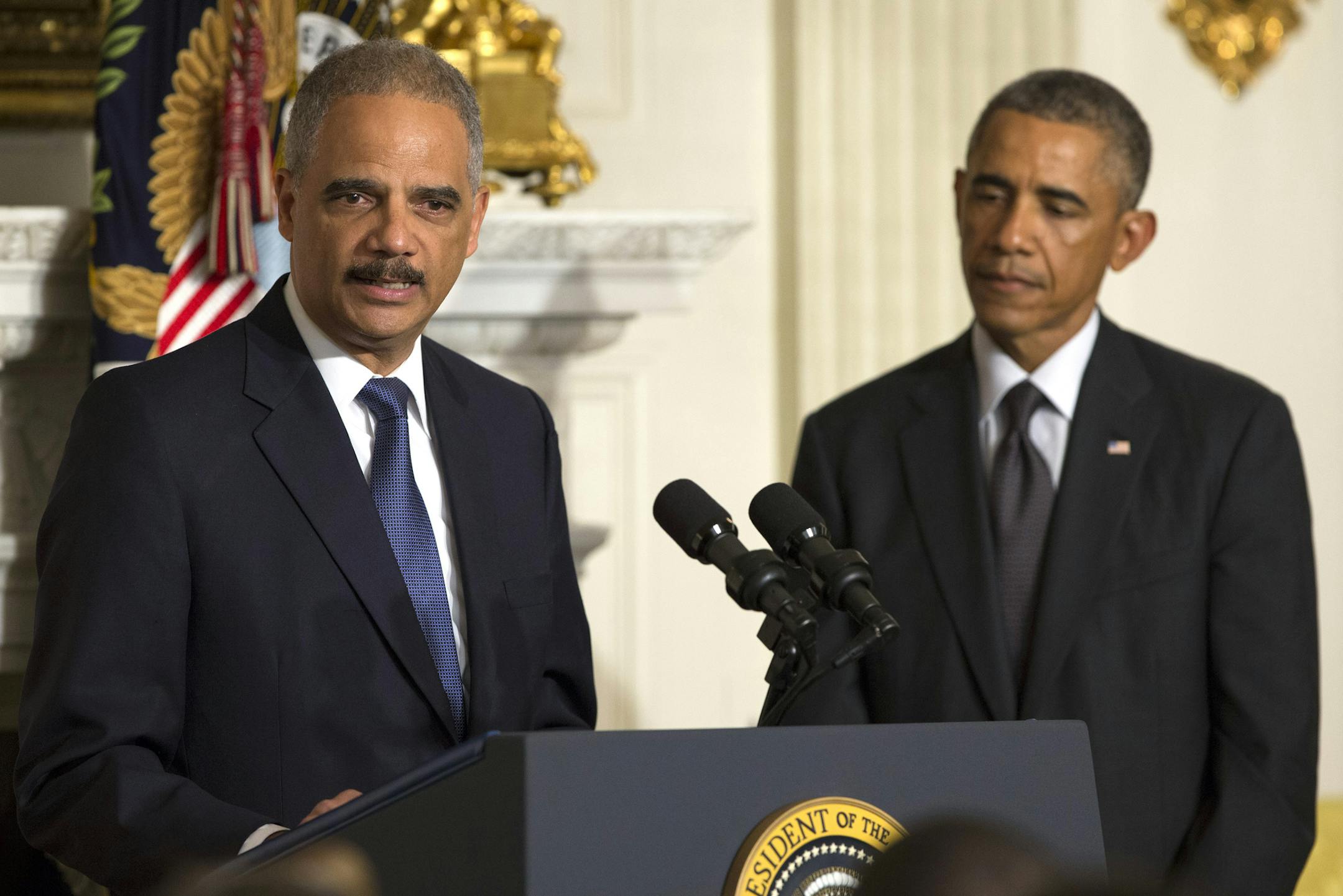
Attorney General Eric Holder's resignation is bad news for President Obama's racial-justice legacy. Obama has done little to address race during his presidency, beyond the actions of his Justice Department. With Holder's exit, that track record suggests the president is now done with race. And that's a shame, because Holder is leaving with much unfinished business.
Holder is not an attorney general who happens to be black. He is, proudly, the first black attorney general. His civil-rights record — including suing states on voting rights, strengthening the Justice Department's Civil Rights division, and bringing cases against police departments for excessive force — is extraordinary. Holder will be remembered alongside his hero Robert Kennedy, as well as Ramsey Clark and Nicholas Katzenbach, as the attorneys general who did the most to uphold "equal justice under law."
No government official has done more to reform criminal justice than Holder. The United States locks up more people than any other country in the world. For most prosecutors, that's been the source of bragging rights. Holder, on the other hand, explained the devastating impact of mass incarceration on our families, economy and democracy. He ratcheted down the war on drugs, spoke against prison for minor, nonviolent offenses, and offered the opportunity for clemency to people imprisoned under draconian sentencing laws.
In other words, for black Americans, Eric Holder has been everything that President Obama has not. The African-Americans who danced in the streets of Harlem when Obama was first elected did not expect that the president would, in four or eight years, reverse centuries of entrenched subjugation. But they did assume he would make racial justice a significant part of his platform. They were sadly mistaken.
For all of Holder's focus on structural discrimination in the criminal and civil justice systems, the president has tended to blame black culture. Early in his presidency, he told a church audience "Too many fathers … have abandoned their responsibilities, acting like boys instead of men. … You and I know how true this is in the African-American community." Obama's scolding has sometimes seemed misplaced, as when he told members of the Congressional Black Caucus to "quit whining, quit complaining" and the graduates of Morehouse: "No more excuses. Nobody cares how much discrimination you suffered."
From his early years on the national stage, Obama has aimed his cultural critiques at the most dispossessed African-Americans. Campaigning in 2007, Obama mocked the work ethic of "gang bangers," saying, "Why I gotta do it? Why you didn't ask Pookie to do it?" What Pookie needed from the president was a job. Yet black unemployment has remained at least twice the level of white unemployment throughout the Obama administration. Pookie's sister needs some help, too. But on the president's watch, the percentage of black women living under the poverty line has risen.
In short, the two most powerful African-Americans in the country think about race in fundamentally different ways. Holder is not as much the president's alter ego on race as he is the brother from another planet.
The attorney general has forcefully advocated for race-based remedies, including affirmative action in college admissions and drawing voting districts to enhance minority voting power. While Obama also supports these programs, he has said, "I think it's a mistake to start thinking in terms of particular ethnic segments of the United States rather than to think that we are all in this together."


