

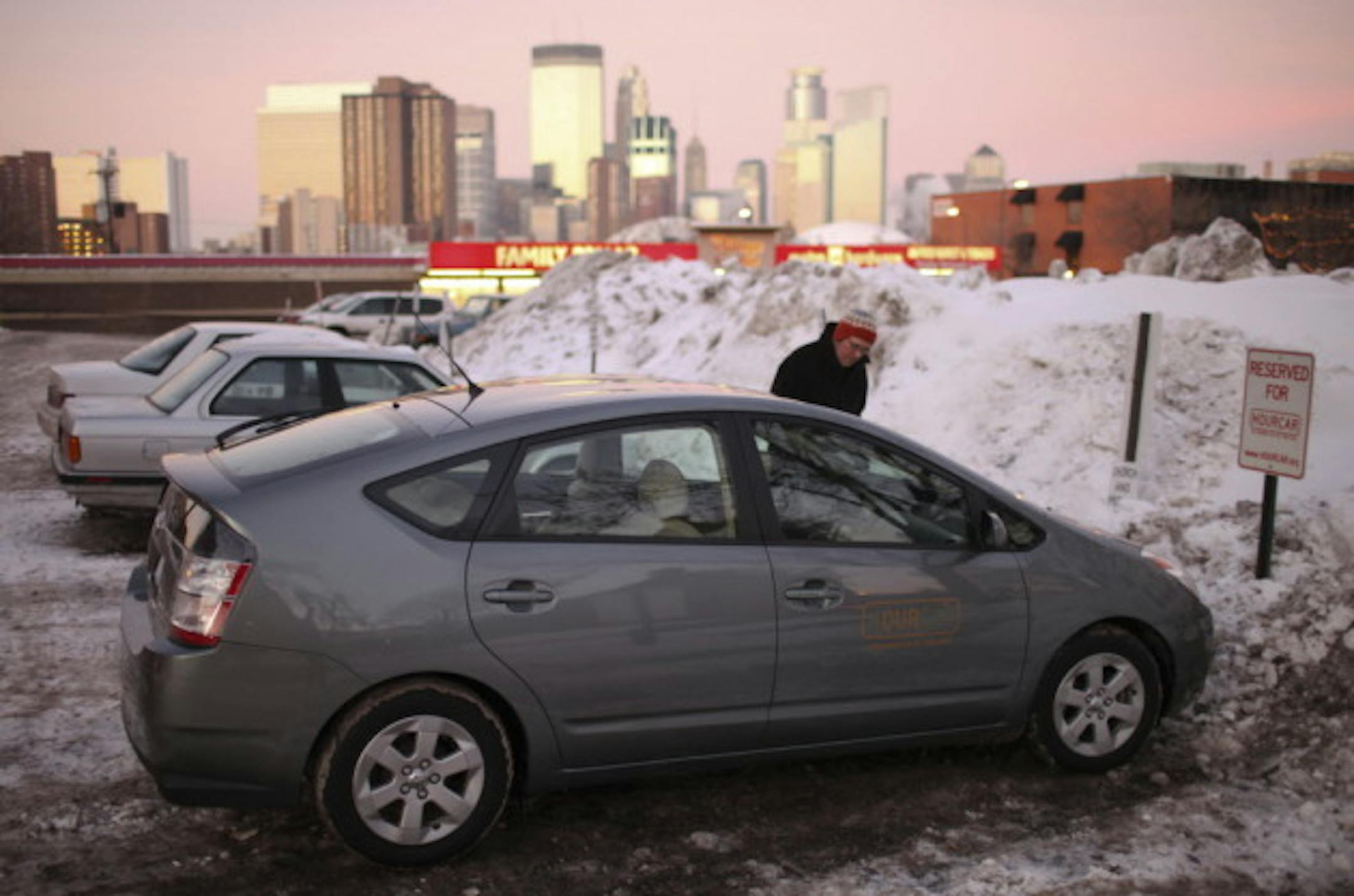
Just over a year ago, Joe Laha's car quit and he had a decision to make: Either buy a new one or go vehicle-free. He chose the latter.
Laha bikes 2 miles from his home in Minneapolis' North Loop neighborhood to his job as audio visual director at the Westin Hotel downtown at 6th Street and Marquette Avenue. He drives only when the need arises, such as running errands or making his weekly trip to the grocery store. For those occasions, he borrows a vehicle from Hourcar, a Twin Cities car-sharing program.
"There is slightly more planning involved in planning out your weekly or daily car use, but we've made this work without too much disruption in our lives," said Laha, who shares an Hourcar membership with his girlfriend.
Laha is part of a small but fast-growing number of metro-area residents who are ditching car ownership in favor of mass transit and other modes of transportation, and relying on Hourcar to fill their need for wheels.
The car sharing service recently announced that it will nearly double its fleet from 39 to 70 this spring to serve its exploding membership that now totals more than 1,900 and could serve up to 3,500 people.
Many of the new fuel-efficient vehicles will be parked along the Central Corridor light-rail line set to open next year and near transit corridors in high-density areas in Minneapolis, said Chris Duffrin, executive director of the nonprofit Neighborhood Energy Connection, Hourcar's parent organization.
"A lot more people are making the switch to those modes of transit, and this is what it is intended to support that, so you can give up car ownership, but have occasional access to a car when you need it," he said.
Car sharing programs in the United States grew 43 percent from July 2011 to July 2012, with more than 806,300 members, according to Susan Shaheen of the Transportation Sustainability Research Center at the University of California-Berkeley.


