

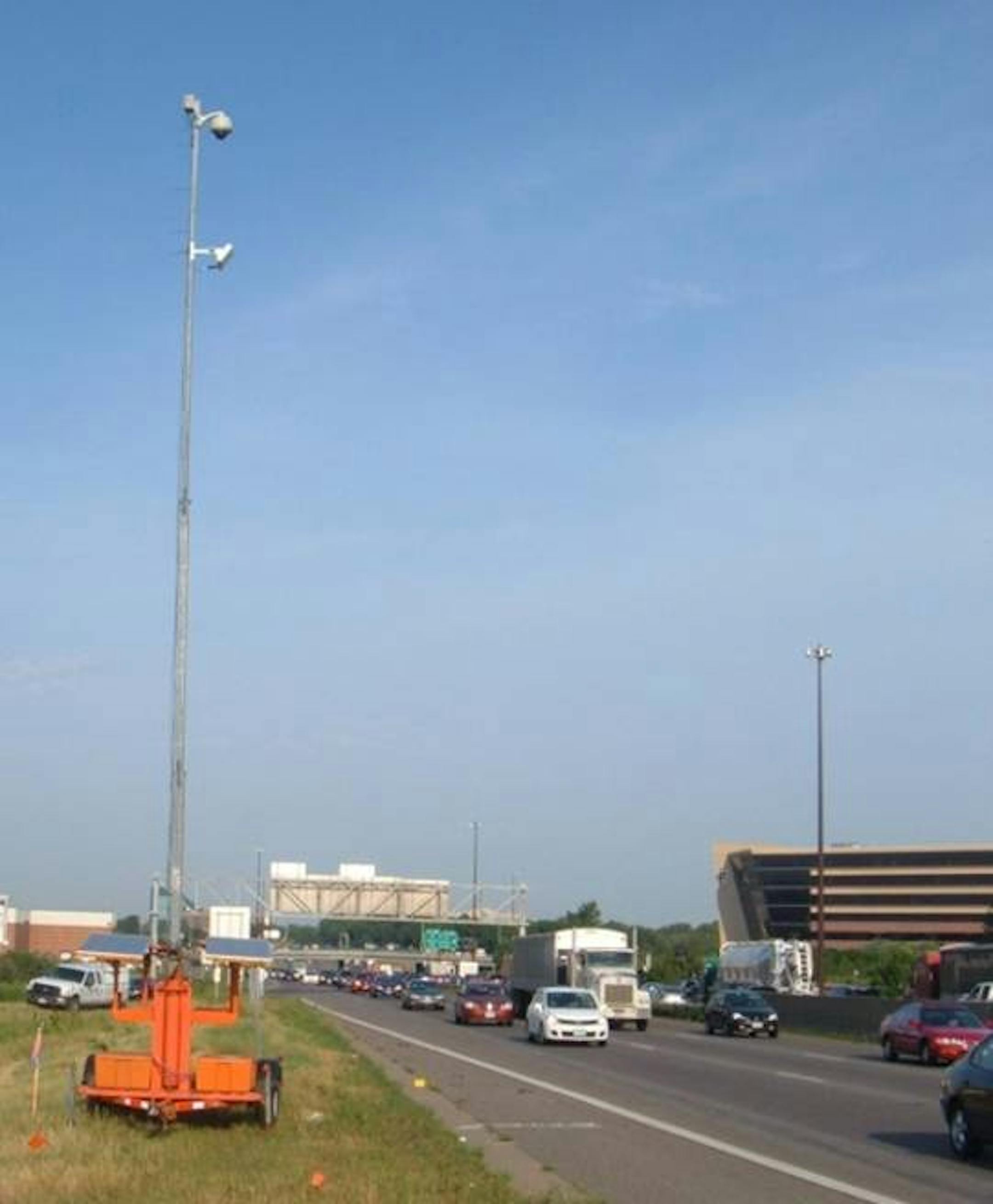
Orange trailers with solar-powered radar sensors affixed to the top of a tall mast have been parked along Twin Cities highways and freeways this summer that are under construction.
And, they have piqued the curiosity of several motorists who have asked The Drive what they are.
Although they look like something the National Security Agency would deploy to spy on us, there is nothing sinister going on here. The Minnesota Department of Transportation (MnDOT) is renting more than 60 of the units to collect traffic data in congested work zones and give commuters real-time information on how long it will take to get through.
Usually, MnDOT uses loop detectors placed every half-mile in the pavement on major metro area arteries to collect information about highway speeds and calculate travel times that are posted on overhead message boards. But they don't work during road construction, as they have been on I-494 in Bloomington and I-35W in the northern suburbs.
"That is the No. 1 complaint I get when the travel time signs go down," said Brian Kary, a MnDOT freeway operations engineer. "They want them up and running. People value that, and that is why we are doing this project."
It's not inexpensive. Each of the trailers is equipped with solar-powered batteries, a radar sensor and a cellular modem to transmit data. MnDOT rents each of the trailers for $250 a week. This summer, it deployed 16 trailers along I-694 between Hwy. 252 and I-35W. It had another 12 on I-494 between Hwy. 100 and Hwy. 5. And it will have 36 of the units on I-35 between County Road 50 and County Road 2 in Scott County where a 10-mile project that started last week will have the freeway reduced to a single lane in each direction for six to eight weeks. Currently the work zone runs from County Road 70 to the Elko/New Market exit.
"They are spendy units," Kary said. "That's why we are not using them everywhere. We use them on big jobs with permanent lane closures with significant impacts on the system that cause delays. We try to mitigate that and give good information."
Kary said the temporary radar detectors are just as accurate as the in-pavement loop detectors and provide good data. But, even so, traffic in a work zone is fluid, as are lane configurations, which makes projecting travel times as "a challenge."


