

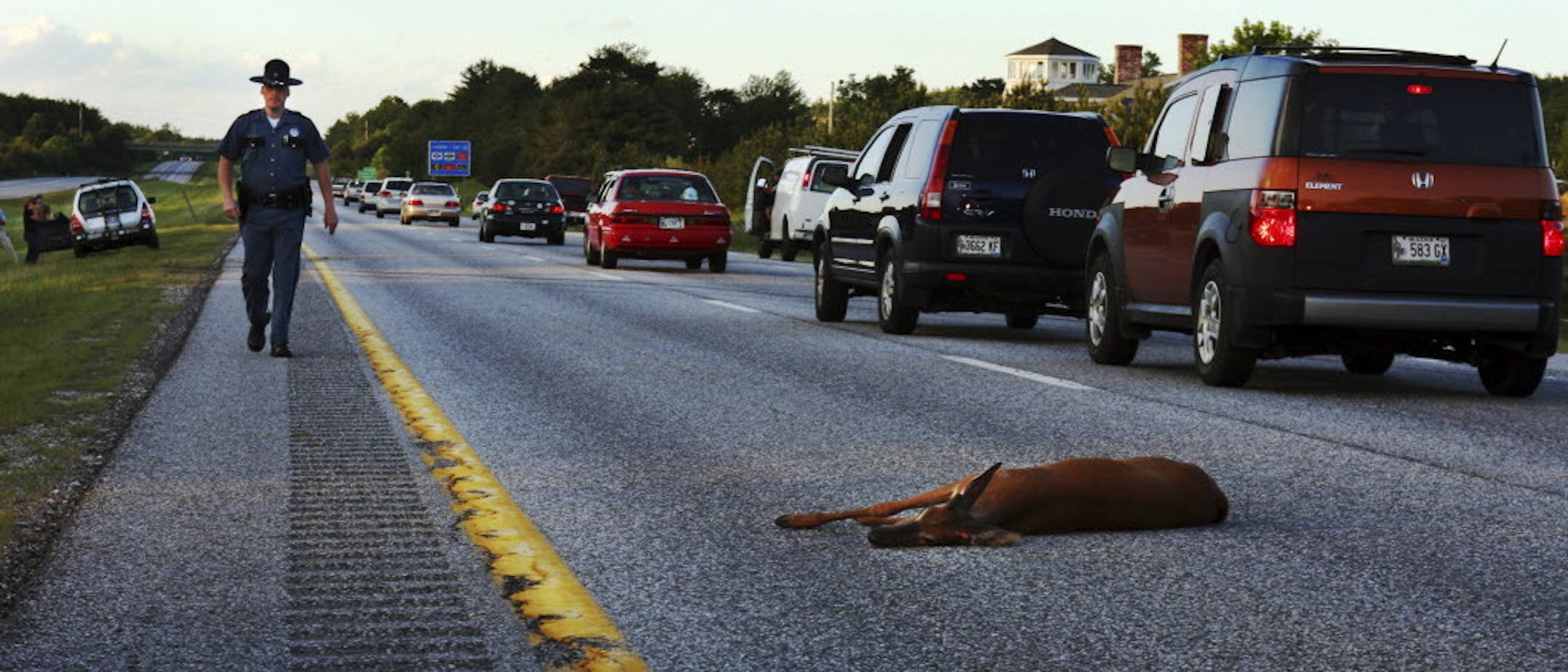
Like many motorists, I log a lot of miles at this time of year, but I've never been too concerned about hitting a deer. A new report out last week by State Farm Insurance indicates that perhaps I should. Maybe we all should.
October and November are the peak months for car-deer collisions, and Minnesota is the sixth most likely place in the nation to strike a deer while driving, according to the insurance company's analysis of claims data and driver counts from each state provided by the Federal Highway Administration.
Overall, the chances of any one motorist bagging a buck while behind the wheel over the next 12 months is 1 in 174. But in Minnesota, where the Department of Natural Resources estimates there are nearly 1 million deer roaming, the chances are much higher at 1 in 80.
"Deer are not an uncommon sight along our roads, and they tend to do unpredictable things, like stop in the middle of the road, or cross and quickly recross," said Lt. Eric Roeske of the Minnesota State Patrol. "Motorists and [motorcycle] riders need to stay focused on the task at hand, and drive or ride defensively by looking for reflecting deer eyes and silhouettes, especially during lowlight times and in forest and farm areas."
Over the past three years, there have been 7,484 deer-vehicle collisions in Minnesota, with more than one-third of those occurring in October and November, according to the Department of Public Safety.
They don't come cheap, either. Nationally, the 1.2 million mishaps collectively cost about $4 billion annually or $3,414 per vehicle.
Nor are they just a rural phenomenon.
With urban sprawl and more roads passing through wildlife habitats, deer are finding their way into the city more frequently. (Remember the buck found along the Mississippi River in downtown Minneapolis last week?) Last Wednesday, a motorist struck a deer during the morning rush hour on Hwy. 52 at 70th Street in Cottage Grove.


