

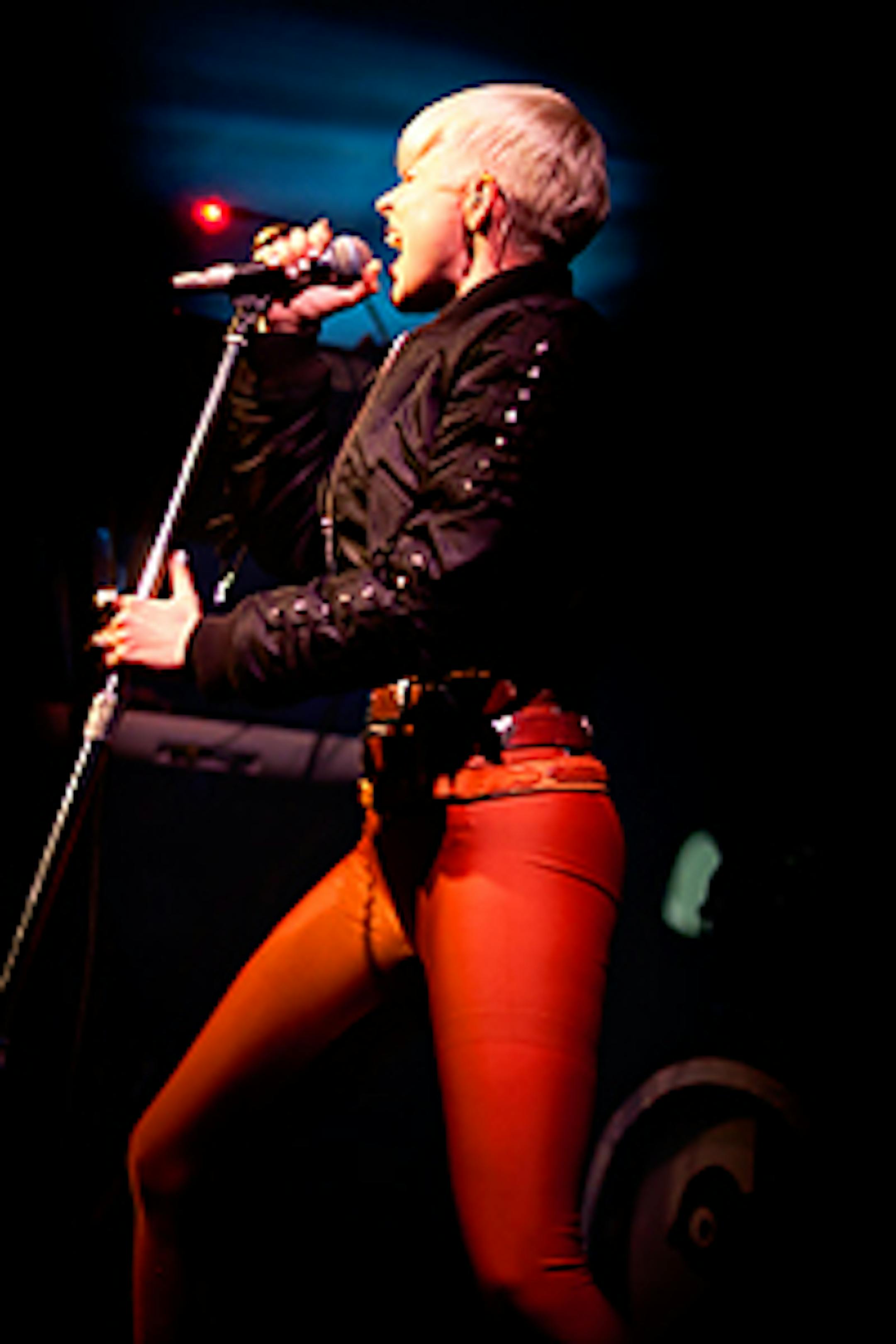
Robyn shows Minneapolis love
It was obvious even before her first Swedish-accented "Hello" just how well Sunday's packed audience at the Fine Line knew Robyn and her music. It wasn't until her second encore, though, that the Stockholm-reared singer proved how well she knew the audience. She did so with two lovingly chosen, cleverly re-created cover songs: a tender and nearly a cappella verse and chorus of Abba's "Dancing Queen," preceded by a hard-thumping tear through Prince's "When Doves Cry." There wasn't a dry eye -- or at least a dry armpit -- in the room after that.
Taking the stage in a zipped-up, punked-out bomber jacket that never could've lasted in the overheated club, the Prince-sized 31-year-old immediately burst into a fireball of energy. She opened with her robotic hit "Fembot" and followed it with the poppier gem "Cry When You Get Older." Stripping off the jacket to a tight, belly-cropped Lycra top, Robyn broke out some fast and furious dance moves for "Cobrastyle." She then bowled over the crowd with her masterpiece "Dancing on My Own," which proves how well she can pull off sexy, upbeat pop with smart, dark undertones.
The rest of the show bounced between those kind of poppy, don't-mess-with-me anthems and the more grinding digi-romps. Fans were exiting in total satisfaction when Robyn unexpectedly reappeared for the second encore, urging of Prince, "If you see him, tell him I love him." The only more fitting finale would have been if she had instead sung "Baby, I'm a Star."
- Chris Riemenschneider
New vü on Hüsker Dü
Maybe because most Twin Cities writers know better than to get between Grant Hart and Bob Mould, the new book "Hüsker Dü: The Story of the Noise-Pop Pioneers Who Launched Modern Rock" was authored by a Memphis-based freelancer and humorist, Andrew Earles. He predictably finds little humor here. The book eventually comes off as sour as some of the gripes the members of Hüsker Dü have with each other.
Earles does a terrific job painting the Twin Cities scene of the late '70s and early '80s. As he points out, most scenesters were less than receptive to the disheveled-looking, noisemaking trio from (gasp!) St. Paul. Which is why Hart, Mould and Greg Norton started their own label, hit the road and became DIY trailblazers.
Yet Earles also announces in the introduction that his book will address neither the band's drug use nor the fact that two of its three members are gay. There's also little detail on the band's legal issues with SST Records. It really just seems as if Earles did not want to ask the hard questions. The most glaring hole is that Mould "politely" declined to participate, instead spending most of last year working on his autobiography, due to be published in June.
Earlier this week, Mould said he has not read Earles' work, but he wished it well and emphasized that his tome will be different.
"Naturally, my book deals with that period, but it's only one facet of who I am, what I've done so far, and how I became the person I am today," he said, citing at least one specific contrast: "I've had major issues with my own sexuality over the years, and my book will shine a very bright light on that part of my life."


