

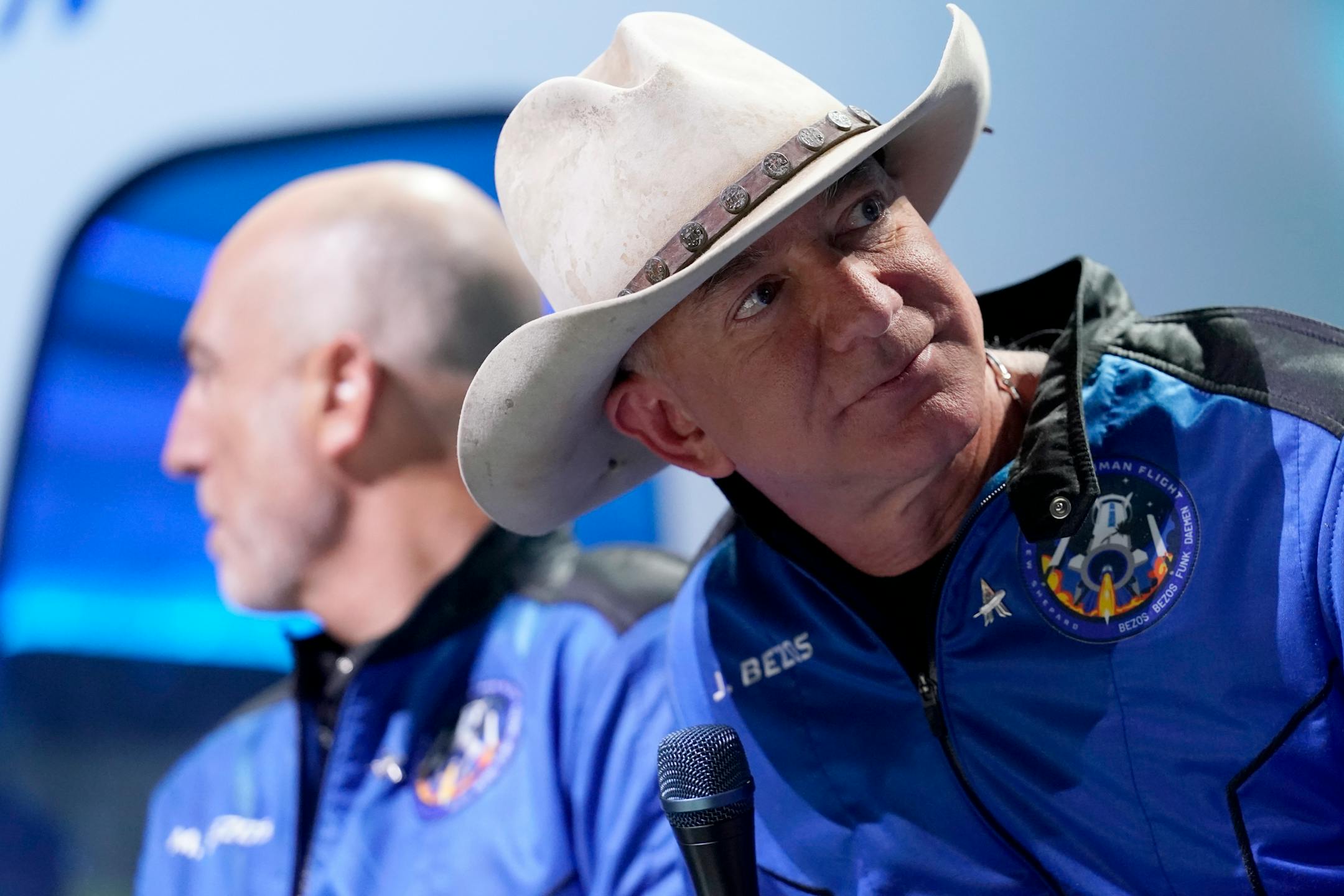
So, the Blue Origin endeavor that brought Amazon founder Jeff Bezos to the soft edge of space on Tuesday has been costing the centibillionaire about $1 billion of his wealth per year. It bought him and the three other occupants of his capsule 10 minutes of flight with four minutes of weightlessness, during which they did somersaults, snacked on slow-moving Skittles and said things like "oh, wow."
Bezos also said Tuesday that Blue Origin has sold nearly $100 million worth of tickets for future passenger flights. An unrelated market research report has pegged the global suborbital transportation and space tourism market at $2.6 billion by 2031. That would include competing efforts like that of Virgin Galactic, whose founder, Richard Branson, beat Bezos to the ultra-atmospheric vicinity earlier this month, and SpaceX, whose founder, Elon Musk, remains personally earthbound but has said he wants "to die on Mars, just not on impact."
But is there another point to it?
Well, to be clear, Musk doesn't intend to die alone. He wants humans to colonize Mars, partly for the adventure but also as a sort of insurance policy should something go tragically wrong on this planet, whatever in the world that might be — hard to imagine.
But in the more immediate term, SpaceX has a deal with NASA to help land astronauts on the moon. It's a new way for taxpayers to boldly go where they've gone before. Blue Origin wanted in on this action also, but was underbid, so it did what companies do in the global rodeo of competitive business: It filed a protest with the federal Government Accountability Office (a decision is expected in August) and lobbied Congress to give NASA more money, perhaps some of which Blue Origin might be awarded (the congressional effort is in bicameral limbo).
But is there another point to it? Something that could benefit humanity as tangibly as other ideas well-grounded people might dream up?
There is, though you'll have to fire up your powers of visualization. Just as people sometimes credit government for moving things into the future — DARPA and the internet pop most readily to mind, though so do proposals for public seed money in areas such as clean energy or even social equity — private money possesses that potential, too.
And when it comes to what can be achieved in space, the U.S. government has been playing small ball for a while. This was put best, perhaps, by Miles O'Brien, the science correspondent for the PBS NewsHour and an aerospace analyst for CNN, in a commentary for the Washington Post — keep all that straight, would ya? — in which he wrote: "For decades, NASA has acted like that guy bragging in a bar about winning a state championship 50 years ago." Glory days!


