
Brown: Bitterness dies, but gratitude lasts generations

Remembering a grandfather whose gruffness couldn’t erase his moments of kindness.

Columnist Icon
The Minnesota Star Tribune
November 25, 2025 at 6:32PM
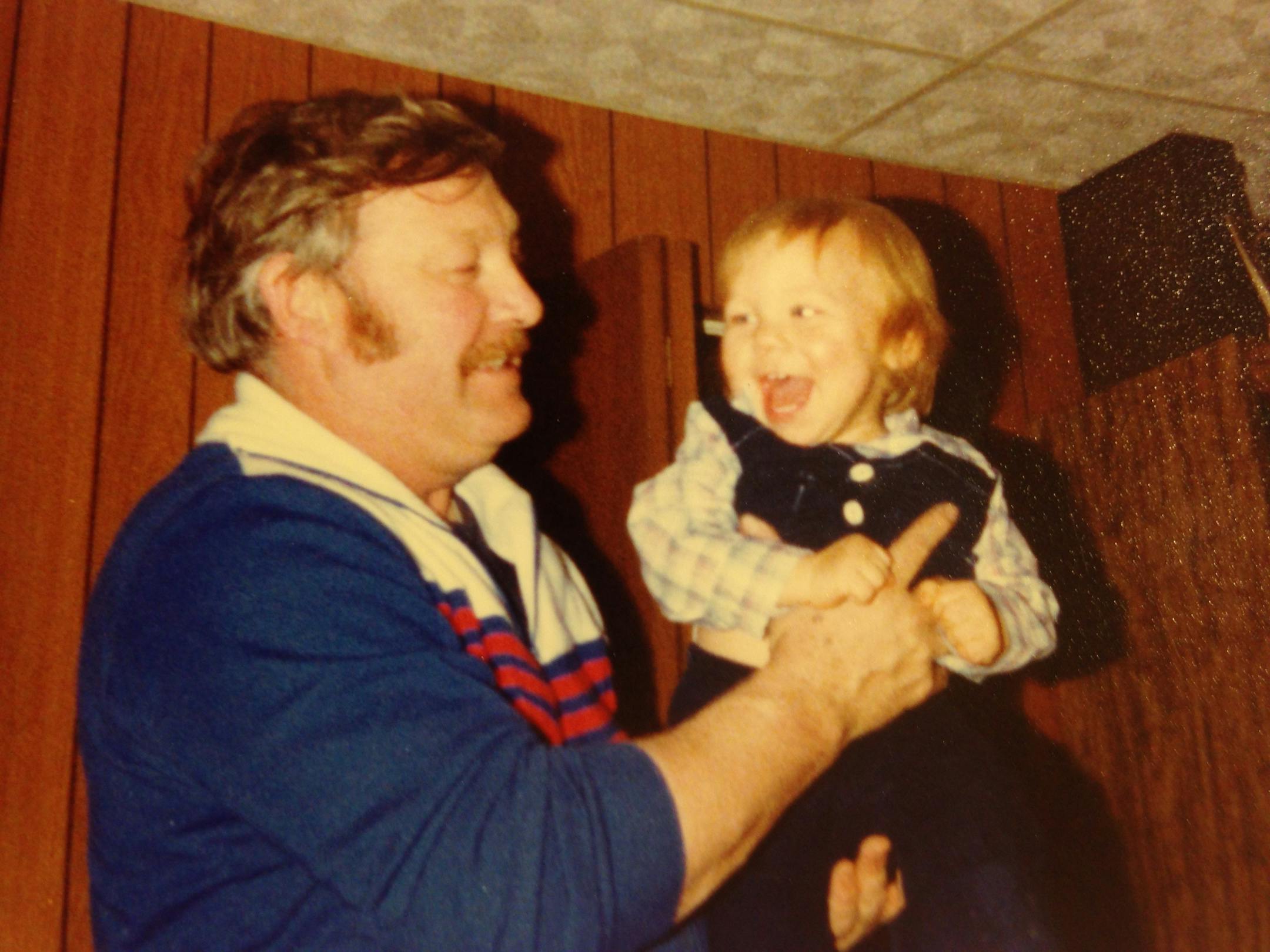
Marvin Johnson holds his grandson, Aaron Brown, on Christmas Day 1980.
Marvin Johnson holds his grandson, the column's author, on Christmas Day 1980. (Courtesy of Aaron Brown )

Opinion editor’s note: Strib Voices publishes a mix of commentary online and in print each day. To contribute, click here.

•••

The United States sets aside a national holiday for gratitude, even though American culture does little to encourage the practice. We say, “be grateful,” but the advice more easily flows down to people having a hard time rather than upward to those with heated garages filled with fancy equipment. If we could all act on gratitude, we’d be unstoppable. Because gratitude paid forward can sustain every living thing that walks the earth.

Perhaps we miss this because Thanksgiving coincides with a time of year that is fundamentally sad. Our carefully planted perennials look like road hay. Frogs lie frozen like chicken nuggets at the bottom of an icy pond. Another fall reminds me that my Grandpa Johnson is still gone. By all appearances, so is my youth. Soon enough, we will all be gone. Pass the gravy.

It’s amazing what lasts and what doesn’t. My grandfather and I were close. He wanted a son and had six daughters. I was the first grandson. When I was a kid, he carried me through the streets and bars of Keewatin, Minn., like a prize turkey. He was a town cop and iron miner who had wanted to be a newspaper writer, and I actually got to do that. As an adult, I went with him to the American Legion Veterans Day spaghetti feed, where we both won the Thanksgiving turkeys coveted by every old man in town. It was a random drawing, but our shared success felt like vindication.

Prideful euphoria does not last, however. I think back to the days when my grandpa was dying, years really, and how bitter he became. Regret poured out of him. No fear, no worry, no misdeed, by him or anyone else, went unmentioned. He remembered the shame of his father losing his job on the railroad for drinking, then his own drinking and the hardship it caused. Something about the end of the line brought a desperate sort of remorse. For a long time, this overshadowed my memories of him. But there’s one memory that never stopped glowing like an ember in a cold stove.

I’m a kid and we’re spending another Sunday at Grandma and Grandpa’s house. I walk in the door and Grandpa pins a plastic sheriff’s badge on my shirt. It’s the best thing ever. I run all over the neighborhood, blasting through leaf piles like a dog with the zoomies. But when I get back to the house, the badge is gone. A little scrap of gold, it could be hidden anywhere in the autumnal landscape of an entire town.

I remember crying, not only because of the badge, but because I thought I would disappoint my grandpa. After all, he had appointed me sheriff, a position of considerable responsibility.

But my grandfather — a man who routinely hollered at anyone who failed to finish a can of Shasta soda, even the nasty grapefruit kind, because it cost money — went to one knee and hugged me. The badge wasn’t important, he said. It’s OK.

There’s a kind of love that’s really just gratitude for everything being OK as it is. That’s the love I felt that day.

Anyway, this special day won’t be removed from my memory until my brain rots like an old peach. But I learned something else after Grandpa died.

A man contacted me to ask if I was related to Harold Johnson. My grandpa’s name was Marvin, but Harold was his father. A man described as gruff by my grandpa, who was certifiably gruff, my great-grandfather died of cancer years before I was even born.

This man’s mother grew up with my grandfather in the same neighborhood along the Great Northern Railway tracks that cut through Keewatin. They were just a few houses apart, but on different sides of the tracks in more ways than one. My family had a radio. His had no coal to heat the house through winter.

My great-grandfather was a fireman for the railroad. Being a fireman meant shoveling coal, which seems simple, but it was in fact a fine art of knowing exactly how much to shovel and when. If you screwed up, the boiler would explode. That didn’t happen often, but often enough to remain on one’s mind. Approaching a stop, a fireman got to slow down. Rest. Maybe stick the spade into the coal pile. Or maybe, like my great-grandfather, take one more scoop of coal and chuck it out the window into the yard of the family with none.

The son of the little girl who ran out to pick up the coal all winter long wanted to thank me for my great-grandfather’s generosity. Well, in truth, it was the railroad’s coal. But it was Harold’s kindness. And as bitter as some days would become for Harold and his son Marvin, it is their improbable kindness that survives them.

Bitterness has no place in nature, where time soothes acid into water. We have much to be grateful for, not only because of what we have but because at this very hour we possess the ability to be kind and generous to others. Our warmth will outlive us, and we make it ourselves.

about the writer

about the writer

Aaron Brown

Editorial Columnist

Aaron Brown is a columnist for the Minnesota Star Tribune Editorial Board. He’s based on the Iron Range but focuses on the affairs of the entire state.

See Moreicon

More from Columnists

See More
card image
Richard Tsong-Taatarii/The Minnesota Star Tribune

Plus: “Fraud tourism,” a shooting tragedy in Stewartville, the Democrats’ 2024 election campaign and more.