

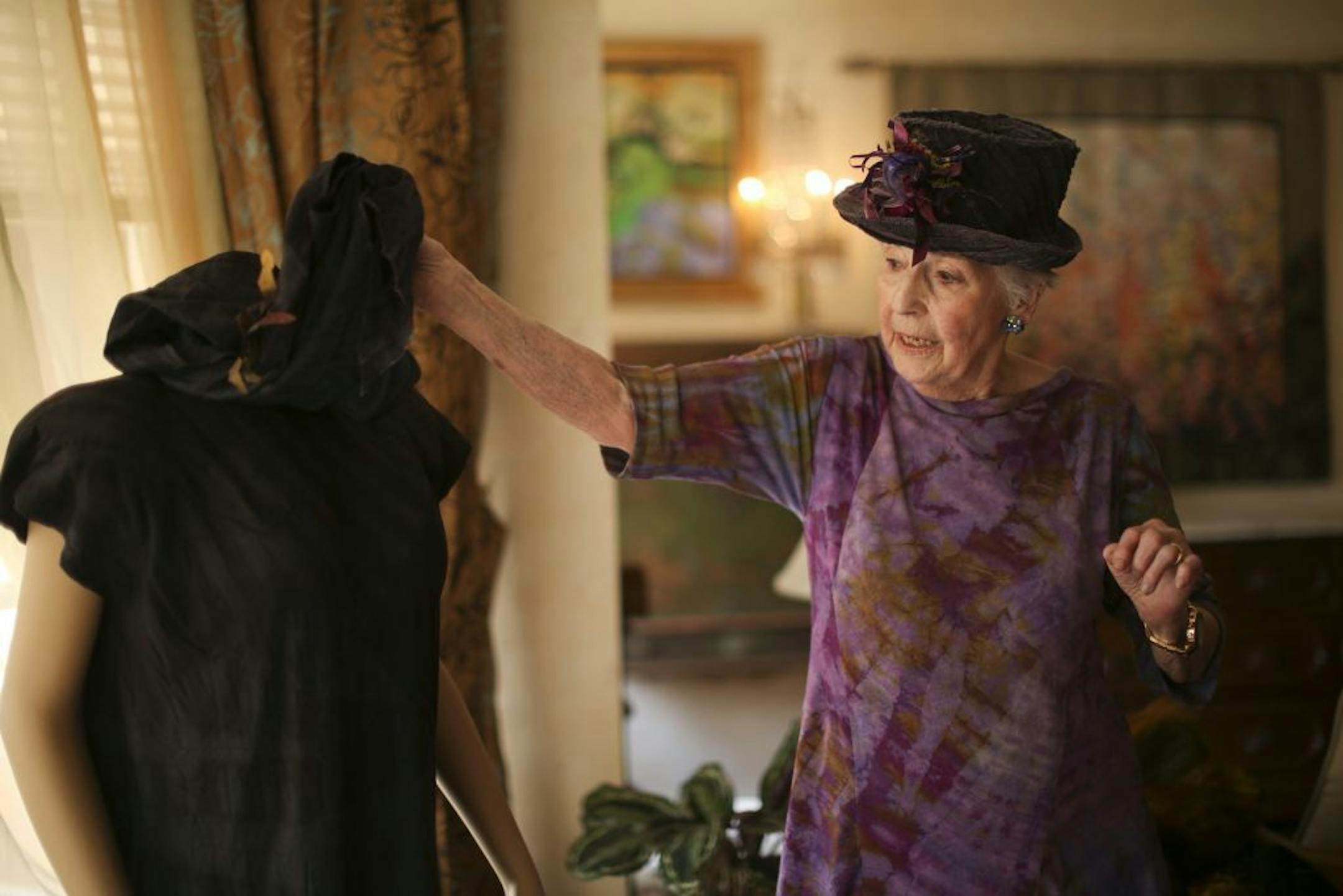
Gini Corrick's work tools look right at home in her kitchen. A slow cooker. A microwave. One of those boxy white roasters you use when you need more oven room at Thanksgiving. In these, Corrick concocts her fabric dyes, often using natural materials such as an avocado seed that she's cranked into a vise and sliced. (It exudes, of all things, a vivid red.)
Into these dyes, Corrick immerses fabric that she's twisted, pleated, puckered or bound around a length of PVC pipe. Once untwisted, unpleated, unpuckered or unbound, the pattern of dyed and undyed cloth is, however imagined, always a revelation.
"That's why I never, ever, take it off the pipe before I go to bed," she said solemnly. "I wouldn't be able to sleep."
Finally, Corrick stitches the dyed fabric into stunning wearable pieces of art that have earned her national and international honors.
Yet she won't claim mastery of the craft, hewing to an artistic philosophy, common to many cultures, that flaws enable the spirit of a garment to roam free.
Her first one-woman show opens at 4 p.m. June 7 in the Terrace Room of Kenwood Isles apartments, 1425 W. 28th St., Minneapolis. Public hours are 1-4 p.m. June 8-14.
Corrick practices the ancient Japanese technique of shibori, which looks at first glance like tie-dye. Really amazing tie-dye. The technique dates back to the eighth century, but "is definitely having a moment," according to a recent Wall Street Journal article about hot design trends.
Shibori involves specific ways of creating elaborate patterns of dye transfer and dye resistance. One of Corrick's favorites involves tightly stitched pleats that, when undone, look like great grins of horse teeth, which is what she calls the pattern.


