

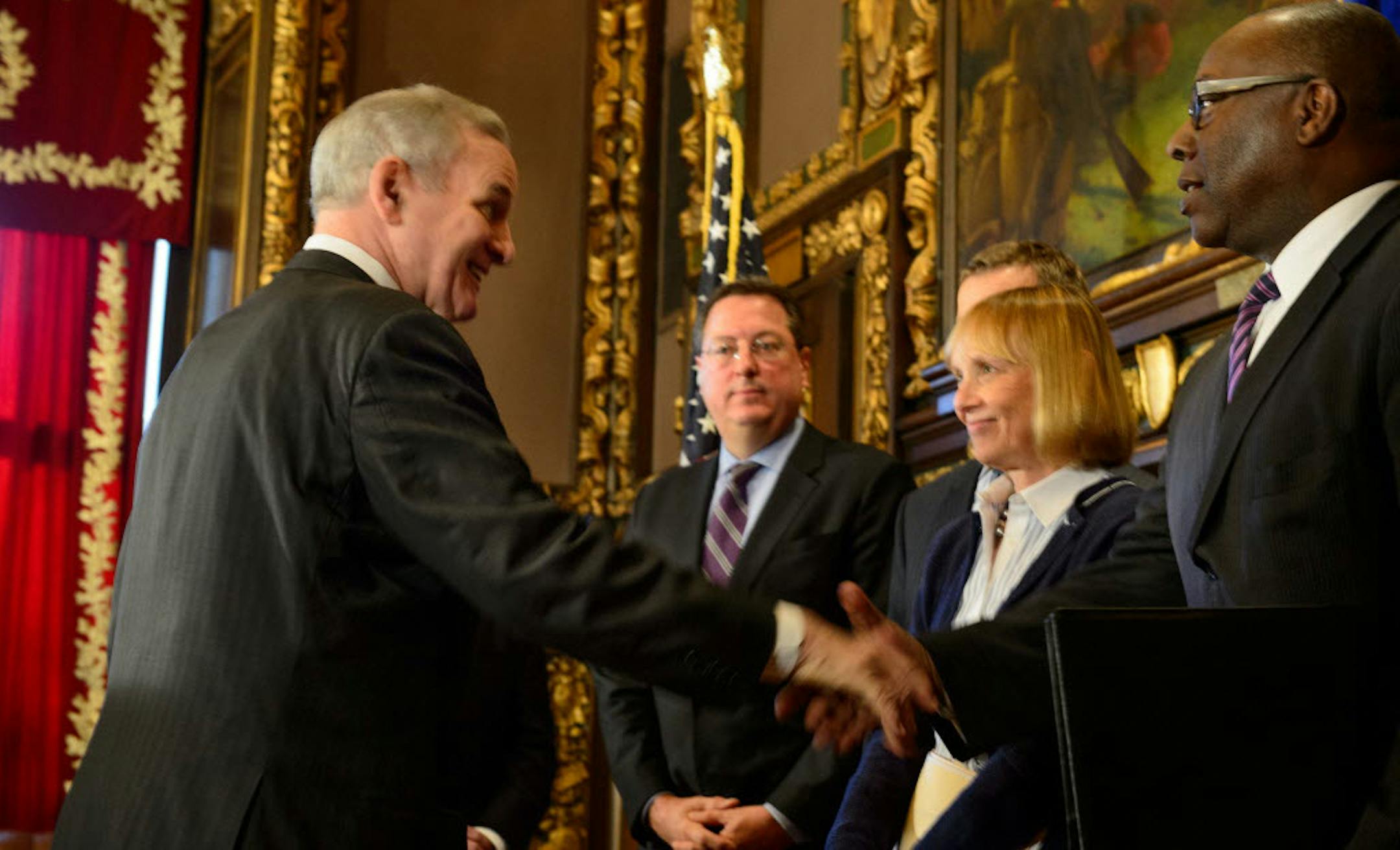
We've barely broken ground on that new football stadium across the street from where I write, and already we're starting to see the benefits, just like they promised.
Super Bowl, home boy, cash money, to paraphrase Vikings great Randy Moss.
Gov. Mark Dayton and a collection of the area's top business leaders held a news conference Monday to reveal that if we get that stadium built on time, and the NFL has not been sued out of existence by then, we might just (wink, wink) be a contender to host the big game by 2018.
You know what that means.
Sure, it means third-rate rock bands playing "The Yard" and guys in face paint vomiting behind the berms at the federal courthouse. But it also means a half-billion-dollar boost to the local economy, if you believe the NFL and its boosters.
And if you believe the NFL and boosters, you may have recently taken a helmet-to-helmet blow to your brain, economists say.
"Strangely, whenever you start asking people for the actual economic report, you get missing-study syndrome," said Victor Matheson, an economics professor at College of the Holy Cross who has studied the financial trickledown of big events.
"When economists not related to the NFL actually look back at the data, including Minneapolis in 1992, the impact of a Super Bowl is much smaller," between $30 and $120 million, Matheson said. "You shouldn't turn that down," he added. "You've already decided to build the stadium, but you can't use the number $500 million to justify the $500 million you just spent on a stadium."


