

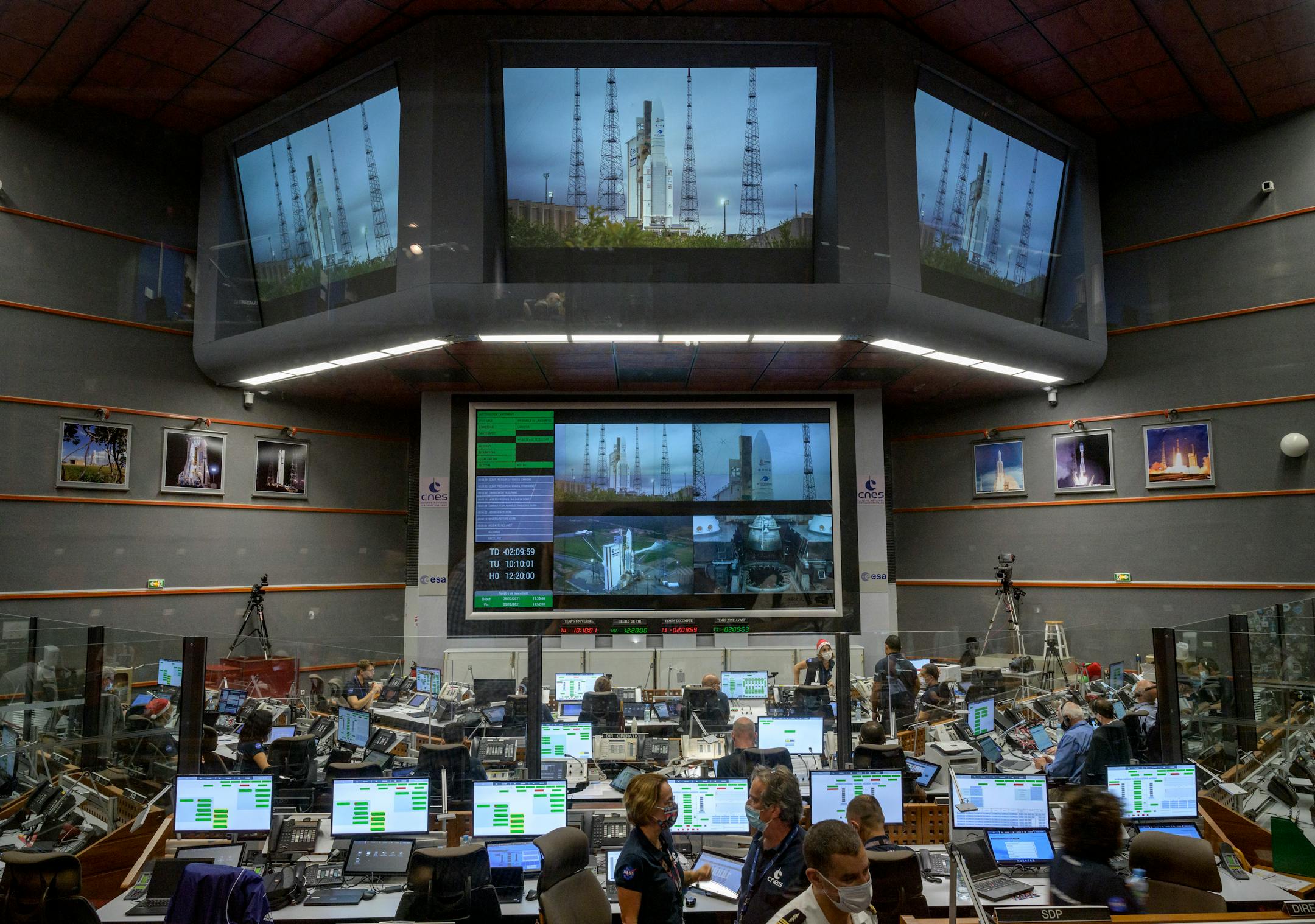
Like many other packages delivered on Dec. 25, a new telescope arrived in space Saturday with some assembly required.
The gradual unfolding of the James Webb Space Telescope, currently en route to its station 930,000 miles from Earth, is high drama. The long years of development, complete with the invention of several new technologies and the investment of billions of dollars, now depend for their success on many things going right.
With hundreds of things that could go wrong on its 29-day journey, Webb — which is named after the man who led NASA from 1961 to 1968 — represents a gamble of appropriately astronomical proportions.
But the potential payoff is cosmically huge as well.
"This telescope will be able to see back in time significantly farther than other telescopes can," said James Flaten, associate director of NASA's Minnesota Space Grant Consortium. "Being so much bigger than anything else that's available, it will be able to see things that are significantly fainter, and hence things that are significantly farther away. Which basically means significantly older."
In conversation with an editorial writer, Flaten pointed out that Webb's light-gathering mirror, at 6.5 meters across, is significantly larger than that of the Hubble Space Telescope, which measures just 2.4 meters. But Webb has another advantage: its ability to see infrared light. That will allow it to peer through the veil of dust that obscures some regions of space.
"A whole bunch of stuff that we currently can't see well at all will become visible," he said. "And considering how large it is, it can see significantly fainter things, and hence it can see things that are older. The reason being that the older something is, the farther away it is and the fainter it is."
A NASA tracking tool shows the projected timetable for various benchmarks in the telescope's mission. By now, Webb has cleared the moon's orbit and will soon deploy its multilayered sunscreen and unfold the gold-coated mirror. A specially designed cooling system will keep the observatory cold enough to pick up infrared light from distant targets.


