

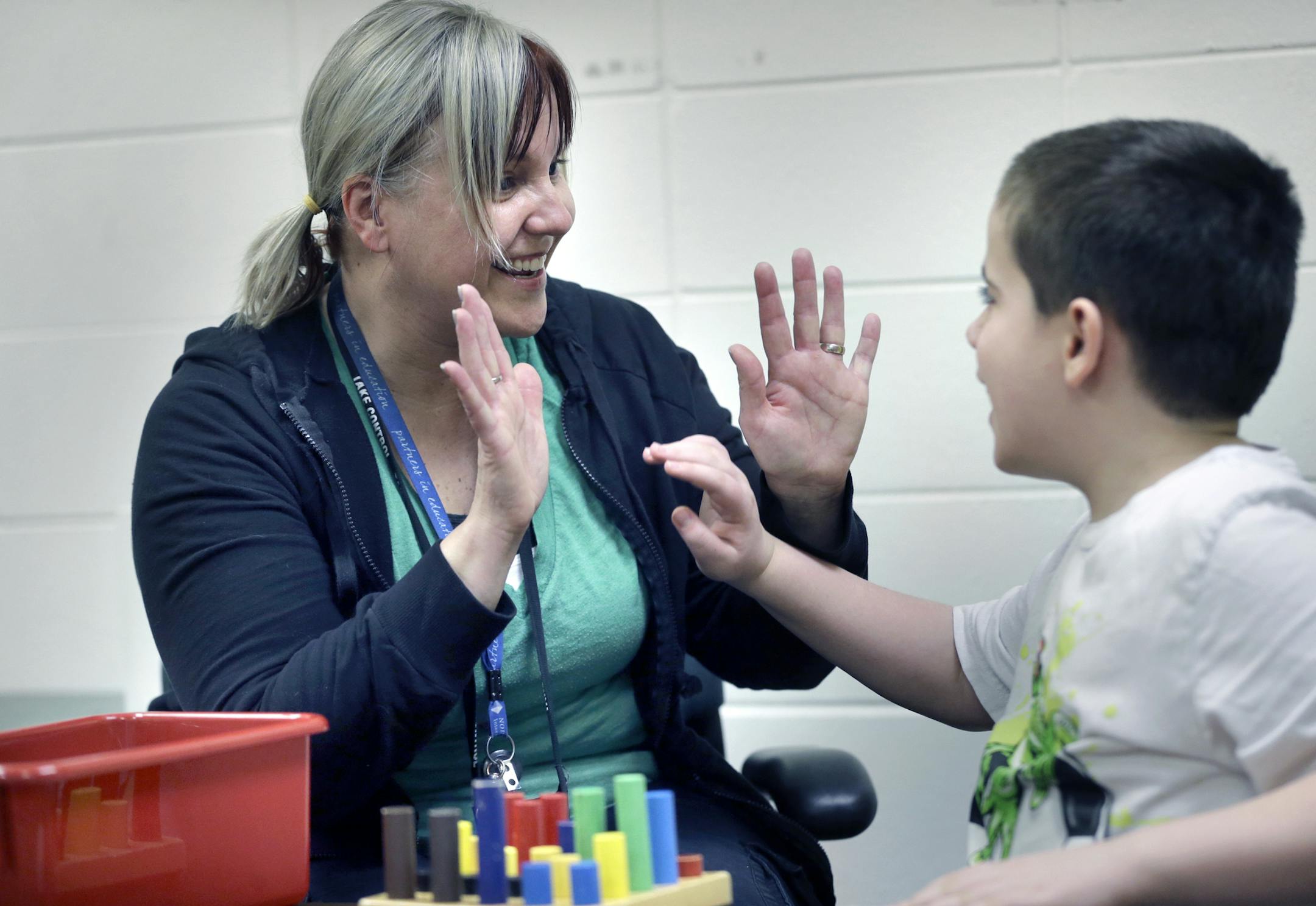
Heather Cronin Ott sits on the gym floor, hands locked with the fourth-grade boy's as she helps him learn sit-ups. You can't spot the bruises, scratches and bite marks that line her arms.
"It's an occupational hazard," said Cronin Ott, 42. She works with autistic children and helps provide learning tools for other teachers in a specialized, 26-student program for children in grades K-5 who have difficulty fitting into traditional school programs.
"These are great kids — a whole range of personalities, learning abilities, physical issues," she said. "But sometimes, the only way they know to communicate — to say, I'm scared or I hurt or leave me alone — is to hit, bite, spit or yell."
Learning new ways to communicate is the primary reason they attend the Communication and Interactional Disorders Program, housed in a wing of Otter Lake Elementary School in White Bear Lake. It is a service of Special School District 916, which serves 10 northeastern Twin Cities suburban districts. She learned American Sign Language to better communicate with some children whose disability makes speaking difficult.
Cronin Ott's class is called gym, but a lot more goes on here than mere physical exercise during her daily half-hour sessions in each of the school's six-student classes, where children are grouped more by ability than age.
"This is why I'm so drawn to these kids," she said. "I can really make a difference in a child's life. Working with parents, other teachers and other specialists, I can help a child begin to make sense of the world, to achieve some success, to feel good."
In her class, they learn to actually hear instructions so they can be followed, to adjust energy from an exhilarating run to the stillness of yoga, to describe what they're feeling and ask for what they need.
"It's so easy to stereotype kids with autism or other learning disabilities, try to fit them into the same box," said Cronin Ott, who was drawn to special education after working at a group home for adults with developmental disabilities.


