

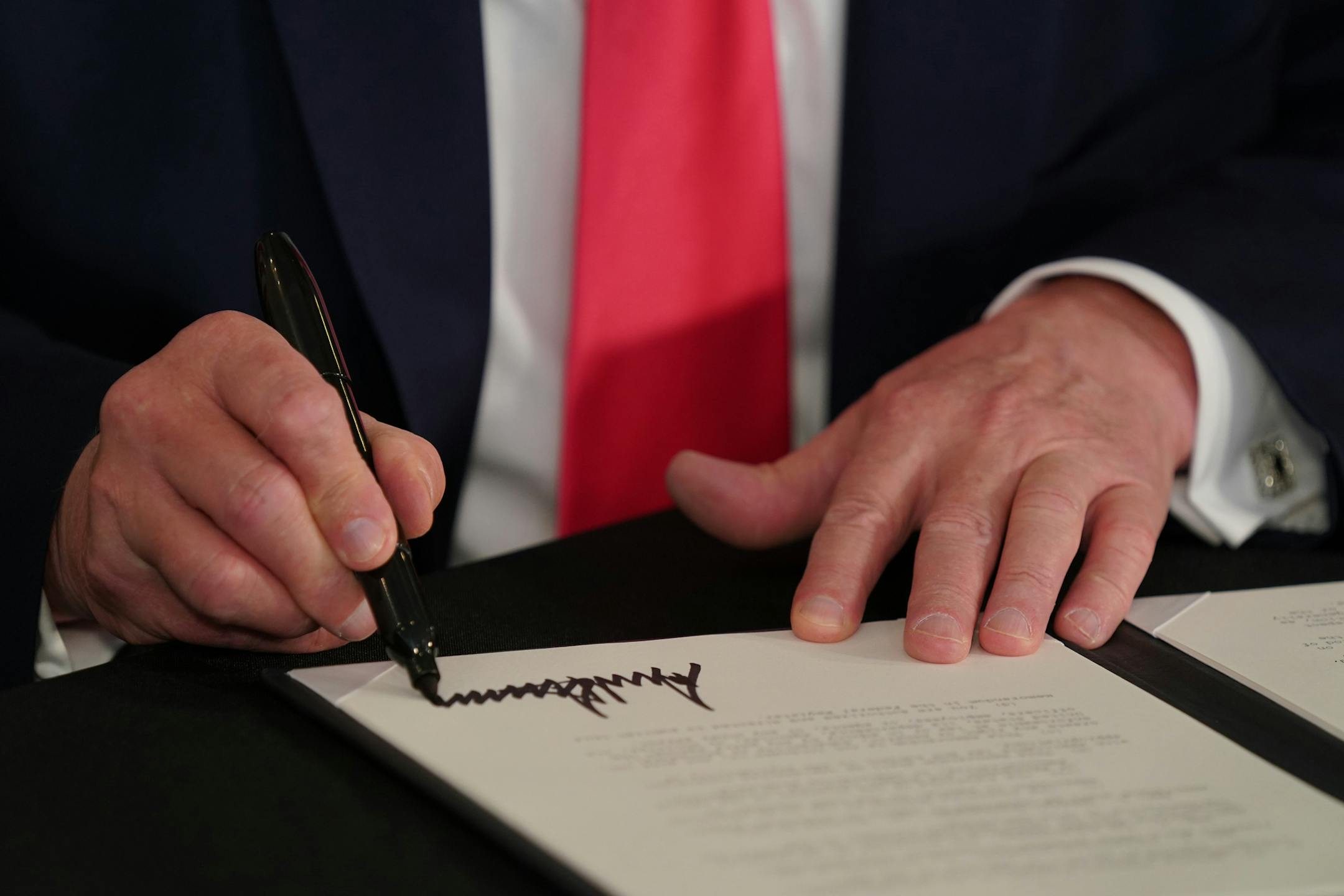
It's an exhausting pattern, but the lack of clarity and competence from this White House seems to complicate every critical situation. This time, mass confusion reigns again because President Donald Trump issued a flurry of executive orders and memorandums over the weekend that purports to end congressional gridlock with his own coronavirus aid package.
Trump said he would provide a payroll tax "holiday" to workers; extend heightened unemployment benefits, this time at $400 per week; extend eviction protections and further delay student loan payments and waive interest.
But it pays to read the fine print with this president. First, it is unclear whether Trump has the legal authority to essentially appropriate funds, a clearly defined constitutional role of Congress. And on the orders themselves, there is less than meets the eye.
The payroll tax action would only defer the employee portion of that tax. That money would still be owed, and unless Congress took subsequent action, could stick Americans with an unpleasant balloon payment in the future. Trump, who has outlined few clear second-term goals, did say that if re-elected he wants to "terminate" the payroll tax, essentially defunding Social Security and Medicare.
There's also a catch with the enhanced unemployment benefits. States would have to come up with $100 of the $400, a tall order when most are facing deficits. Minnesota has a $2.4 billion deficit projected for this budget period and a $4.7 billion deficit in the next two-year budget.
The eviction protection, on closer examination, is little more than a vague directive to federal housing officials to look for ways to avoid eviction.
There are other problems. To fund his extended unemployment benefits, Trump would raid the federal disaster relief fund, shifting $44 billion to pay for barely five weeks of benefits just as the nation enters hurricane season. Already parts of the Midwest have been devastated by a powerful storm with damage spanning several states.
What's curious is that Trump, who once styled himself a master dealmaker, most often favors not negotiating but unilateral action. Worse, there is a seat-of-the-pants quality to these proposals that leaves other people to scramble on how to make it all work or quietly ignore them.


