

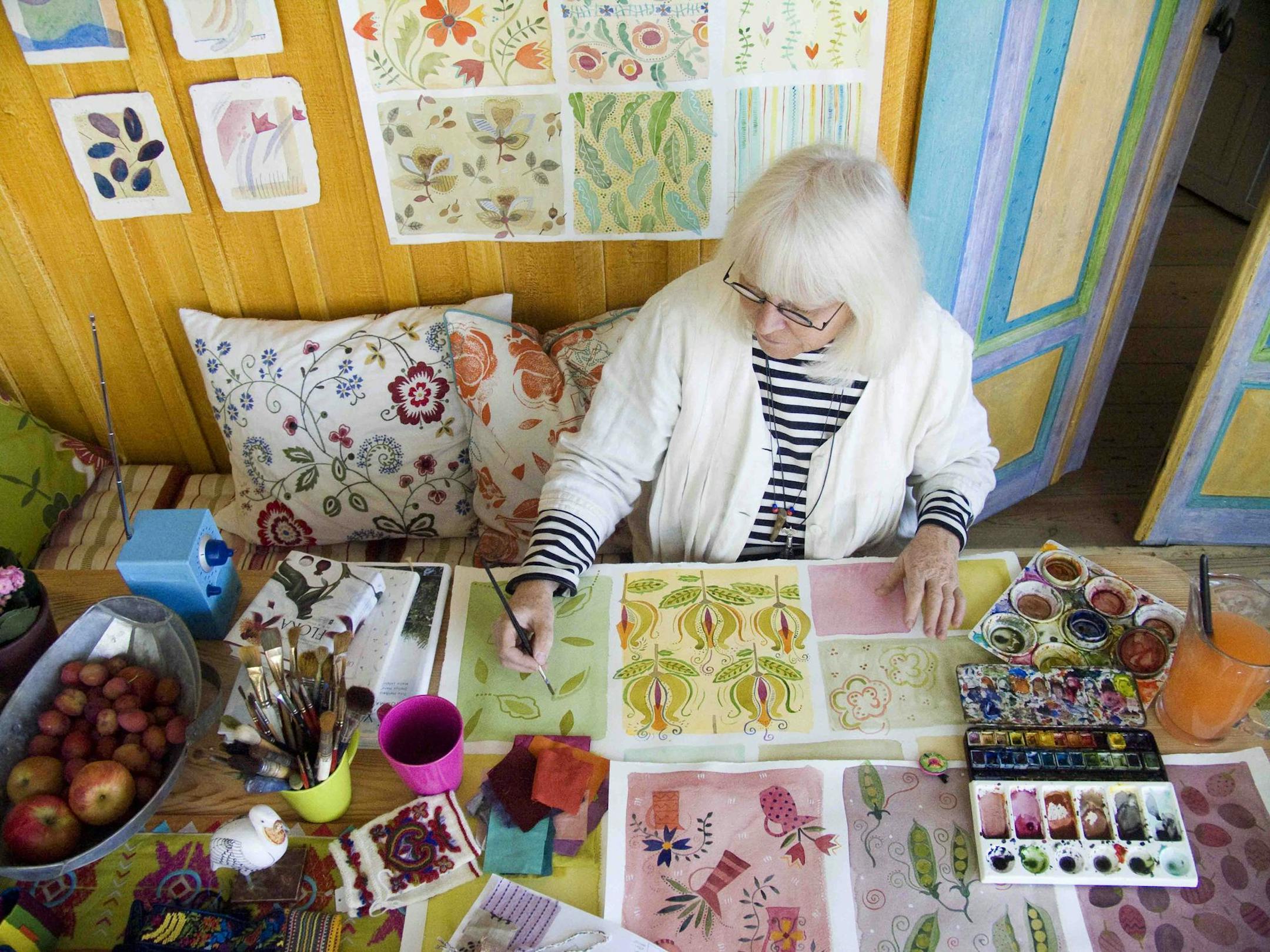
It's been 40 years since Gudrun Sjödén opened her small Stockholm shop, a destination for women's clothing with bright colors, botanical patterns and geometric shapes. That small business slowly became a global fashion empire, reaching customers in 70 countries.
And now the Swedish designer can add another accomplishment to her list: She's opening her first museum exhibit stateside, courtesy of the American Swedish Institute (ASI) in Minneapolis. "The Swedish Institute contacted me and asked if I was interested in doing an exhibition," Sjödén said by phone from Sweden last week. "I said, 'Yes, of course. Let's do this.' "
Sjödén recently staged an exhibition in her native Sweden. So "we knew a bit about how to make it happen," she said. "And nowadays we have a lot of customers in the United States, so I thought people would appreciate seeing the exhibition."
The installation kicks off Thursday night with ASI's First Look party and fashion show, and continues through Oct. 28. Gallery-goers can expect to see designs from Sjödén's previous collections and textiles created with her watercolor art, plus a pop-up shop featuring clothes from her Fall 2018 collection.
Who is Gudrun Sjödén?
Sjödén finds herself curious about the Swedish community in Minnesota, adding further appeal to her collaboration with ASI. "I learned that there are people [in Minnesota] who learn Swedish even though they've never been to Sweden," she said. "That is so interesting."
Another fascination is the hardships faced by the Midwest's first Swedes: no railroads, no roads, growing all their own food. "It was not easy at all to find a way to survive."
Sjödén can relate to the plight of living off the land. She was born in 1941 on a farm near a small Swedish mill town. When her father was drafted into World War II, the family lived in a pavilion with no electricity or water. She passed the days racking hay and fetching firewood. She sees the experience as a positive, though, ultimately shaping her vision as an entrepreneur.
Her childhood also involved knitting and weaving, and her art school training focused on freehand drawing and painting. Along with the bright colors of the '60s, these early influences left a permanent imprint on her style. While other textile artists of the time were consumed with political agitation and cultural disruption — the designs of Mah Jong are a notable example — Sjödén remained true to her folklore- and nature-inspired art, creating clothes in the style of Marimekko but with an aggressively feminine twist.

