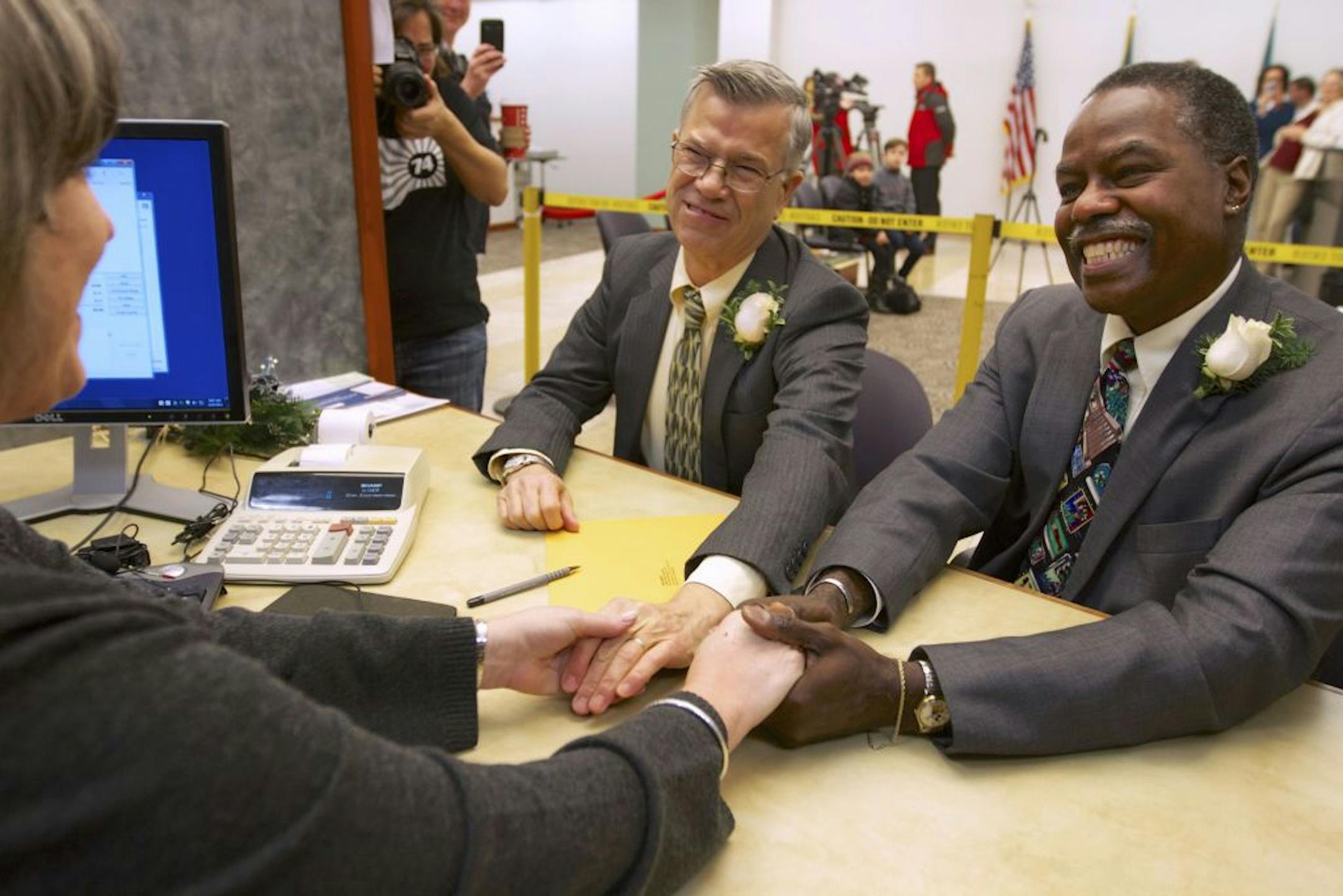
WASHINGTON - The Supreme Court announced Friday that it would enter the national debate over same-sex marriage for the first time, agreeing to hear a pair of cases challenging state and federal laws that define marriage to include only unions of a man and a woman.
One of the cases, from California, could establish or reject a constitutional right to same-sex marriage. Another case, from New York, challenges a federal law that requires the federal government to deny benefits to same-sex couples married in states that allow such unions.
The court's move comes against the backdrop of a rapid shift in public attitudes about same-sex marriage, with recent polls indicating that a majority of Americans support allowing such unions. After last month's elections, the number of states authorizing same-sex marriage increased by half, to nine.
The court's docket is now crowded with cases about the meaning of equality, with the new cases joining ones on affirmative action in higher education and the future of the Voting Rights Act of 1965. Decisions in all of those cases are expected by June.
The new California case was filed in 2009 by Theodore B. Olson and David Boies, two lawyers who were on opposite sides in the Supreme Court's decision in Bush vs. Gore, which settled the 2000 presidential election. The suit argued that California's voters had violated the federal Constitution the previous year when they overrode a decision of the state's Supreme Court allowing same-sex marriages.
A federal judge in San Francisco agreed, issuing a broad decision that said the Constitution required the state to allow same-sex couples to marry. The decision has been stayed.
A divided panel of the 9th U.S. Circuit Court of Appeals affirmed the decision. But the majority relied on narrower grounds that seemed calculated to avoid Supreme Court review or, at least, attract the vote of the court's presumed swing member, Justice Anthony Kennedy.
Judge Stephen Reinhardt, writing for the majority, relied heavily on a 1996 majority opinion from Kennedy in a case which struck down a Colorado constitutional amendment that had banned the passage of laws protecting gay men and lesbians. The voter initiative in California, known as Proposition 8, had done something similar, Reinhardt wrote.