

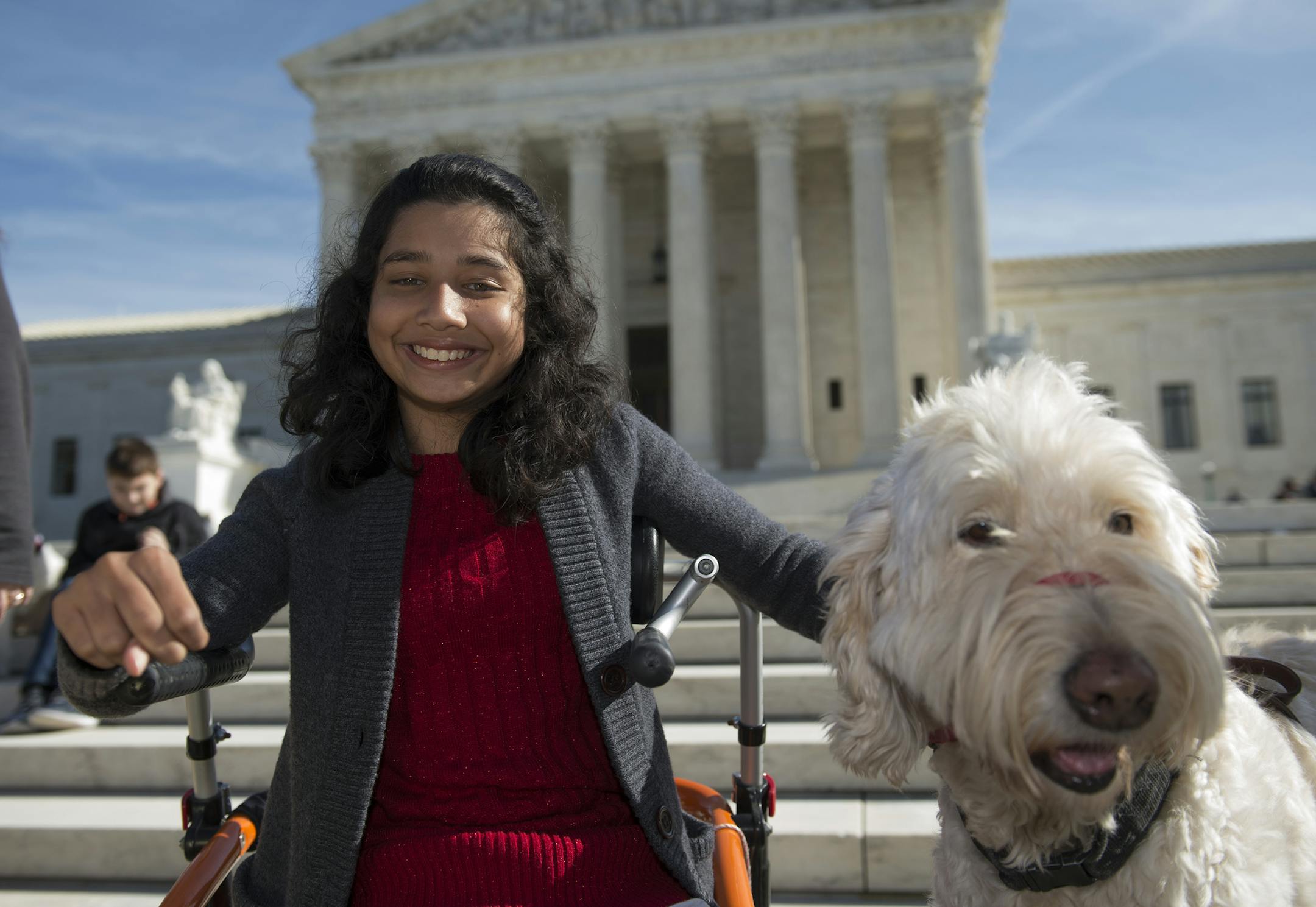
WASHINGTON – The U.S. Supreme Court on Wednesday unanimously ruled that the U.S. Sixth Circuit Court of Appeals should reconsider whether Ehlena Fry and her family can sue a Michigan school district for its decision years ago to tell Ehlena, who has cerebral palsy, that she couldn't bring her service dog to school.
In Fry v. Napoleon Community Schools, Ehlena's parents and their lawyers from the American Civil Liberties Union argued that they shouldn't be required to exhaust administrative remedies under the federal Individuals with Disabilities Education Act (IDEA) before suing under a law involving access to public institutions, as the school district argued.
The eight-member court largely agreed — not deciding whether the Frys had fully proved their argument, but sending it back to the lower court with instructions on a two-pronged standard that could help decide such cases in the future.
Justice Elena Kagan wrote that exhaustion of the administrative procedures is unnecessary in cases where the larger point of a suit is about "something other than the denial" of that statute's guarantee of a free and appropriate public education for students with disabilities.
The Frys brought the case against the Napoleon Community Schools and the Jackson County Intermediate School District in 2012, saying that when Ehlena was 5 — she was 12 when the case was argued last year — the staff at Ezra Eby Elementary balked at her bringing her dog Wonder to school to help her retrieve dropped items, open and close doors and perform other tasks, saying that a human aide could help.
But Ehlena's pediatrician had prescribed Wonder to be with Ehlena at all times to help them solidify a working bond. Eventually, the Frys moved Ehlena to a new school where Wonder was welcomed. The school district argued that the Frys could have sorted out the situation by using the process under the IDEA law instead of suing for damages under the Americans with Disabilities Act.
The Supreme Court instructed the Sixth Circuit to determine whether the same claims could be raised "if the conduct had occurred in a public facility which was not a school" and whether an adult with disabilities who was not a student could have "pressed the same grievance."


