

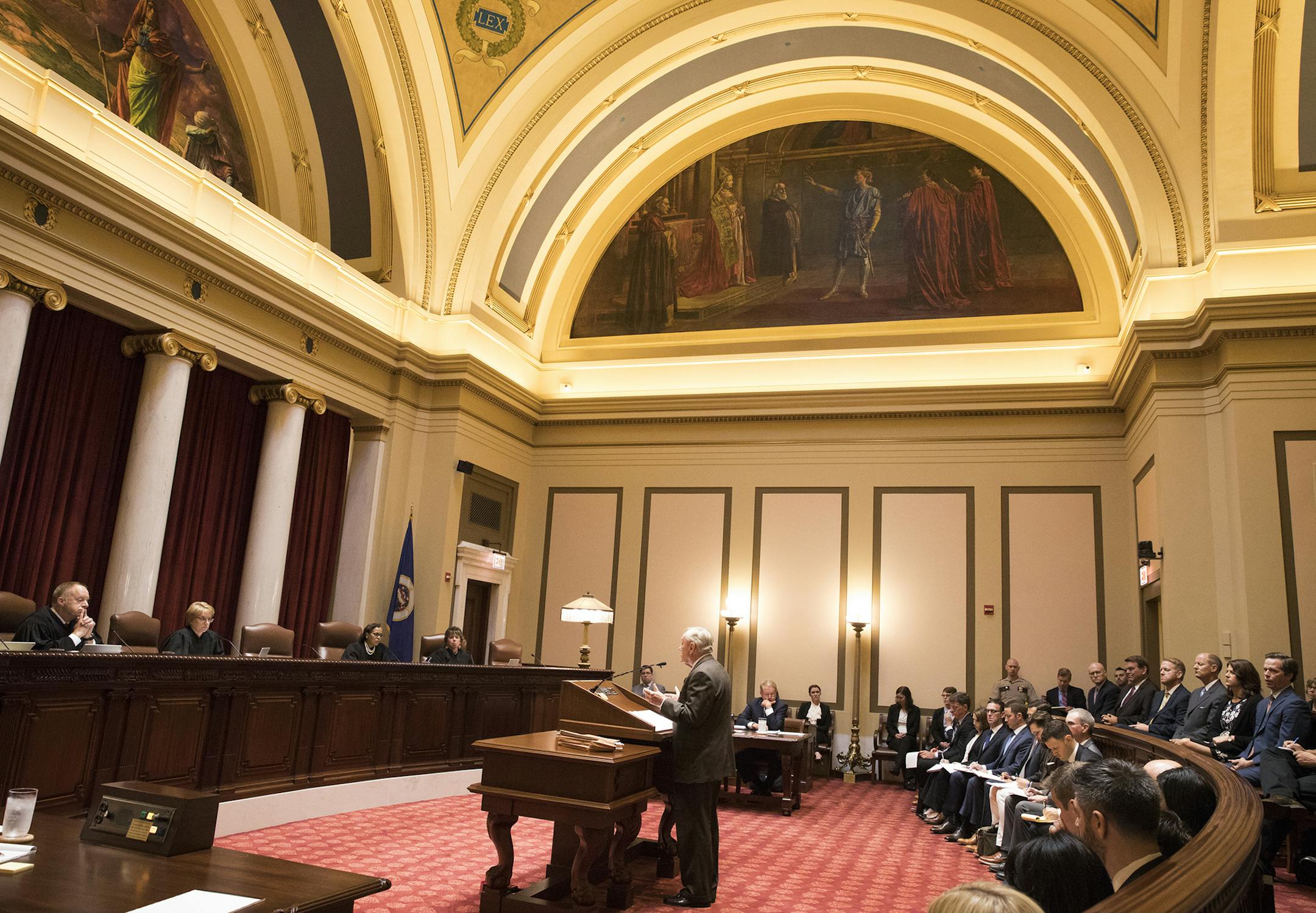
Resolve your dispute yourselves. That in essence is what the Minnesota Supreme Court told DFL Gov. Mark Dayton and the GOP-controlled Legislature on Thursday, citing the principle of judicial restraint as it "decline(d) to decide" whether Dayton's May 30 veto of the House and Senate's 2018-19 operating budget violated the state Constitution.
That 5-1 ruling is a disappointment to those — including this Editorial Board — who hoped the courts would definitively rule that one branch of state government cannot threaten the functioning of another. That's what Dayton's line-item veto does, albeit to a degree that is a matter of dispute. Chief Justice Lorie Skjerven Gildea, writing for the majority, concluded that "the Legislature has funding to sustain it until it reconvenes in regular session" on Feb. 20.
It does, but barely, courtesy of the Legislative Coordinating Commission, which coincidentally was meeting when the high court's opinion was issued. The commission authorized release of up to $20.8 million in its funds, enough to continue minimal operations until early February. But back-office functions critical to the run-up to the 2018 session are already disrupted. More undesirable consequences will unfold if the impasse continues. That's why Dayton should see the court's order not as a victory, but as a summons to action. A negotiated deal that includes the reversal of Dayton's veto remains the desirable outcome.
Dayton has good reason to take the lead in ending this fight. His ability to influence his final legislative session as governor is at stake. As Senate DFL Minority Leader Tom Bakk warned, "This will be the biggest do-nothing session we've ever seen" if no agreement is reached. Implicit in those words is a warning to the governor: He is at risk of a revolt by DFL legislators no longer willing to uphold this veto, and potentially others.
The governor should concede that while his veto got a pass from the court, it did not produce its desired result. It did not lead to a quick restart of negotiations over several disputed items in bills Dayton had just signed into law. Dayton should now offer to undo the veto in exchange for assurances that the 2018 session will be a "regular" one. Among his goals should be a bonding bill of at least $1 billion; approval of pay increases for state employees; and funding for stepped-up efforts to combat opioid abuse, improve cybersecurity and protect people living in senior facilities from abuse.
Dayton can still press for the changes he originally sought in the normal course of the 2018 session. But first he needs to ensure that the session will operate normally. The high court's decision leaves that in unsettling doubt.
![After The Minnesota Supreme Court upheld Gov. Mark Daytonís veto of the budget of the state House and Senate and the Legislative Coordinating Commission meeting ended, Rep. Joyce Peppin, Minnesota House, left to right, Speaker Kurt Daudt, chair of Legislative Coordinating Commission and Senate Majority Leader Paul Gazelka, talked to media members Thursday, Nov. 16, 2017, at the State Office in St. Paul, MN.]
DAVID JOLES ï david.joles@startribune.com A decision is expected from the Minn](https://arc.stimg.co/startribunemedia/GCF65JYV6T6IPMBUW552PO6DEE.jpg?&w=1080)


