

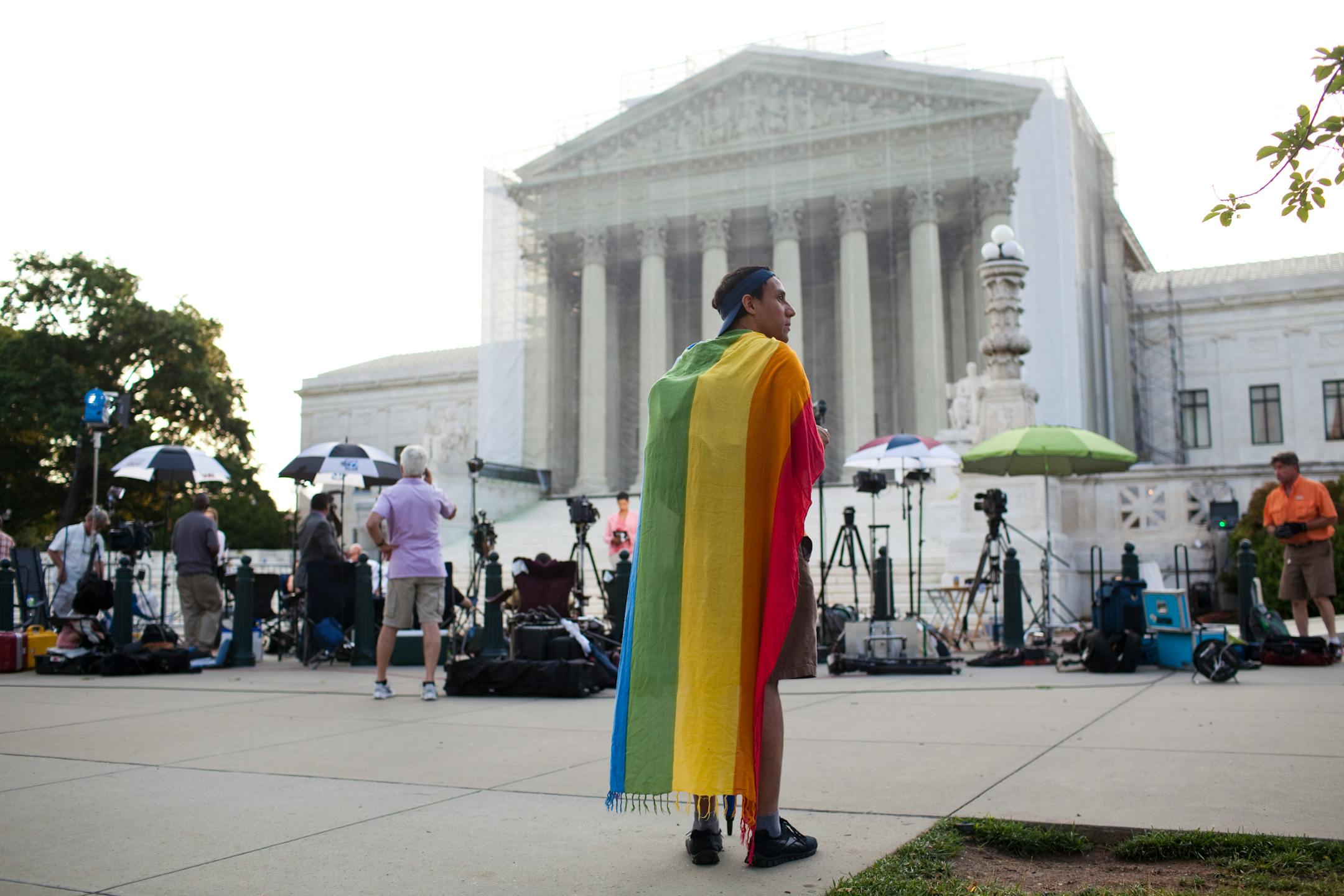
"All deliberate speed" — that was the gradualist coda the U.S. Supreme Court added in 1955 to its second Brown v. Board of Education ruling after it ended school segregation. In striking down the Defense of Marriage Act without establishing a general constitutional right for gay people to marry, the court did the same thing for same-sex marriage that it once did for segregation: declared a principle without putting it fully into practice.
In Brown, the court's goal of making desegregation palatable failed when Southern whites mounted widespread resistance. Whether the same strategy will work better this time remains to be seen, but it certainly sets the stage for many legal and political battles over gay marriage in the years ahead.
The big principles Justice Anthony Kennedy declared in his U.S. v. Windsor opinion (which was joined by the four Democratic-appointed justices) lived up to the standard he set in the landmark gay-rights cases of Romer v. Evans and Lawrence v. Texas. In short, Kennedy wrote, DOMA was an affront "the equal dignity of same-sex marriages."
DOMA was unconstitutional because it was intended to "disparage and to injure those whom the State, by its marriage laws, sought to protect in personhood and dignity."
Constitutional Touchstones
The idea that every human has a basic right to dignity and personhood doesn't appear in the text of the Constitution, either in the equal protection clause (which by its language applies only to the states, not the federal government) or in the due process clause of the Fifth Amendment, which does apply to the federal government and has been taken to incorporate equal protection. Through Kennedy's opinions on reproduction, sex and now marriage, however, dignity and personhood have become undeniable constitutional touchstones.
This is Kennedy's legacy. The Windsor decision will join Casey v. Planned Parenthood, which upheld Roe v. Wade, and Lawrence v. Texas, which protected gay sex, in the pantheon of grand declarations on the meaning of liberty. (Although all these opinions go against current Catholic moral teaching, careful readers of the future will note that Kennedy's ideals of dignity and personhood resonate strongly with the language of his church's moral theology since Vatican II.)
Beyond the abstractions, things get complicated quickly. The DOMA decision means that gay couples married in states that recognize their union will get full federal benefits. But what will happen to same-sex marriages in states that don't recognize them? And, if same-sex marriages are now entitled to "equal dignity" under the Constitution, can some states continue to deny people of the same sex to wed?


