

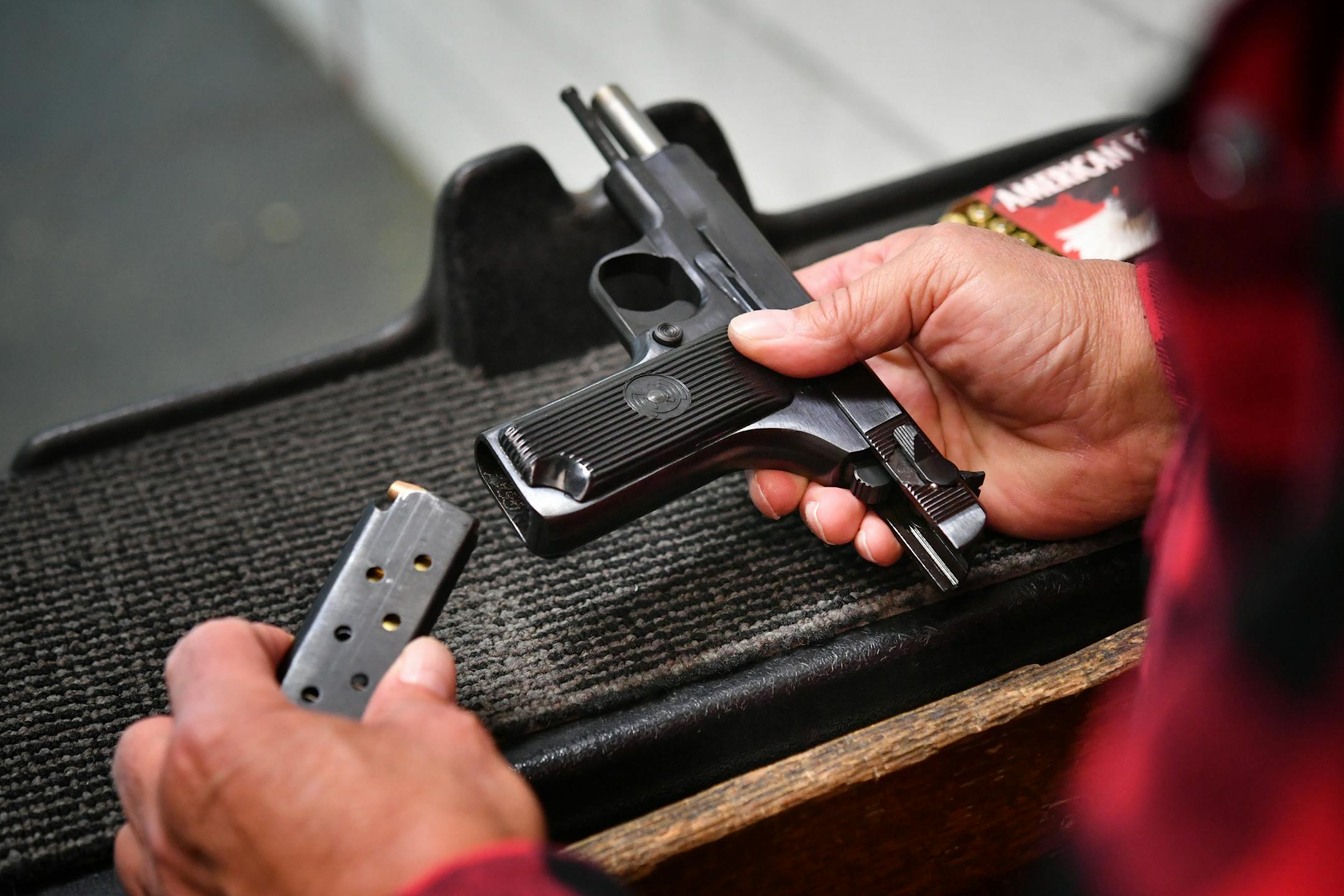
For years, cities across the country have limited who may carry a gun in public. The Supreme Court will soon decide whether these limits violate the Second Amendment. The effect could be staggering — the difference between a few hundred guns and hundreds of thousands of guns on the streets of Los Angeles, New York City or Washington.
With stakes so high, commentators have naturally speculated about the outcome. Given the court's conservative supermajority, many expect the court to dramatically expand the right to carry firearms in public.
Quietly, however — in a rare action taken through the court's docketing procedures — some of the court's conservative justices may have tipped their hand. What they've revealed is a fact-sensitive approach to the case that should give gun safety proponents reason for cautious optimism.
Start with a bit of Supreme Court 101. When a party that has lost in a lower court wishes to obtain the Supreme Court's review, it files a petition for a "writ of certiorari." The most important page of this petition is the first one, which sets forth the question presented by the case. As the court's own rules explain, "Only the questions set out in the petition, or fairly included therein, will be considered by the Court." The "question presented" thus dictates the scope of the court's analysis.
It takes four justices to vote in favor of granting a "cert" petition. And in nearly every granted case, the justices vote to accept, verbatim, the question presented in the petition. (Occasionally the justices will limit their review to one of multiple questions in a petition, or add a threshold question to clarify the court's power to hear the case. )
In the cases the court initially decided to hear this term, the justices accepted the exact wording of a question presented in all the cert petitions — all, that is, except the landmark gun rights case, New York State Rifle & Pistol Association vs. Bruen. In this case, they took the significant step of rewriting the question presented, and thus changed the trajectory of the case.
Rewriting a question may seem trivial. It is not. Last term, out of 58 cases, the Supreme Court rewrote the question presented in just one. Tellingly, the justices then decided that case entirely on the basis of the revised question, holding that an earlier decision by the court does not apply retroactively. The same was true in the year I clerked at the court: The justices rewrote just one question and proceeded to decide that case precisely on the new grounds.
In this term's gun case, the revision seems equally crucial.


