

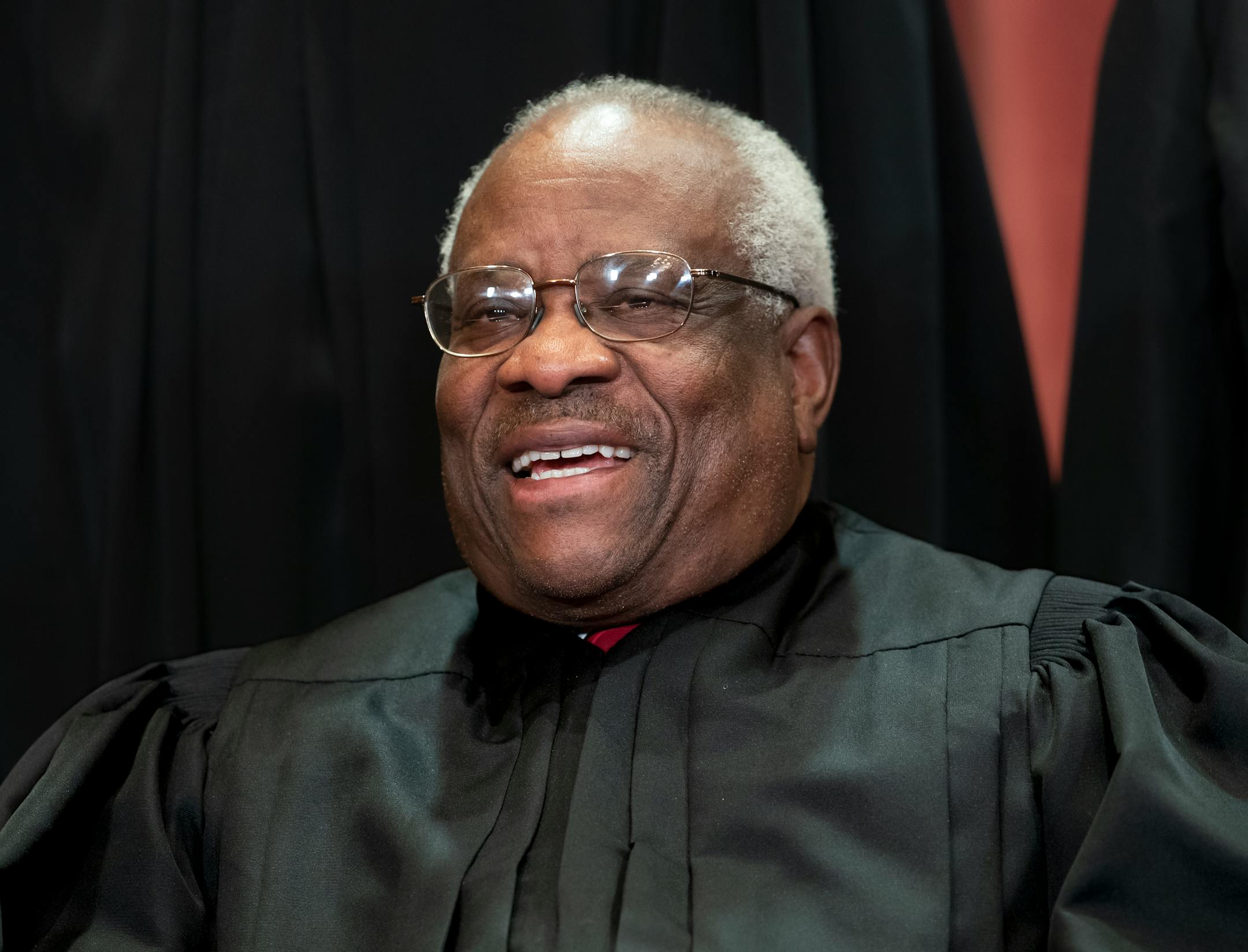
Earlier this month, a speech warning about the dangers of politicizing the U.S. Supreme Court was delivered in Utah by an authoritative, insider source, who cautioned that "[a]t some point the institution is going to be compromised." He voiced his growing concern that eventually we could "chip away at the respect of the institutions that the next generation is going to need if they're going to have civil society."
The next generation should be very, very afraid. The speaker was Justice Clarence Thomas, the longest-serving member of the High Court, and that his words were delivered inside a swank hotel to benefit a foundation run by a partisan Republican who'd played a key role in shifting the court rightward, former Sen. Orrin Hatch, was neither the biggest irony nor the most outrageous.
Less than two weeks later, D.C. journalists Bob Woodward — yes, the Watergate Bob Woodward! — and Robert Costa published a bombshell scoop about a lengthy series of politically explosive text messages that the justice's wife, Virginia, or Ginni, Thomas — well known in the capital as a right-wing activist — sent to Donald Trump's then-top aide, chief of staff Mark Meadows. The messages show that between President Joe Biden's November 2020 election victory and the Jan. 6, 2021, insurrection at the Capitol, Ginni Thomas was aggressively lobbying the White House to overturn the result — a battle that might well have ended up before her husband's Supreme Court.
On so many different levels, the Ginni Thomas-Meadows communications are deeply disturbing. The most immediate question is arguably the most specific one: Is Justice Thomas' integrity tainted by all of this?
There's no clear indication from the texts that Ginni Thomas took up her unsupported claims of election fraud with her husband; her one allusion to "my best friend" — the top Thomas watchers like the New Yorker's Jane Mayer say that's almost certainly Clarence — isn't overtly political. We do know, however, that Justice Thomas was the court's lone vote against turning over key Trump records to the House committee investigating Jan. 6 — a vote many experts in legal ethics find troubling, as do I and many regular folks.
Yet there's something else about the Ginni Thomas texts that people find distressing, even though it's arguably not illegal. That's the unhinged content of her writing. In one text, the wife of a sitting Supreme Court justice claimed that members of what she called "the Biden crime family" were en route to barges near the Guantanamo Bay prison camp awaiting military trials for sedition, an idea that circulated only in the online world of QAnon, not in any reality-based circles. Ginni Thomas also sent Meadows a link to a since-deleted YouTube video with false claims of election fraud from a QAnon-friendly right-wing conspiracy theorist who has previously referred to the 2012 mass murder of children in Newtown, Conn., as a "false flag" operation.
There was an endless stream of chatter on social media last weekend about the Ginni Thomas file, yet folks had a hard time pinning a name on the great angst they were feeling. I'll take a stab at it. The majority of Americans — the people who gave more votes to Hillary Clinton in 2016 and even more to Biden in 2020 and put the Democrats back in nominal control of Congress — are still, despite those victories, watching the car careen off the cliff, and we are unable to find the brakes. There seems to be no way or no will to hold our staggeringly corrupt leaders accountable — whether it's Trump defrauding the banks or plotting an attempted coup from the Oval Office, or a Supreme Court justice ruling on his wife's bat-guano crazy political crusade. And there's seemingly no way to stop the crazy, like QAnon, from getting crazier. I'm in a total funk over the state of the union, and when I wrote that on Twitter hundreds of people agreed with me.
But the growing illegitimacy of the Supreme Court, in particular, feels like the downward slide of U.S. democracy is crossing the Rubicon. Like the greater American experiment, the high court has been deeply flawed at times — Dred Scott and Plessy v. Ferguson leap to mind — yet there was much residual good will from the expanded civil rights and generally (though not always) more bipartisan confirmation hearings of the mid-20th century. The Supreme Court has long held greater public trust than comparable institutions like Congress — but its numbers are plummeting. The court's September 2021 Gallup Poll approval rating of 40% is an all-time low.


