

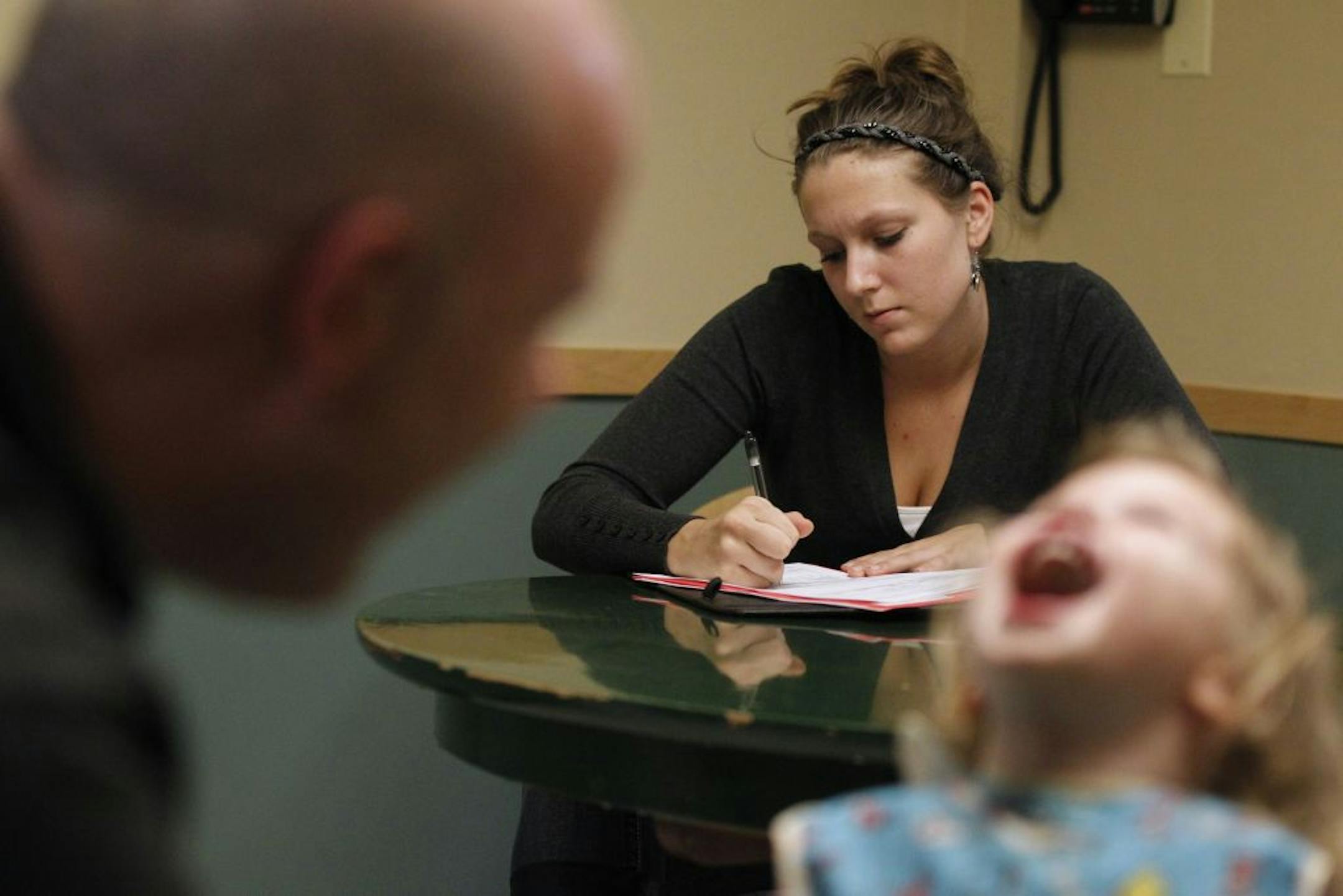
Every Thursday night, John drives to a St. Louis Park program that allows him to visit -- with constant one-on-one supervision -- his young daughter. The surveillance is ordered by the courts.
John parks his car on the left side of the building and heads to a "parenting room." A half hour later, the child's mother parks on the opposite side of the building and drops off her daughter. Mother and father never meet. Security systems watch for trouble. And the child gets to see a parent she is attached to, regardless of circumstances.
Each year, thousands of children across Minnesota participate in such "supervised visitations," a critical and sometimes controversial component in child protection and domestic violence cases. As counties press for family reunification for children in foster care, the visits play a critical role in a child's transition back home. They're also essential for women fleeing abusive relationships, whose ex-partners and husbands nonetheless have rights to visit their kids.
But there are no state standards for supervision or security for the nonprofits and individuals who oversee the visits. There's no required licensing or training, and each county handles things differently. While many rely on the special child visitation programs run by nonprofits, others enlist foster parents, family relatives or case aides who may oversee visits at city parks, libraries or even McDonald's.
Supervised visitation blasted into the public spotlight last month after a Washington man blew up his house during what was supposed to be a supervised session with his sons. "That story about the father who blew up his house led a lot of people to wonder about supervised visitation," said Linda Domholt, a vice president at Perspectives, the family services nonprofit that John goes to each week.
"There's a lot of need but not a lot of funding for this," she said. "It's time to shed some light on it."
Lynn Lewis, human services manager for Hennepin County, said the service is critical.
"The cases that we see going to court, and getting supervised visitation, are some of the toughest," she said. "It can be a convergence of issues: drug abuse, domestic violence, poverty, untreated mental illness. You put a combination of any of those together and it could be toxic for a child."


