

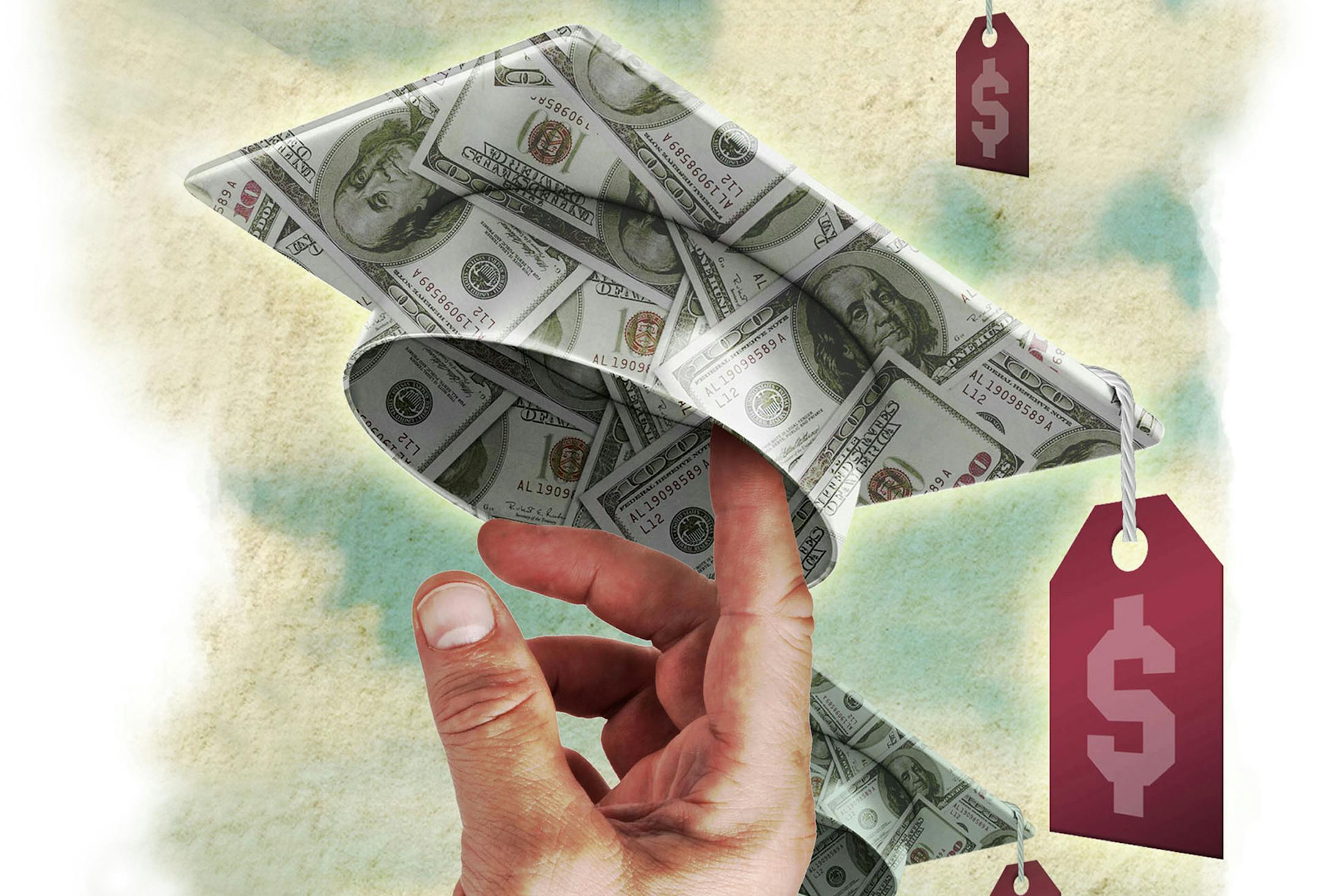
Student loan debt is penetrating political consciousness more deeply this campaign season than any in memory — and to that, we'd add that it's about time.
Americans' outstanding student loan debt hit $1.2 trillion in May, according to the Consumer Financial Protection Bureau. It outstripped total consumer credit card debt a few years ago; today student loans are second only to home mortgages in total U.S. consumer debt burden.
About that mortgage connection: John Burns Consulting, a homebuilders' adviser, said this month that student loan debt is responsible for an $83 billion drag on home buying this year. That's 414,000 homes that won't be sold because 5.9 million Americans under age 40 — triple the number since 2005 — spend $250 or more per month on college loan debt service.
It's about time that politicians — and other Americans — recognize that a debt load that heavy does not burden recent college grads alone. The whole economy is affected when the purchasing power of that many aspiring young adults is pinched. That consequence should have been discussed more widely as governments in Washington, St. Paul and other state capitols squeezed higher ed funding in the past decade.
To their credit, Minnesota candidates for state and federal offices are talking now about high student loan debt as a problem government helped create, and that government ought to help remedy. For example, Democratic U.S. Sen. Al Franken is promoting a good bill that he co-sponsored this year to reduce the interest rate on federally guaranteed student loans to 3.86 percent from the current 4.6 percent, and to allow existing loans to be refinanced at that lower rate. The bill, which was financed by putting a floor under the income tax rate paid by the nation's top earners, attracted 56 votes in the U.S. Senate in June, four short of the number needed to break a GOP filibuster.
Franken's Republican opponent, Mike McFadden, said in July that he could support Franken's bill if it weren't financed with a tax increase. He pointed to sharply rising tuition as the chief student debt culprit at Tuesday's noontime Voterpalooza at the University of Minnesota, implying that colleges and universities can do more to clamp down higher ed costs.
That's undoubtedly true. But few enterprises could cope with the deep funding cuts the Legislature dealt the University of Minnesota and Minnesota State Colleges and Universities (MnSCU) during the past two recessions without raising prices. A MnSCU analysis showed that state support per full-year-equivalent student dropped from an inflation-adjusted $4,766 per year in 2002 to $2,787 in 2012. It's projected to be up to $3,247 in 2015 — still lagging the 2002 level by one-third.
MnSCU also reports that among students at two-year colleges, average annual student borrowing is up nearly twice as much as tuition rose between 2006 and 2013. That suggests that there's more to rising student debt than tuition increases alone.


