

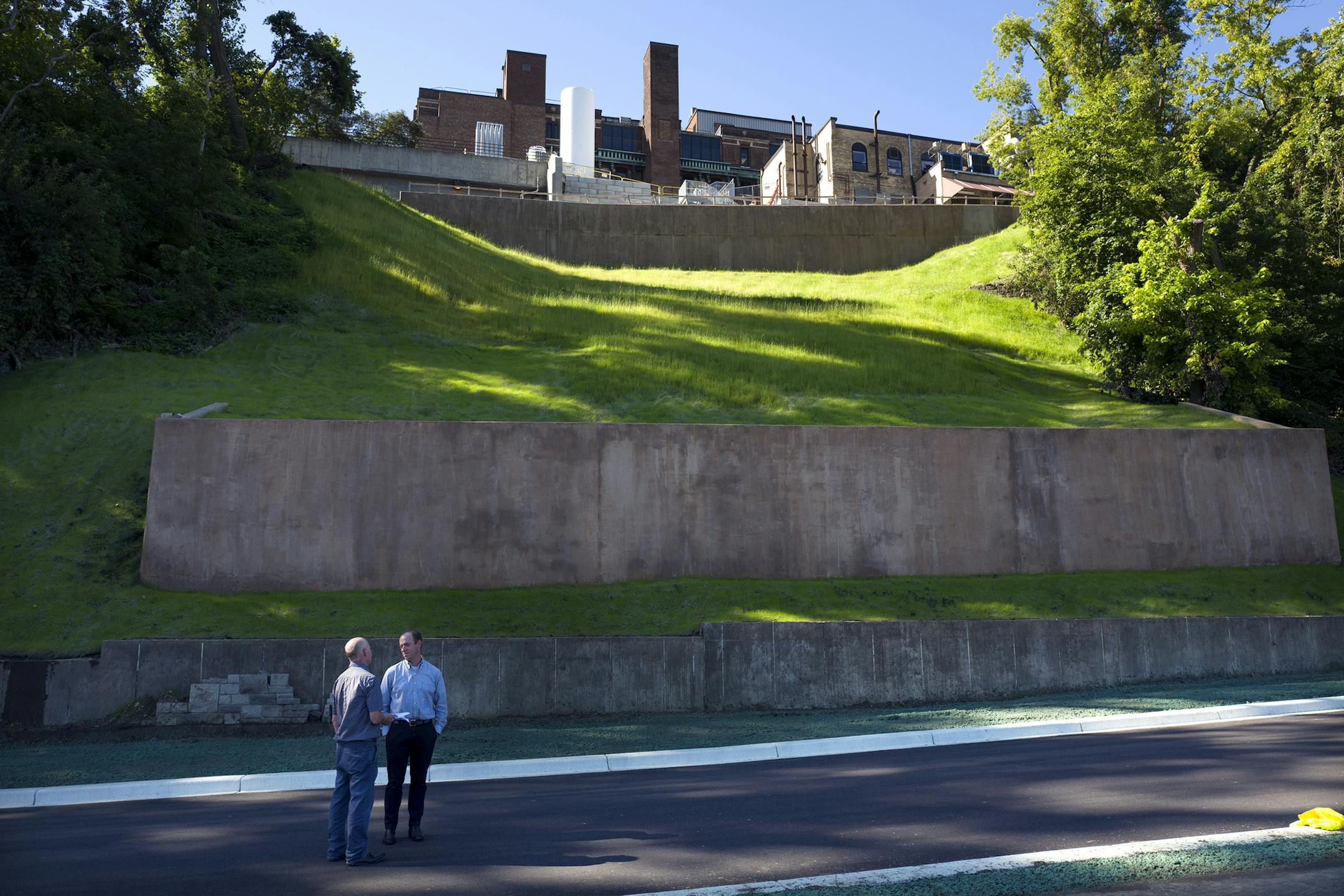
Building walls was a recurrent theme in the presidential race. For cities, walls do much more than protect borders. Of course they can divide us, the way medieval ramparts helped to repel invaders. But they also can bring us together.
Seating walls provide places of gathering and conversation. Even retaining walls, which shore up steep slopes, are celebrated for climbing. And memorial walls and columbaria are designed to be places of gathering, albeit sacred and often somber ones. Here is a small sampling of some of the walls of the Twin Cities and what they provide in our urban landscape.
For thousands of years, the Mississippi River swelled and shrank and shifted course. In Minneapolis, we see traces of the river's changing course in the steep slopes of Lowry Hill, the Oak Grove neighborhood south of Loring Park and in Bryn Mawr.
It's no surprise that many of Minneapolis' most impressive retaining walls are found in the Lowry Hill neighborhood near the Walker Art Center. Because these stretches of what had been river bluff promised dramatic vistas, they were desirable sites for 19th-century builders, who constructed retaining walls, including the gray limestone wall that wraps the corner of Groveland Terrace and Dupont Avenue S. Gently sloping inward and topped with stepped caps, the wall sweeps up Dupont with gentle curves. On Groveland, it runs beneath a canopy of old yew trees, arcing with the street and opening up new vistas as you walk.
The Platteville limestone used for this wall comes from a fossil-rich, ancient lake bed that appears in outcroppings along the Mississippi River. (You also can find Platteville stone in the Pillsbury "A" Mill and the Nicollet Island Inn. For early builders, it was plentiful and nearby.)
Preserving a historic hospital
In the late 1880s, Dr. Martha Ripley founded the Ripley Maternity Hospital, which served poor pregnant women in a time of high infant mortality. In 1896, the hospital moved to a five-acre parcel on Penn and Glenwood avenues N., overlooking Bassett Creek. In 1910, the former "Babies' Bungalow" was built to isolate sick infants from other patients.
The location of the hospital campus, which forms the northern edge of the same former riverbank as Lowry Hill, required a retaining wall. A fieldstone wall was built along the sidewalk, stretching more than 100 feet. Perched above it, the Babies' Bungalow was built with the same fieldstone.
Now known as Ripley Gardens, an affordable housing development, the old hospital campus is one of the city's best examples of preserving a historic landscape and buildings as a coherent whole.


