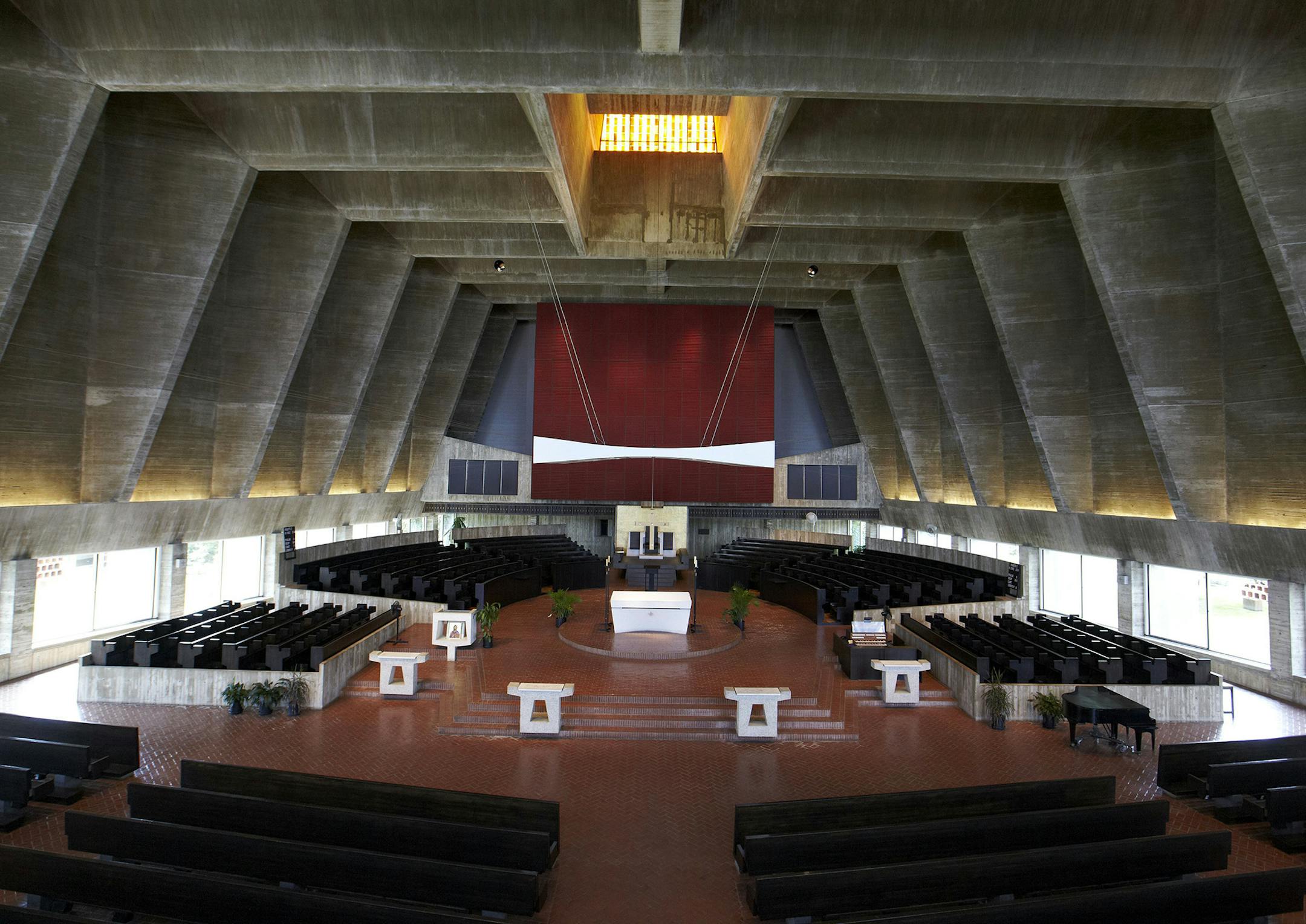
Rising from a flat wooded plain in central Minnesota, the sharply angled St. John's Abbey bell banner commands awe. A towering portal from the outside world to the sacred interior of the abbey church, the imposing 112-foot-high poured-concrete slab beckons visitors to come in and behold the further wonders of contemporary design envisioned by Hungarian-born architect Marcel Breuer in the 1950s.
It's one of the most breathtaking examples of modernism in Minnesota, and set the standard for a new era in religious architecture.
Renowned architect I.M. Pei once said that had the boldly shaped structures, composed primarily of thousands of tons of concrete, been built in a more populated area on either the East or West Coast, the abbey would be a world-famous example of mid-20th-century architecture.
But beyond the admiration of the monks, priests and students who pass through the environs daily, it isn't as widely celebrated as it might be, given its significance as a tangible reflection of the Catholic liturgical reform movement of the mid-20th century.
Victoria M. Young hopes to change that with her recently published book, "Saint John's Abbey Church: Marcel Breuer and the Creation of a Modern Sacred Space" (University of Minnesota Press, $35). Young, who chairs the Art History Department at the University of St. Thomas, where she also teaches modern architecture history, said that the committee of clerics formed to choose an architect wanted someone "who could help them create a church as special as what their medieval counterparts did with the first Gothic structure, the Abbey of Saint-Denis."
In the 1950s, St. John's Benedictines were becoming known as leaders of liturgical reform, intended to get congregations more involved in worship rituals, including converting masses from Latin to native languages and reworking altars so priests faced toward congregants rather than away from them.
"For the Benedictines, modernism was not a stylistic issue but rather a tectonic one," Young said. "They were interested in the materials that could shape appropriate forms for a newly refined worship. Functionalism was key. They were very focused on the engineering showing through in the design, which actually follows the Gothic tradition, only using modern materials."
While Breuer was not Catholic and had no previous liturgical design experience, he had been highly praised for his residential work, and was riding high on his much-buzzed-about plans for UNESCO headquarters in Paris, completed in 1955. (It's no coincidence that the vaulting legs of St. John's bell banner resemble those of the Eiffel Tower; Breuer passed it every day on his way to the UNESCO project.)