
Stopping traffic in downtown Rochester

Mayo program contributes to the revival of the peregrine falcon

May 13, 2017 at 8:24PM
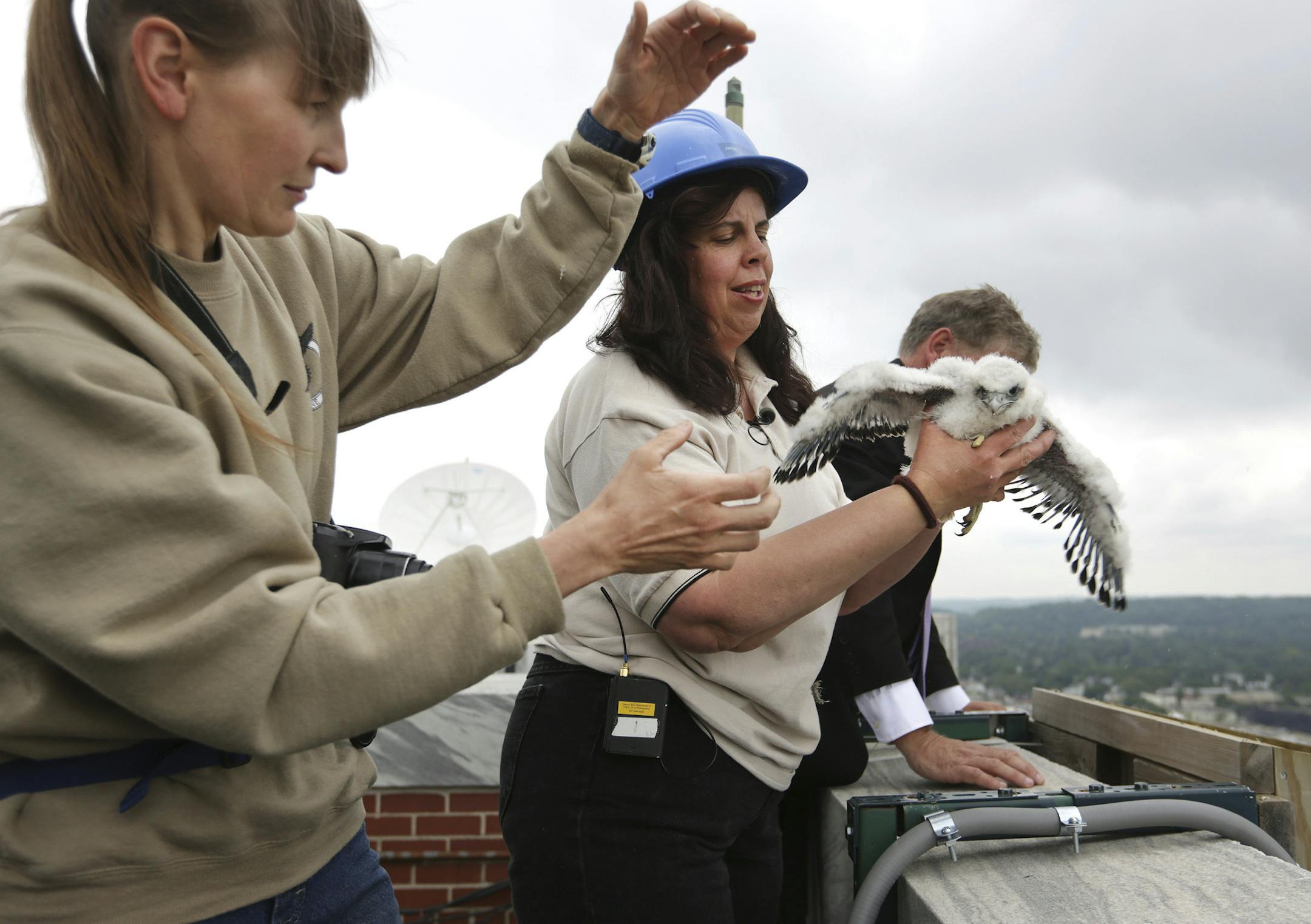
ADVANCE FOR WEEKEND OF MAY 13-14 - FILE - In this June 10, 2013, file photo, Karla Anderson, left, and Jackie Fallon remove a young peregrine falcon from a nest box on top of the Mayo Building in Rochester, Minn. (Joe Michaud-Scorza/The Rochester Post-Bulletin via AP, File)
Karla Anderson, left, and Jackie Fallon removed a young peregrine falcon from a nest box on top of the Mayo Building in Rochester. (The Minnesota Star Tribune)

ROCHESTER – Every so often, Mayo Clinic facilities chief Tom Behrens will get a call telling him that one of his birds has landed on a downtown Rochester street and is blocking traffic. All of Second Street will be backed up.

And Behrens will know that one of his young peregrine falcons, testing out its new wings, will have swooped to the ground and has yet to figure out how to get itself back aloft.

"It happens in the spring when they start flying around," Behrens said.

Such inconvenient moments are really an auspicious sign. No one notices when something is disappearing. But when a bird is blocking traffic, you know the falcon is on the rebound. It is also one sign of Mayo Clinic's involvement in a program that has contributed to that revival in the Midwest over the decades.

Once on the verge of extirpation as a result of the use of the pesticide DDT, the falcon has been on a decadeslong rebound. The peregrine was removed from the federal endangered species list in 1999.

Last week, the Mayo program marked its 30-year anniversary with an event at Mayo Clinic. The event featured naturalists from the Midwest Peregrine Society, a live falcon and stories by the people who have been a part of the program over the years.

"It's just amazing how we've worked with nature and worked together" to bring about the bird's revival, Behrens said.

As unit head of facilities operations, there is nothing about Behrens' title that suggests his 25-year involvement as manager of Mayo's falcon program. Yet he inherited the responsibilities because of the role tall city buildings played in the falcon's resurgence. Such urban settings, experts realized, mimicked the cliffsides on the Mississippi River that falcons use as nesting areas to hatch and raise their chicks.

A collaboration of the Raptor Center-University of Minnesota and the Peregrine Falcon Midwest Society, the program was started in the Twin Cities and eventually came to Rochester.

Over the years, falcon programs at Mayo have been crowd favorites among patients and staff. Some patients even schedule their appointments so they can be in Rochester when the falcons are present. An EarthCam provides 24/7 coverage when the falcon pairs are breeding on the Mayo building as they are doing now. (Hattie, the female, is incubating three eggs, while Orton is out hunting for himself and Hattie.)

"They typically arrive in late winter and they stay in and around the Mayo building until early June or a bit after that, until the baby falcons are independent, and they go," said Matt Dacy, director of Heritage Hall and chairman of Heritage Days, which supports the falcon program.

Behrens estimates that the Mayo program has accounted for 90 falcon offspring over the decades. Bands put on the birds' legs help in their identification, and Mayo falcons have been spotted as far south as Ohio and north into Canada.

Behrens finds the birds fascinating. They are considered to be among the fastest animals in the world, their aerodynamic structure allowing them to reach speeds of 200 miles per hour when they divebomb. War planes have been modeled after them, Behrens said. They also are fierce and territorial, particularly the female.

"Sometimes, they fight to the death and [the winner] takes over [the territory]," he said. "And the male will just mate with whoever wins. He's committed to the site, not necessarily the bird."

Dacy said last week's event also included a panel discussion with people who were part of the program in its early days. "It's really meant to be an educational program, and we want to give back to the community," he said.


Master licensed falconer Andrew Weaver released a five year-old female peregrine falcon to exercise and get the chance to hunt down a homing pigeon near a field Friday, Jan. 17, 2014, in Stillwater, MN. The falcon was also fitted with a transmitter that emitted a signal and through radio telemetry, allowed Weaver to track down the falcom that had caught and killed the homing pigeon Weaver had earlier release on the edge of woods and was feeding on the bird.](DAVID JOLES/STARTRIBUNE) djoles@start
Once threatened by the toxic pesticide DDT, peregrine falcons are making a comeback. (The Minnesota Star Tribune)
about the writer

about the writer

Matthew Stolle, Rochester Post Bulletin

More from No Section

See More
FILE -- A rent deposit slot at an apartment complex in Tucker, Ga., on July 21, 2020. As an eviction crisis has seemed increasingly likely this summer, everyone in the housing market has made the same plea to Washington: Send money — lots of it — that would keep renters in their homes and landlords afloat. (Melissa Golden/The New York Times) ORG XMIT: XNYT58
Melissa Golden/The New York Times

It’s too soon to tell how much the immigration crackdown is to blame.