

Is any word misused more often in the news media than "liberal"?
Here's one example from the New York Times last spring: "The House Democratic campaign arm is nearing open warfare with the party's rising liberal wing as political operatives close to Speaker Nancy Pelosi try to shut down primary challenges before what is likely to be a hard-fought campaign next year to preserve the party's shaky majority."
Hidden within this 46-word thicket is the strange idea that liberals are at war with the party's leadership and seeking to oust its long-serving incumbents — who are themselves, of course, liberals.
It's not just the Times. Here's a garbled claim about a year ago from the Washington Post: "The Democratic Party's left-wing insurgency found its limits Tuesday night, with voters favoring establishment candidates over more liberal challengers in almost every closely watched race across several states." Yet the victors that night in 2018 were actually the more liberal candidates; the defeated challengers who had been seeking to replicate the feat of current U.S. Rep. Alexandria Ocasio-Cortez, D-N.Y., just weeks earlier were not so much liberal as radical or leftist.
Scads of examples like these are littered throughout the press. For several years now, reporters and pundits have been incorrectly applying the word "liberal" when they mean leftist. This turnabout is ironic. After all, in the 1970s and 1980s, conservatives cynically misrepresented liberalism as an extremist philosophy — basically, a synonym for radicalism. Spiro Agnew, vice president under Richard Nixon, briefly popularized the ungainly term "radiclibs." And although Nixon and Agnew are gone, journalists, it seems, continue to unwittingly carry on their work by blurring the distinction in ways that matter for Democratic politics.
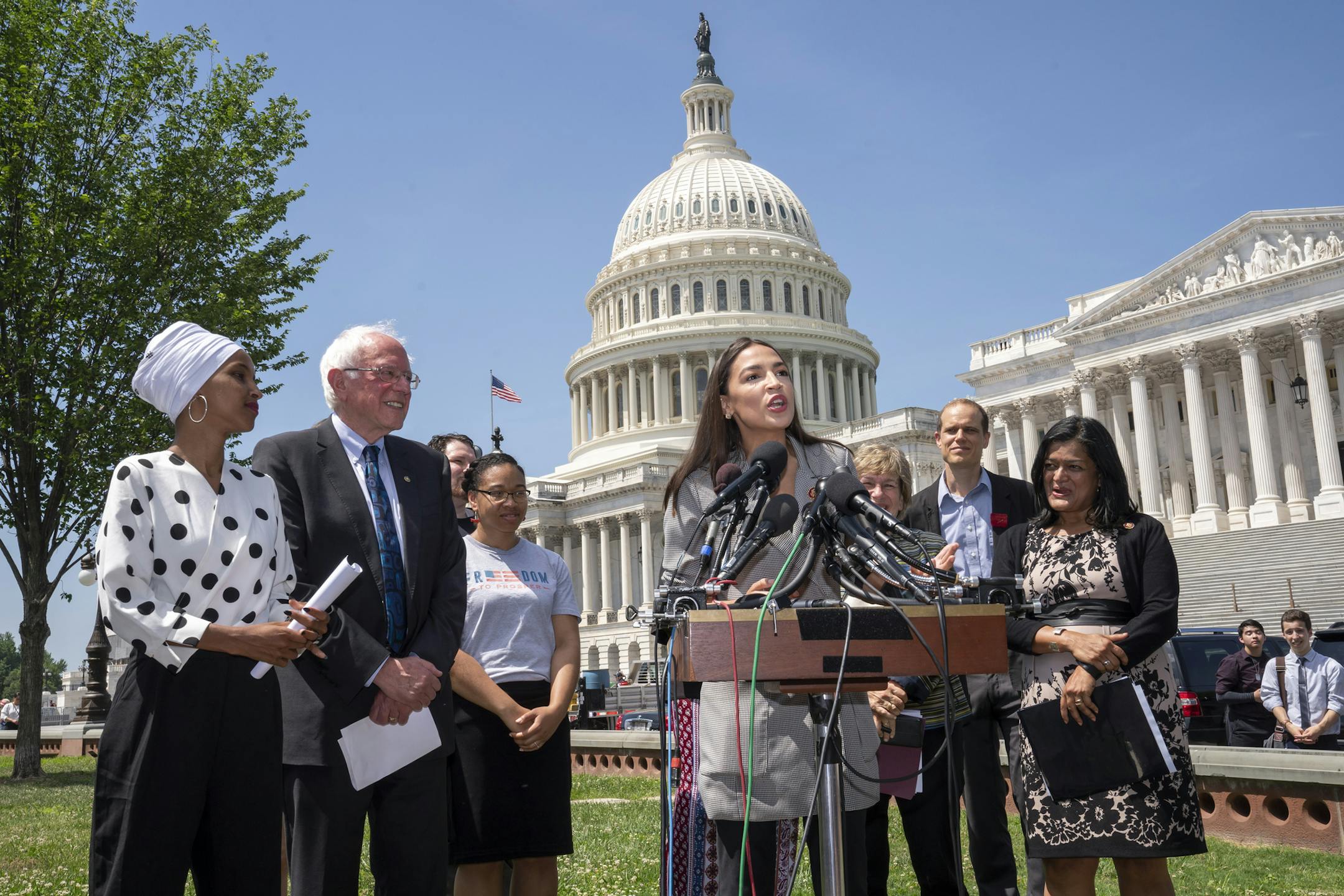
Liberalism has been the governing philosophy of the Democratic Party since Franklin D. Roosevelt, if not Woodrow Wilson: a doctrine of liberty, equality, justice and individual rights that relies, in the modern age, on a strong federal government for enforcement. The party has remained ideologically diverse, ranging from moderates or conservatives — Joe Manchin of West Virginia, for instance, or Rep. Conor Lamb of Pennsylvania — to leftists or radicals, best exemplified today by Sen. Bernie Sanders, I-Vt., or Ocasio-Cortez and her "Squad."
Most prominent Democrats, however, including established veterans like former Vice President Joe Biden, Pelosi, Barack Obama and Hillary Clinton, are liberal.
So why has liberal come to mean "radical" in seemingly popular usage? In recent years, what was once a left-wing fringe of the Democratic Party has grown significantly. Instead of describing these newcomers and insurgents as "further to the left" than mainstream liberals, reporters succumb to a convenient shorthand, under which those politicians are deemed "more liberal" than the liberals. To clear up the muddle, true liberals like Obama, Biden and Pelosi are recast as "moderates." And how to distinguish Obama, Biden or Pelosi from genuine moderates like Manchin and Lamb is not explained.


