
Steelhead return to North Shore, dogged by population concerns

Population concerns dog steelhead as they make their migratory return to the North Shore

April 17, 2017 at 5:19AM
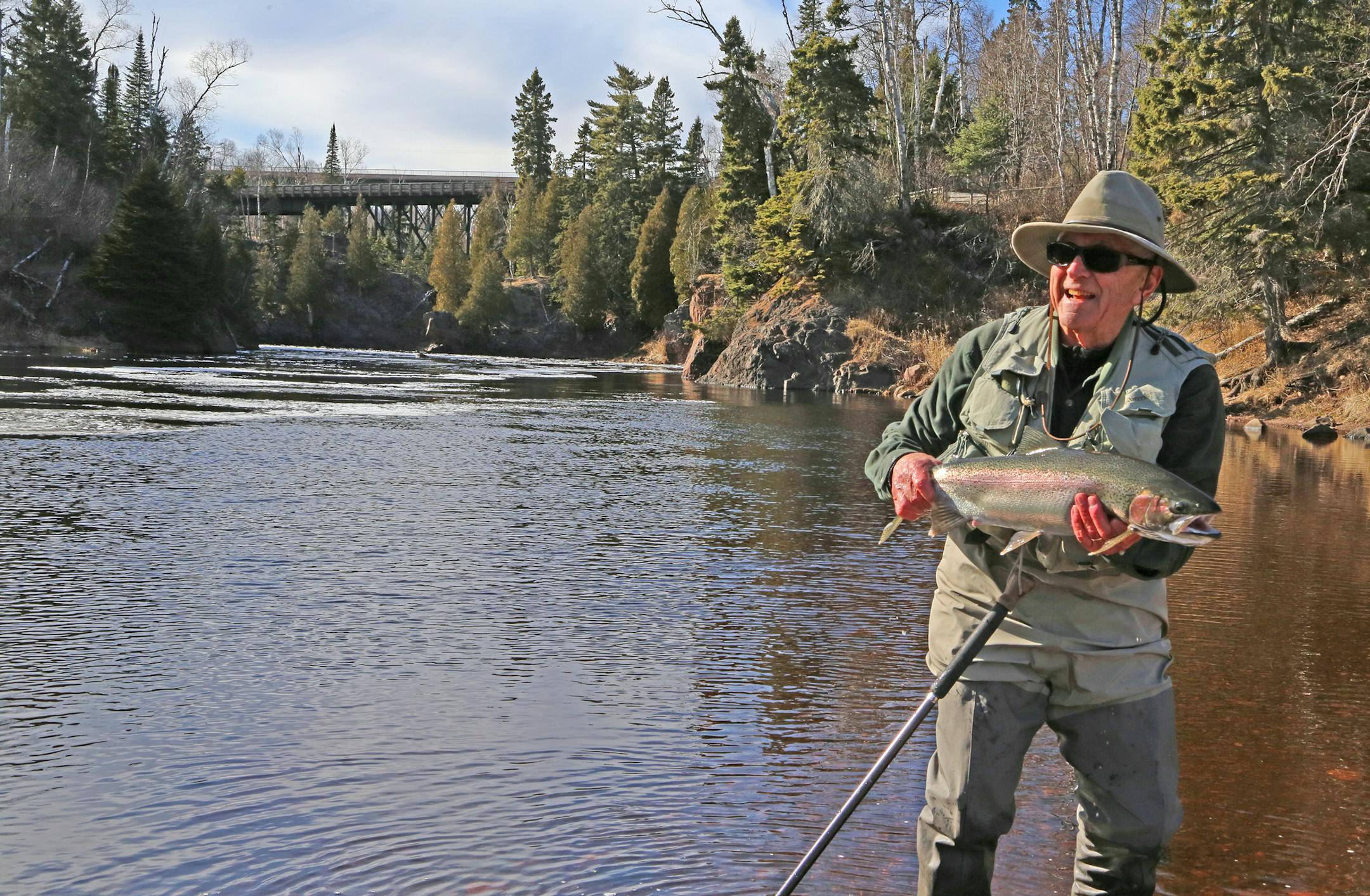
Before catching this steelhead last week on the North Shore, Dave Zentner of Duluth feared it’d be “too early” to get much action. But this catch gave him something to hang his hat on from the trip.
Before catching this steelhead last week on the North Shore, Dave Zentner of Duluth feared it’d be “too early” to get much action. But this catch gave him something to hang his hat on from the trip. (The Minnesota Star Tribune)

On the North Shore – Compared to the fiery autumnal palette that ignites here in early October, when big-tooth aspens and quaking aspens, along with paper birches, yellow birches, red maples and sugar maples, blossom in a firestorm of color, April can seem a placeholder month, neither March with its vestiges of winter, nor May with its flowering primroses, dewberries and violets.

Yet measured by life in and along North Shore streams, from the Amity in the south to the Flute Reed near the Ontario border, April might be the region's most compelling month.

It's in April that the vast watersheds that feed the Gooseberry, Baptism and the Brule — to name three of the Shore's many rivers — empty themselves of snowmelt, which combines with spring rains to tumble toward Lake Superior between and over volcanic relics a million years old.

It's also in April that steelhead, or migratory rainbow trout, travel these rivers, and have for 100 or more years, swimming upstream sometimes 20 miles or more in search of narrow waterways with gravelly bottoms shaded by canopies of overhanging tree limbs — the most hospitable conditions for spawning.

"Let's run up to the Baptism," Dave Zentner said. "It's too early for much to be going on there. But we'll see."

This was last week, on Tuesday, and Dave, of Duluth, along with Mark Kilen, also of Duluth, and I were kicking the steelhead can up the Shore, as it were.

We had just left the Knife River, which in many ways is the poster child of North Shore steelhead streams.

Located barely a half-hour from Duluth, the Knife's proximity to the region's largest population center makes it an easy after-work, before-work or instead-of-work springtime getaway for steelheaders.
The Knife wasn't fishing particularly well Tuesday. Not for anglers. But Cory Goldsworthy, Nick Peterson and Keith Reeves were doing OK.

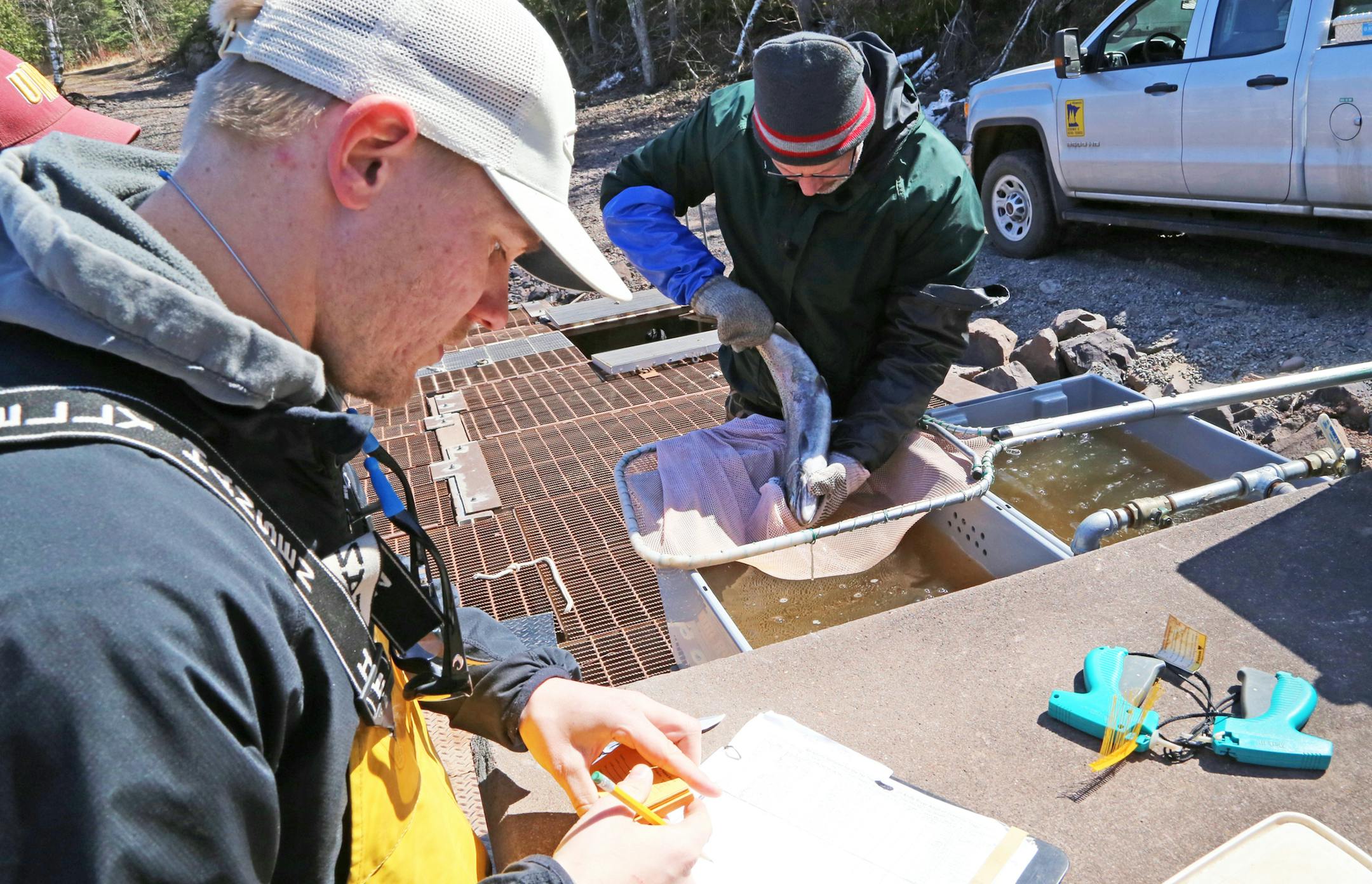
DNR fisheries employees, they were emptying the trap that was built on the Knife in 1996 to catch steelhead swimming upriver to spawn.

Goldsworthy, the Lake Superior area fisheries supervisor, was in the trap itself, at streambed level, netting the confined steelhead, before handing the fish up to Peterson, a DNR anadromous fish specialist, and Reeves, assistant Lake Superior area fisheries supervisor.

Each steelhead's sex was determined, and each was measured and weighed. Also recorded was whether a fish had been caught in the trap previously — telltale by an implanted identifying tag.

Then the fish were released above the trap to continue their upstream journeys.

Built in response to a crashing North Shore steelhead population, the trap tells fisheries managers how many spawning steelhead swim up the Knife in spring.

Also, in May, June and July, the trap catches smolts, or 2-year-old steelhead, swimming downriver to Lake Superior.

The ratio of adults swimming up to smolts swimming down indicates the river's fertility, Goldsworthy said. Effects on steelhead production of seasonal variations such as drought and floods also can be determined.

Overfishing was found to be one reason Lake Superior steelhead declined. But the falloff was perhaps inevitable.

"Historically, lake trout have been Lake Superior's primary predator, feeding on smelt among other forage," Goldsworthy said. "When lake trout were decimated by sea lampreys and overfishing, smelt numbers exploded, and with them populations of steelhead, chinook and coho salmon, which filled the predator void left by lake trout.

"Once we got lamprey controlled, lake trout numbers rose again and smelt declined, leaving less forage for steelhead and salmon, whose numbers also declined, returning the lake to its more natural state."

Challenges to North Shore steelhead persist, notably the possible adverse effects of their interbreeding with Kamloops rainbows. Still, Lake Superior steelhead, generally, are in good shape.

"Our goal in spring has been to hit 1,000 caught in the trap," Goldsworthy said. "The last two years we've done that.''

•••

On some April days, the shores of the Baptism are pockmarked with anglers from the river's mouth to the barrier falls a couple of miles upstream.

On Tuesday, only Tom Salkowski of Buffalo, Minn., was on the river when Dave, Mark and I arrived.

The reason: North Shore rivers warm progressively, south to north, and steelhead don't typically leave Lake Superior en route to their riverine spawning grounds until stream temperatures reach about 40 degrees.

Water at the mouth of the Baptism on Tuesday was a chilly 37 degrees, explaining the dearth of anglers on the river's banks and why Salkowski was fishing at the river's spilling point.

It's there that steelhead that had entered the river would hold until the water warmed further.

Not long after our arrival, Salkowski proved an inspiration when he drew his line tight in the whirlpooling water against the weight of a good fish.

Under any circumstances steelhead are challenging to land, and when I asked Salkowski whether he might benefit from some help, he responded affirmatively and immediately.

Minutes later, he guided a beautiful chrome steelhead into a net I held in the cold river, while not far away, foam-topped breakers crashed thunderously against the Lake Superior shoreline.

"A great fish," I said.

Just upstream, Dave and Mark were fast enjoying what they've enjoyed together for a lifetime: casting flies to fast water for steelhead.

On this day, it was the Baptism. In past Aprils it was the Pere Marquette in Michigan, the Wisconsin Brule or a dozen or more streams farther up the North Shore, in Ontario.

Retired, they each held day jobs, at one time, they say.

But perhaps not so much while steelhead ran.

Soon, Dave's 9-foot fly rod bent toward a fat steelhead, and Mark followed with a smolt, as did I.

This was on Tuesday on the North Shore.

Compared to the fiery autumnal palette that ignites here in early October, the scene was less colorful.

But for us, casting still amid the late afternoon's longer shadows, memorable nonetheless.

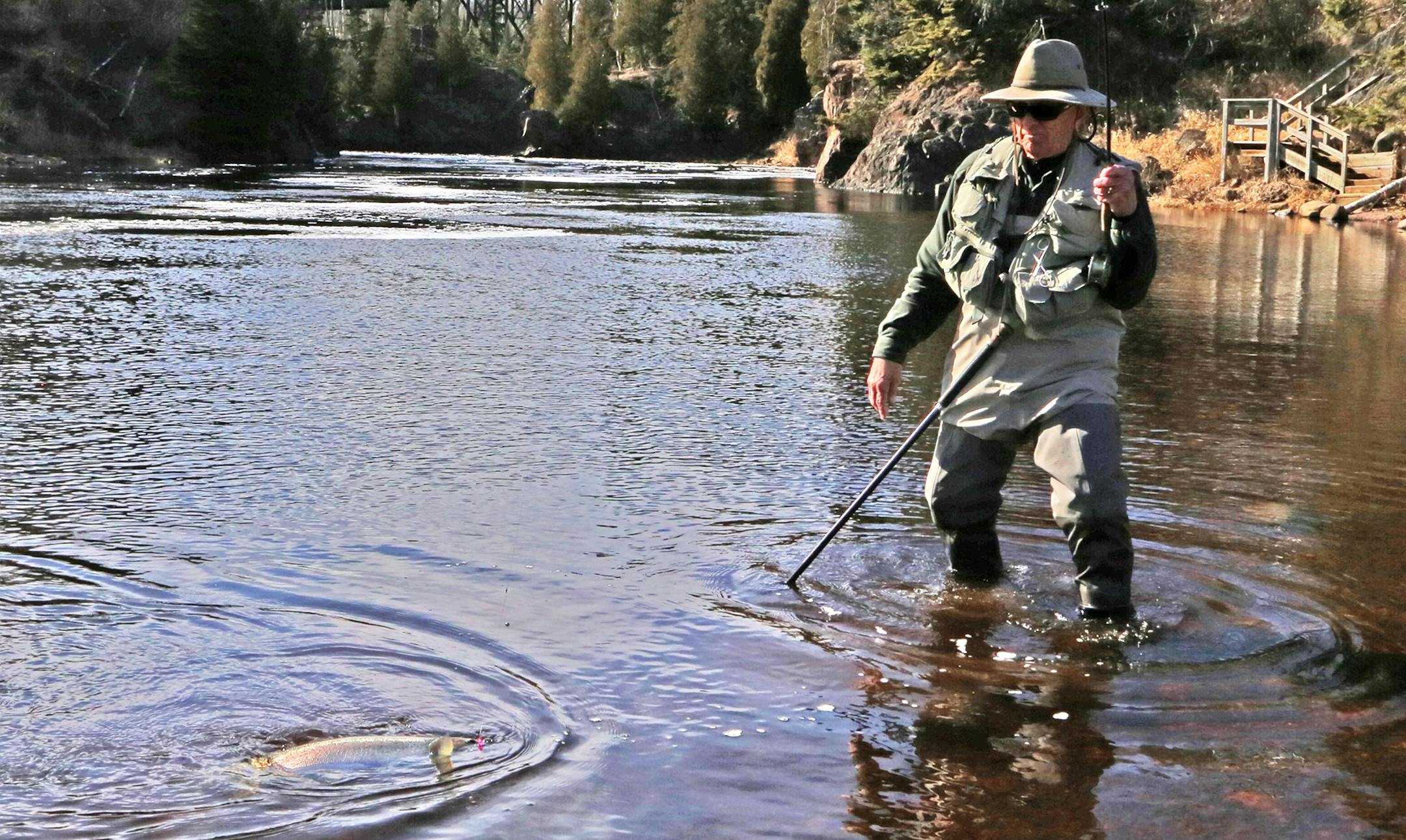
Dave Zentner of Duluth struggles with a steelhead while fishing up the North Shore last week. The Knife River has been fishing pretty well, but steelhead action up the Shore is just getting going.
▲ Dave Zentner struggled with a steelhead while fishing up the North Shore last week. The Knife River has been fishing pretty well, but steelhead action up the Shore is just getting going. * DNR anadromous fish specialist Nick Peterson, left, recorded the length and weight of a steelhead caught in a DNR trap on the Knife River. Keith Reeves, right, assistant Lake Superior area fisheries supervisor, prepared the fish to be tagged. (The Minnesota Star Tribune)
DNR anadromous fish specialist Nick Peterson, left, records the length and weight of a steelhead caught in a DNR trap on the Knife River. Keith Reeves, right, assistant Lake Superior area fisheries supervisor, prepared the fish to be tagged. The fish subsequently was released upriver of the trap to continue its spring spawning run.
DNR anadromous fish specialist Nick Peterson, left, records the length and weight of a steelhead caught in a DNR trap on the Knife River. Keith Reeves, right, assistant Lake Superior area fisheries supervisor, prepared the fish to be tagged. The fish subsequently was released upriver of the trap to continue its spring spawning run. (The Minnesota Star Tribune)
about the writer

about the writer

Dennis Anderson

Columnist

Outdoors columnist Dennis Anderson joined the Star Tribune in 1993 after serving in the same position at the St. Paul Pioneer Press for 13 years. His column topics vary widely, and include canoeing, fishing, hunting, adventure travel and conservation of the environment.

See Moreicon

More from No Section

See More
FILE -- A rent deposit slot at an apartment complex in Tucker, Ga., on July 21, 2020. As an eviction crisis has seemed increasingly likely this summer, everyone in the housing market has made the same plea to Washington: Send money — lots of it — that would keep renters in their homes and landlords afloat. (Melissa Golden/The New York Times) ORG XMIT: XNYT58
Melissa Golden/The New York Times

It’s too soon to tell how much the immigration crackdown is to blame.