

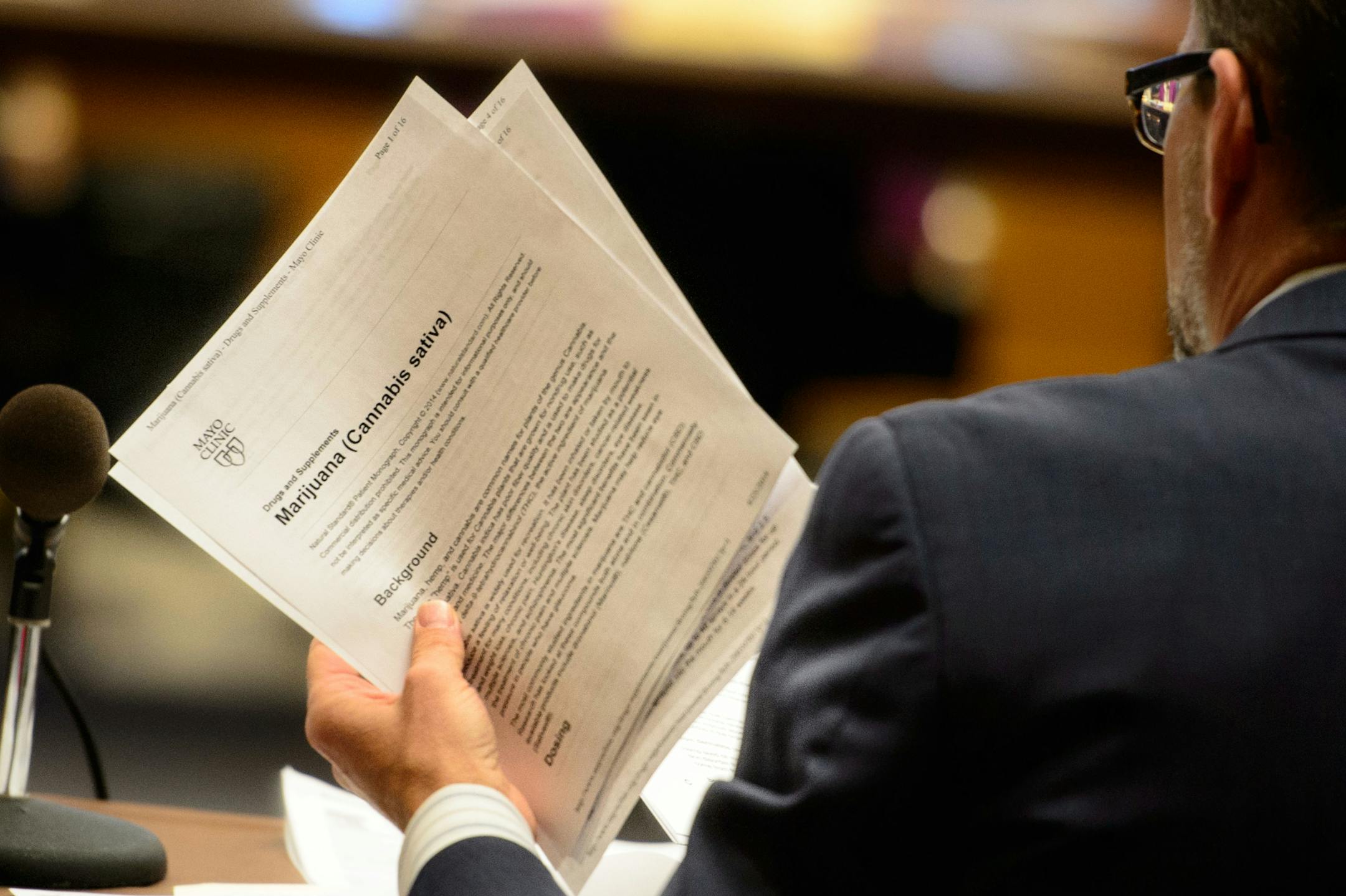
A Senate panel has voted to legalize marijuana for people with some medical conditions, giving new life to a controversial proposal that's opposed by Gov. Mark Dayton.
The Senate Health and Human Services Committee voted 7-3 to allow patients with certain medical conditions to obtain a doctor's prescription and obtain small amounts of marijuana. That includes people suffering from cancer, glaucoma, AIDS, hepatitis C, Tourette's Syndrome, post-traumatic stress disorder, various forms of seizure-inducing epilepsy and other conditions.
The issue scrambled party lines on the Senate panel. Voting in favor were Democratic senators Kathy Sheran of Mankato, Tony Lourey of Kerrick, Jeff Hayden of Minneapolis, John Marty of Roseville, John Hoffman of Champlin, Melissa Wiklund of Bloomington and Republican Michelle Benson of Ham Lake. Benson is also a GOP candidate for lieutenant governor.
Voting against the proposal were Republican senators Julie Rosen of Fairmont and Carla Nelson of Rochester, along with Democrat Chris Eaton of Brooklyn Center.
The proposal has had a team of vocal and sympathetic advocates in the parents of children with severe forms of epilepsy who want to treat their children with a substance known as cannabidiol, which includes a cannabis extract. Kristy Pauling of Montevideo, who wants access to the substance for her daughter Katelyn, was pleased to the bill move after it had stalled for more than a month.
"I'm a registered nurse, licensed by the state of Minnesota, and it's not something I want to try to get illegally and get in trouble," Pauling said. "That's not the kind of family we are."
The bill's opponents unsuccessfully tried to delay the day the proposal would take effect, from July to next February. They also failed to swap out the language that legalizes medical marijuana and replace it with a study similar to what Dayton has proposed.
"This is premature," Nelson said. "We do not know what would be effective. We don't even know what a consistent dose is. This is the Wild West of medicine."


