

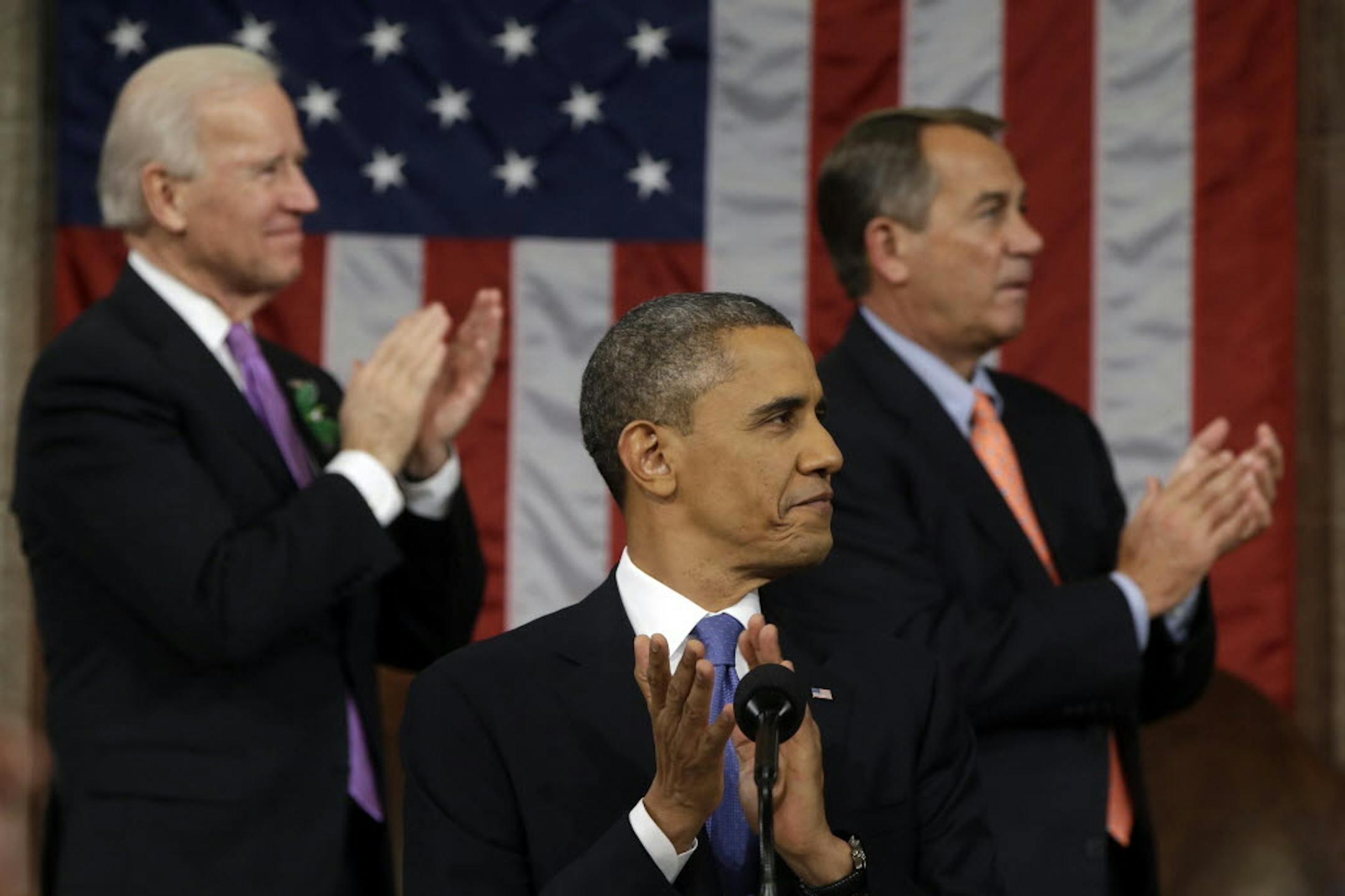
The tepid nature of America's economic recovery continues to be a drag on the middle class -- a point effectively underscored by President Obama on Tuesday night in a State of the Union address before a deeply divided Congress.
The success or failure of Obama's second term is likely to depend on a U.S. economy that's still showing relatively modest signs of postrecession life. Much of the rest of the worthy agenda Obama highlighted -- from gun control to immigration reform to winding down the war in Afghanistan -- will be an afterthought in future legacy discussions without meaningful economic growth leading to higher employment and rising incomes.
For now, Americans appear to have little confidence in Obama's ability to lead the nation on that course. A Gallup poll released this week found that 39 percent approved of his handling of the economy, while 60 percent disapproved. Among domestic issues, only his handling of the deficit ranked lower, at 31 percent approval.
White House occupants often receive too much blame for economic downturns and too much credit for expansions. But Obama didn't try to temper expectations Tuesday. Instead, he prescribed a set of policy initiatives in education, manufacturing, infrastructure and clean energy to "reignite the true engine of America's economic growth -- a rising, thriving middle class."
The public spending to accomplish that economic agenda would not add a "single dime" to the deficit, Obama pledged, although he offered few details on offsets. "It's not bigger government we need, but a smarter government that sets priorities and invests in broad-based growth."
Minnesotans should be encouraged by that promise, as well as by Obama's focus on medical research, manufacturing and workforce development -- all areas in which the state is well-positioned for a stronger-than-average recovery.
"Manufacturing is definitely in a hiring mode," Oriane Casale, assistant director of the labor market information office at the state Department of Employment and Economic Development, told an editorial writer.
The biggest obstacle to U.S. manufacturing growth is likely to be a shortage of skilled job candidates in an aging workforce, but this state is "ahead of the curve" in meeting that challenge because of the efforts of the Minnesota State Colleges and Universities system, said Bob Kill, president and CEO of Enterprise Minnesota, a consulting organization that works with small and midsized manufacturers.


