

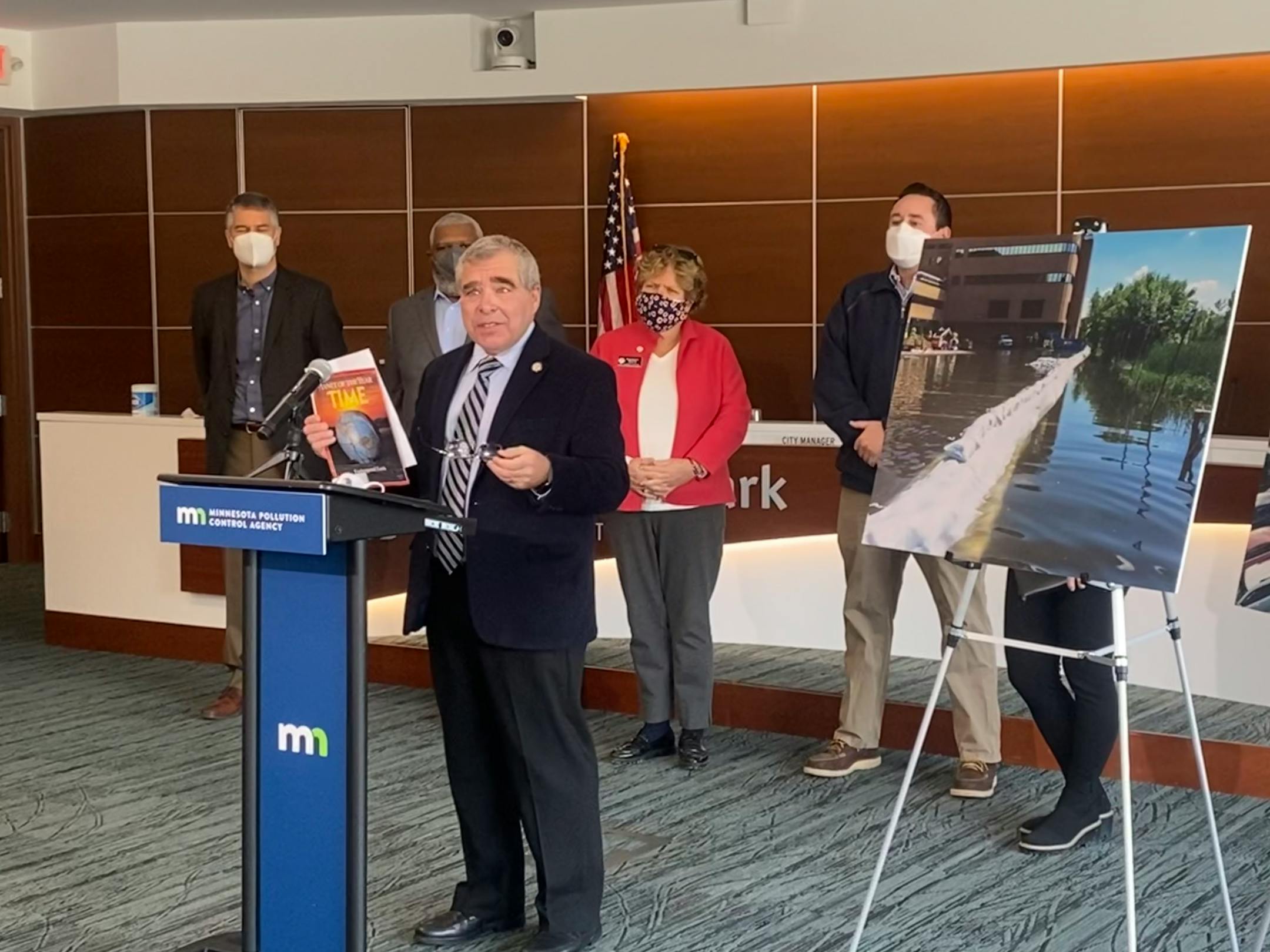
Legislators, city leaders and Minnesota's largest construction union on Wednesday backed Gov. Tim Walz's proposal for a $21 million grant program to help cities ease flood damage caused by climate change.
At a news conference in St. Louis Park, Pollution Control Agency Commissioner Katrina Kessler said increasingly severe rain events are overwhelming aged and undersized storm water systems. Walz's proposed program would help fund system upgrades to protect communities from extreme weather.
More than 155,000 homes and apartment buildings, 13,000 commercial buildings and 29,000 miles of roads in Minnesota reportedly are at risk of severe flooding, according to a study by the nonprofit First Street Foundation.
Along with the state's historic $7.7 billion project budget surplus, Minnesota expects about $6.8 billion from the federal government's infrastructure program. Walz proposes a $2.7 billion infrastructure package, with $940 million dedicated to projects designed to help communities adapt to changes brought by global warming, including the $21 million for flood mitigation grants.
"I frankly don't think it's enough, but I applaud Governor Walz for at least taking a small bite of a big problem," said Sen. Ann Johnson Stewart, DFL-Minnetonka.
Jason George, business manager for the International Union of Operating Engineers Local 49, said the funding would be an investment not only in infrastructure but in local contractors, workers and their families.
"There is no better use of the budget surplus that we are blessed to have here in Minnesota than reinvesting in ourselves," George said. "I look at it like a family's budget. When your family's doing well, and you have money in your savings account, that's the time you fix your house. … And that's what we do here in Minnesota."
Kessler said the grant program, which would offer projects up to $5 million, could fund either four large projects or 10 to 15 smaller ones, including such green infrastructure projects as rain gardens and tree trenches that absorb storm water and reduce flows into storm water systems.


