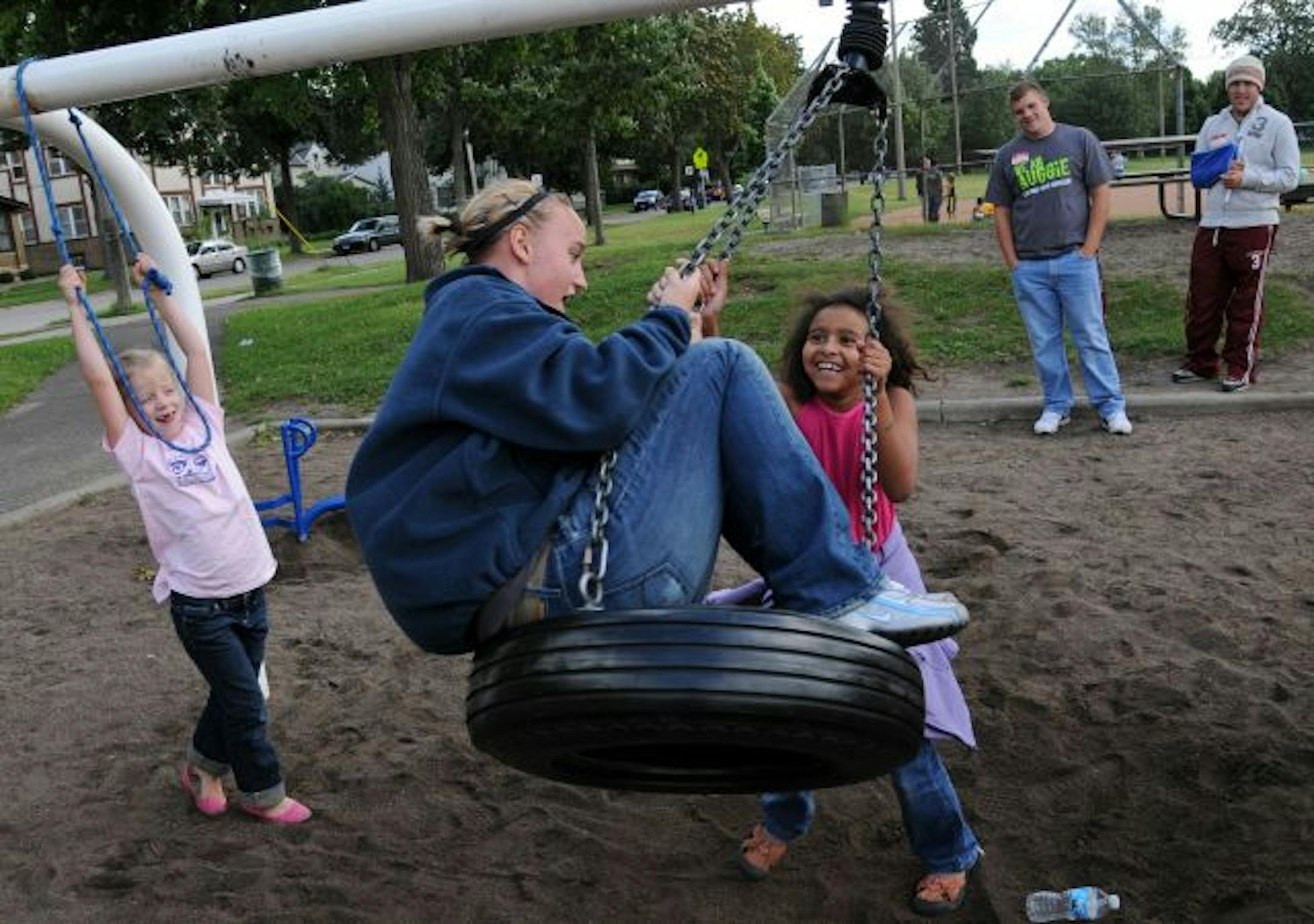
A 5-year-old boy named Mason fell off a swing in the Seward neighborhood Tuesday afternoon and hit his head. Within seconds, a muscular young man in a gray T-shirt scooped him up, asked him where it hurt, and brought the conversation around to the important stuff -- baseball.
"You like Joe Mauer?" Brandon Johnson asked as he stepped into the neighboring school building to find some ice. Mason nodded.
Across Minneapolis, hundreds more Augsburg College students sporting the same gray T-shirts -- "I'm an Auggie," they read -- cleaned churches, painted low-income medical clinics and performed other service work. Just as hundreds of Hamline University students had earlier that day. Just as thousands of University of Minnesota students had earlier that week.
The three schools are among a growing number of colleges and universities that now start the semester by throwing all freshmen into community projects -- before they've set foot in a classroom.
Service is an essential part of education, colleges say, and important to this generation of students.
"By doing it right away, an institution shows students its expectations of what their student experience will be," said James Liberman, first-year programs coordinator at the University of Minnesota. "Here, it's an expectation that students incorporate the Twin Cities into their academic and social life."
The number of colleges and universities doing the same has "definitely grown," particularly in the past five years, said Sue Kelman, spokeswoman for Campus Compact, a national group of more than 1,100 college and university presidents committed to civic engagement in higher education.
As a recent University of Minnesota report noted, there is "growing external pressure on higher education to become more community engaged," and many publications now rank how "engaged" students are. But colleges and universities emphasize that the focus on service is either part of a faith-based mission or has happened organically -- often as a result of increasing student interest.