

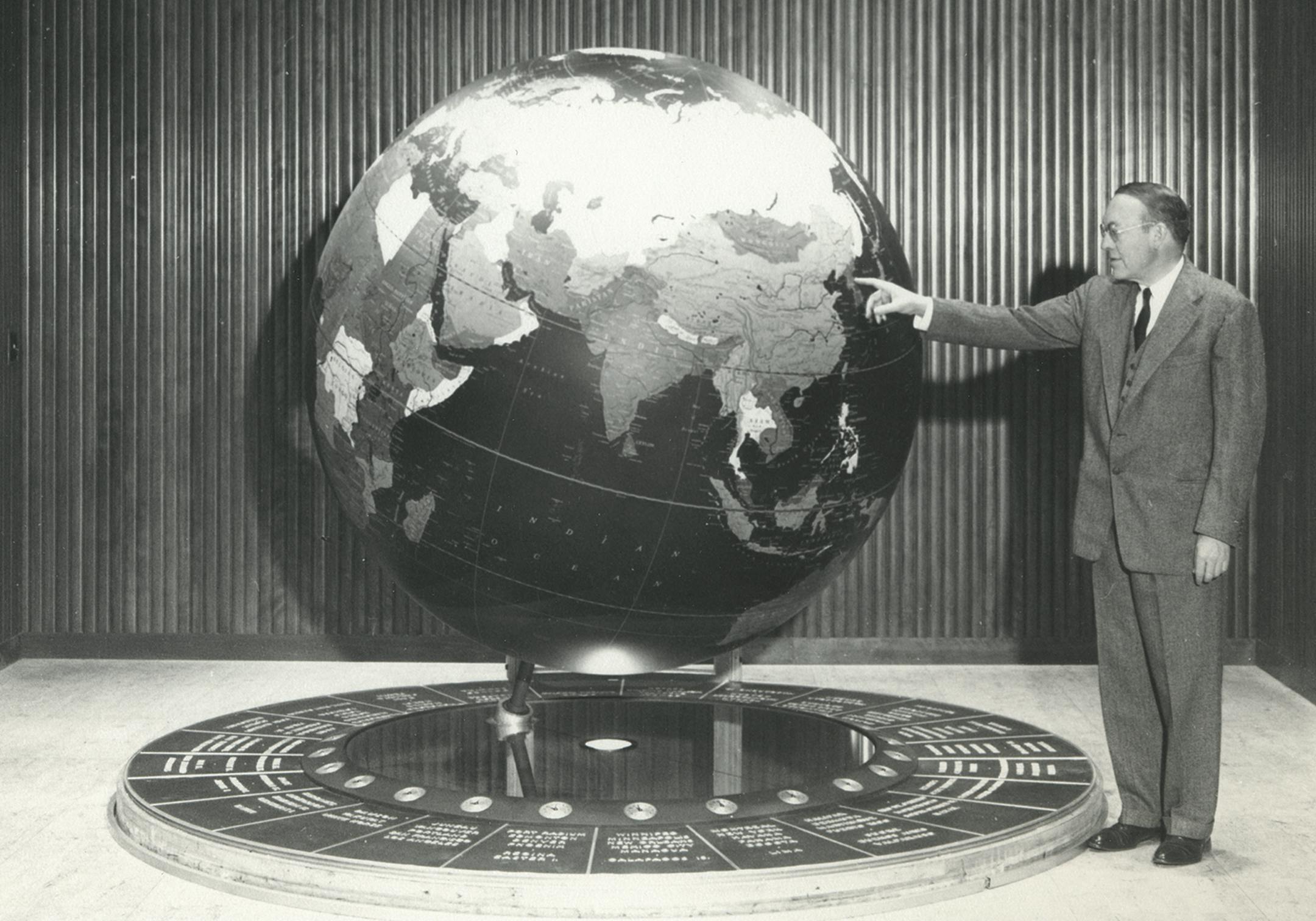
Touting the unveiling of a giant globe in the Star Tribune building's lobby, the company's statement acknowledges how high-tech advancements have made nations neighbors but also warns that this means every war could become globalized. The statement expounds on the expanse of land under Moscow's influence, as well as the geographic and political counterweight of Western democracies. And, as if to stress the consequence of conflict, there's a photo of the publisher pointing to North Korea, the world's hot spot.
But the publisher was John Cowles Sr., not current publisher and CEO Mike Klingensmith. The lobby was in the former Star Tribune headquarters on Portland Avenue in downtown Minneapolis, not the company's modern offices off 3rd Avenue S. And geopolitically, the land mass under Kremlin control was still the Soviet Union, not Russia, and the Korean culprit for international instability was Kim Il-sung, not his grandson, Kim Jong Un.
But just as the restored globe will start spinning again when it's unveiled May 25 as part of the company's 150th anniversary celebration, the world itself has spun back to some of the same issues.
Issues, for instance, like Russia, still depicted as the Soviet Union on a globe that acts as a time capsule. But not to 1951 — when the globe debuted — but 1978, its last update before being stored in a barn for decades. Most notable, particularly for those who haven't recently looked back at a map of the Cold War era, is the sheer size and resulting geopolitical scope of the U.S.S.R., described this way in the statement: "Among the significant facts made clear by the study of the globe is the chief strength of communism lies in its unity of area throughout the heartland of Eurasia. But surrounding this land-based fortress of communism is a ring of coastlands and islands linked by sea and air to the North Atlantic group of democratic nations. Fortunately, in the continent of Anglo-America, democracy too possesses a land-based fortress equal in resources to that of communism."
On Thursday, the day of the globe's rededication after its beautiful restoration by Blue Rhino Studio in Eagan, President Trump will be pressed to rededicate his support to that North Atlantic group of democratic nations at a NATO meeting in Brussels. At issue for many European members — and for a scandal-scarred administration — is Russia's election meddling and provocative military maneuvers that once again have the West on alert.
The alacrity is acute in NATO nations not on the Soviet-era globe, like Lithuania, Latvia and Estonia. Beyond the Baltics, the Balkans — still reflected as Yugoslavia on the globe — are also an ongoing NATO concern in part because of Russian interference in internal and regional politics.
Among the NATO summit's key leaders is Angela Merkel, chancellor of the most consequential country in Europe since its reunification from East and West Germany, which are still shown on the globe. Another Iron Curtain country cartographically uncorrected is Czechoslovakia, which is now divided into the Czech Republic and Slovakia.
Trump will begin his trip with a visit on Saturday to Saudi Arabia. It's uncertain if he'll press the U.S. ally to seek peace in neighboring Yemen. That war-torn nation, depicted as two countries, Democratic Yemen and Yemen, on the globe, is divided once again because of its vicious civil conflict.


