

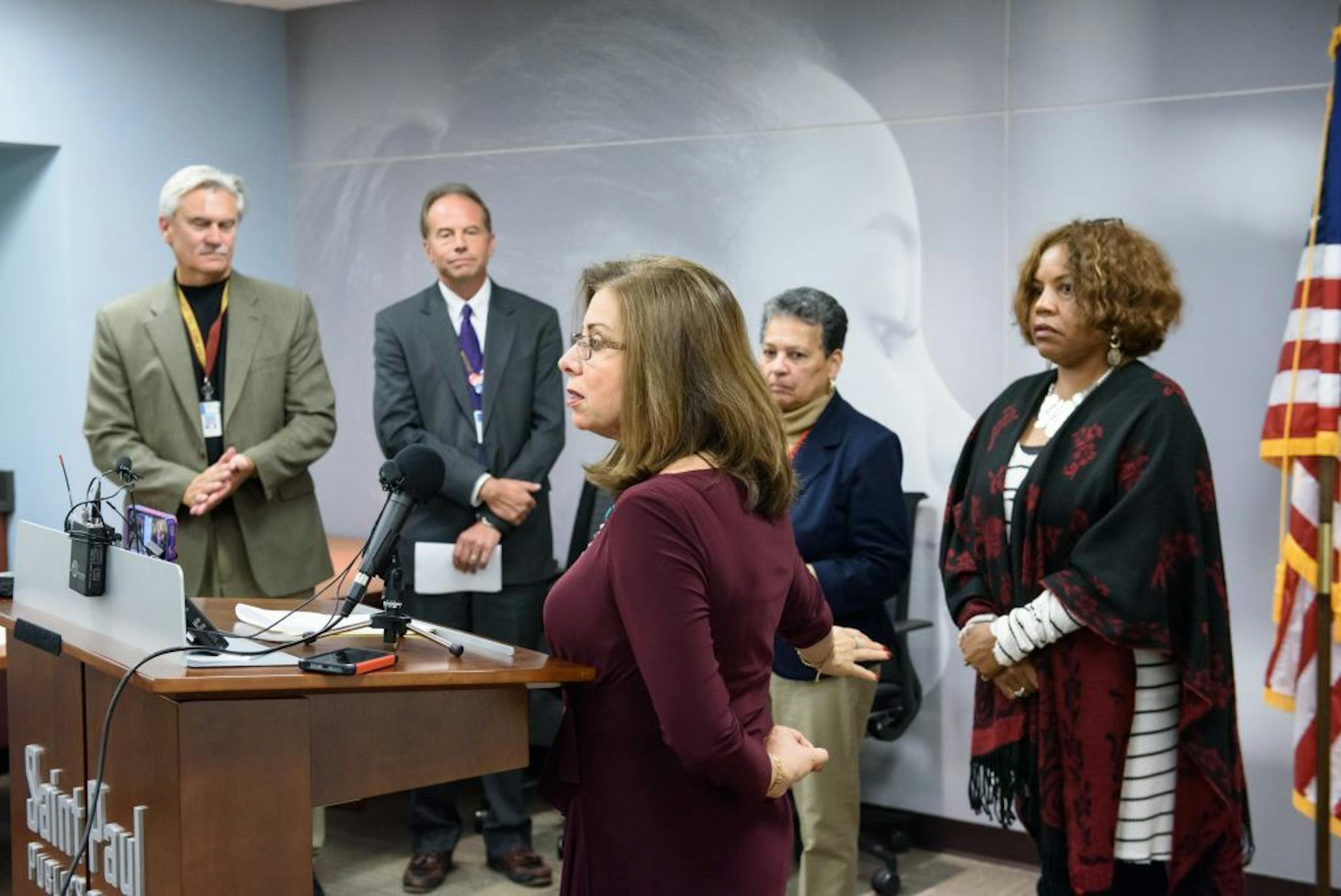
School safety has been a burning issue in St. Paul this fall, and now, as the state's second-largest district and its teachers union dig into contract talks, it's become a hot topic at the bargaining table, too.
The St. Paul Federation of Teachers is pitching an ambitious proposal to improve school climate by drawing upon the expertise of counselors, social workers, nurses and psychologists, and by putting schools themselves in charge of efforts to turn around problem behavior.
Union Vice President Nick Faber says it is essential that a school community, not the district, own the strategies used to make hallways and classrooms safer — and, hopefully, he said, give voice to both teachers and students when disputes arise.
Thus far, the district, eyeing what could be an expensive proposal, has offered, instead, to convene a committee to study the issue and develop a plan that is sustainable, cost-wise. But that position soon could change as a new school board majority takes office in January having already endorsed the federation's ideas on restorative justice in the schools.
"This hasn't been a great start to the school year — for a variety of reasons," Jon Schumacher, one of four school board newcomers aligned with a Caucus for Change movement, said recently. He contends the behavioral incidents that have arisen "stem from a real lack of people being in place and being able to build relationships with our students."
This fall, students at Como Park and Humboldt high schools engaged in fights so large they were described by police as "riots." In October, a Harding High student was caught in class with a handgun in his backpack. He since has pleaded guilty in Ramsey County juvenile court to possession of a dangerous weapon on school property.
In the past two years, Harding has led district high schools in the number of students suspended for fighting — 73 in 2013-14 and 72 in 2014-15.
The union is proposing to build on a pilot project that involved creation of school climate improvement teams made up of educators and school community members. Under its proposal, the district would provide $100,000 to each school that has a team willing to participate in restorative justice work. It also would dedicate a teacher to serve as restorative practice coach at each of those schools. In 2014-15, four schools had school climate improvement teams, a federation report said.


