

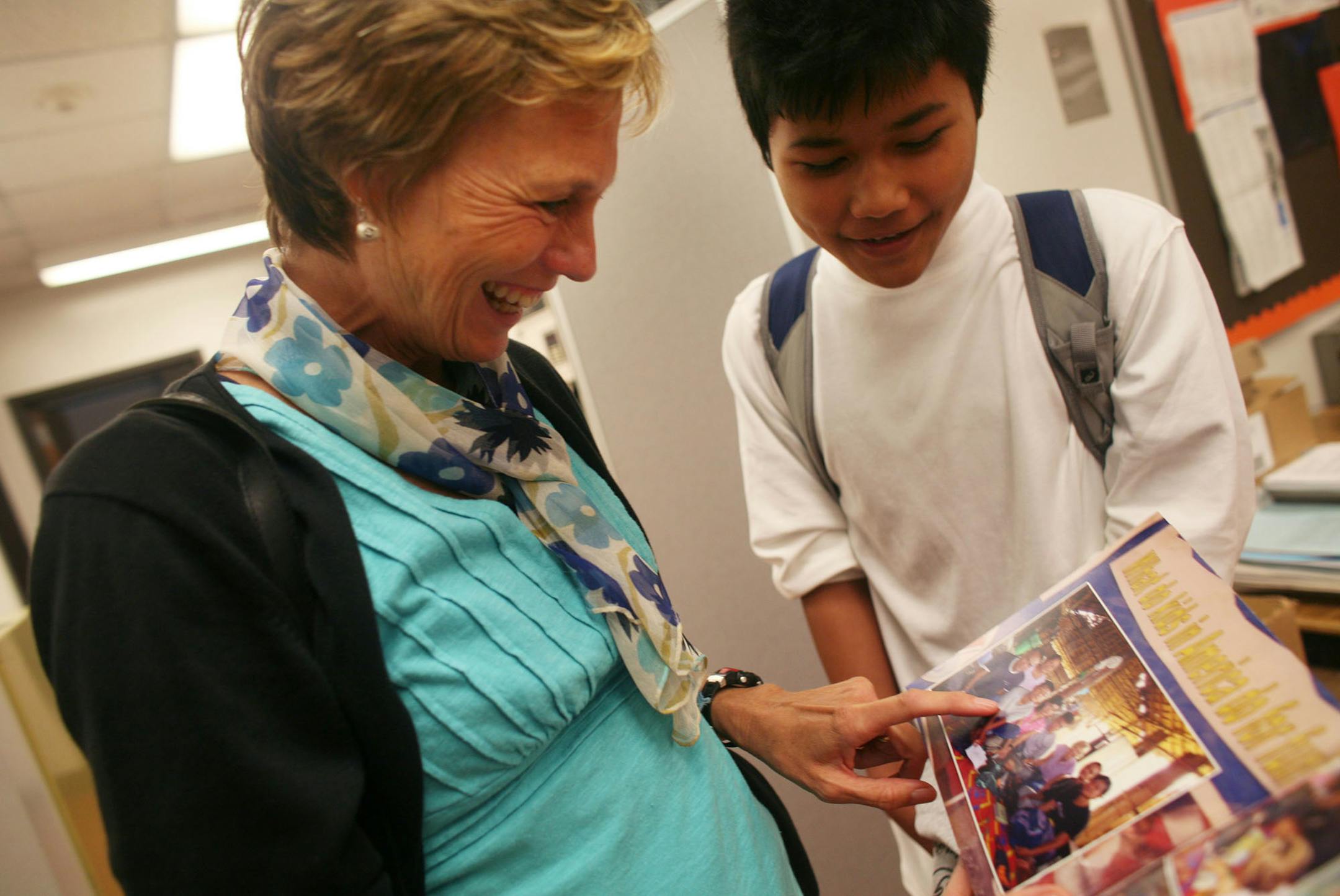
Jane Hall is one of those teachers who makes a point to reach out and connect with her students, many of whom come from other countries and all of whom are learning to speak, read and write English.
"She engages the kids and provides real-life activities for them," said Hall's boss, Mike Sodomka, the principal at St. Paul's Humboldt High School. "Her classroom is so warm and welcoming. It's a model for our building."
This past spring, Hall went even farther in getting to know her students -- about 8,500 miles farther. She took a sabbatical to volunteer as a teacher in the Umpiem Mai refugee camp near the Thailand-Myanmar border, working with Karen refugees from January through early May.
Her motivation was simple: As more Karen refugees come to St. Paul, Hall figured she ought to better understand them. After all, she expects she will soon be teaching them.
"I like to travel to where my students are from," she said, pointing out that she has also spent time in Ethiopia, Laos, Vietnam and Latin America. "I feel it really does help establish a relationship."
According to the United Nations, about 17,000 Karen refugees have come to the U.S. in the past few years and more are expected now that State Department has loosened some restrictions. About 150,000 refugees are living in nine camps in Thailand along the border with Myanmar, which the Karen refer to as Burma. So, Hall said, she wanted to learn what life is like for them there.
At Umpiem Mai, home to about 20,000 refugees, life for Hall meant living with her English language students in a thatch dormitory.
She bathed with buckets of water, slept on a mat on the floor and only had electricity for a couple hours a day. That was better than most. The school where she worked had a generator. Most refugees had only candlelight in the evenings.


