
St. Paul Saints ballpark will be green, city says

The $65 million project is following state sustainability guidelines, which officials say are similar to LEED standards.

November 21, 2014 at 1:31AM
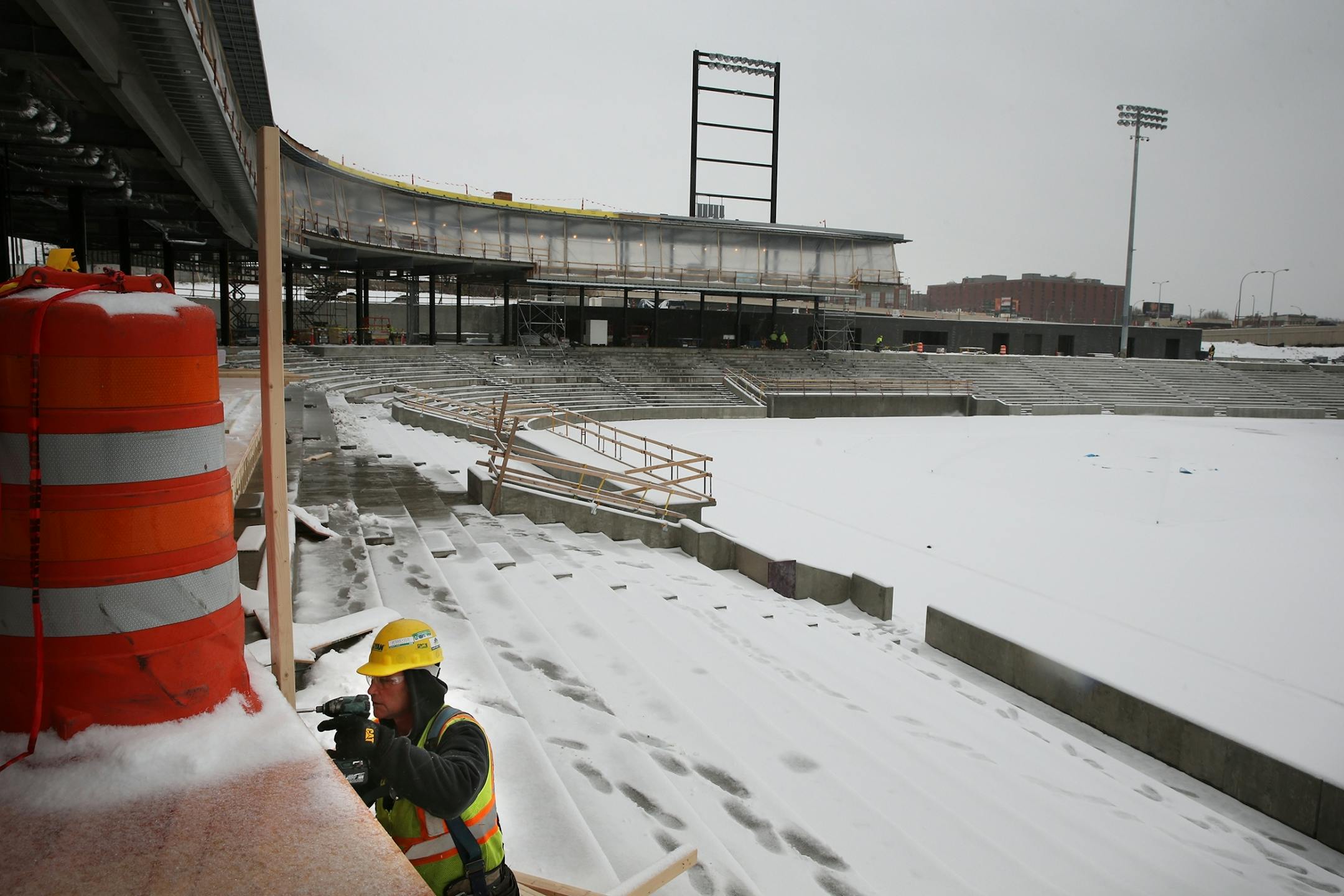
A Ryan Construction worker named Rick, who did not want his last name used, drills boards into place at the Lowertown Ballpark construction site in St. Paul during the first snowstorm of the season on Monday, November 10, 2014.
Work at the ballpark in Lowertown St. Paul last week. (Dml - Star Tribune Star Tribune/The Minnesota Star Tribune)

Following the lead of Target Field and TCF Bank Stadium, St. Paul officials are taking steps to ensure the ballpark rising in downtown for the St. Paul Saints will be green.

The city of St. Paul said Thursday that CHS Field will include an array of solar panels to help power the facility, as well as a system to capture nearby rainwater to irrigate the field and flush the toilets in the outfield restrooms.

"I am excited to announce these new initiatives, which will help make CHS Field one of the greenest minor league ballparks in America," said Mayor Chris Coleman in a prepared statement.

The green systems won't be cost-effective. Taken together, the solar and water systems add a little more than $1 million to the cost of the $65 million project, while saving only about $24,000 in annual operating costs.

But most of the installation costs are covered by corporate and publicly funded grants, project manager Paul Johnson said. And the bigger picture should be kept in mind as well, he said.

"It's important to look at sustainability and what it does to the environment, to not have to build more infrastructure and more power plants," said Johnson, who works for NTH Inc., the Minneapolis real estate firm that serves as the city's ballpark representative. "There's an educational component, too."

The solar installation will include 300 panels that will power 12 percent of the ballpark's electric needs. It will generate 103 kilowatts at peak and up to 132,000 kilowatt hours annually, making it one of the largest on-site solar arrays at a sports facility in the country, Johnson said.

Most of the $600,000 cost of the solar installation will be covered by a $555,750 grant from Xcel Energy.

The $450,000 rainwater system will collect rainwater from the roof of the adjacent light-rail operations and maintenance facility, pipe it to a 27,000 gallon tank at the ballpark, filter it and then deliver it to the field or restrooms.

The water will be used for 10 percent of toilet flushes at the ballpark and save about 430,000 gallons annually during a typical rainfall year. Most of it is covered by a $325,000 grant from the Capitol Region Watershed District and a $100,000 Met Council grant.

St. Paul won't be seeking LEED certification for the ballpark, the gold standard for green development, because it can cost tens of thousands of dollars. But the ballpark will follow the state's B3 standards, which are similar to LEED's.

Kevin Duchschere • 651-925-5035

about the writer

about the writer

Kevin Duchschere

Team Leader

Kevin Duchschere, a metro team editor, has worked in the newsroom since 1986 as a general assignment reporter and has covered St. Paul City Hall, the Minnesota Legislature and Hennepin, Ramsey, Washington and Dakota counties. He was St. Paul bureau chief in 2005-07 and Suburbs team leader in 2015-20.

See Moreicon

More from No Section

See More
FILE -- A rent deposit slot at an apartment complex in Tucker, Ga., on July 21, 2020. As an eviction crisis has seemed increasingly likely this summer, everyone in the housing market has made the same plea to Washington: Send money — lots of it — that would keep renters in their homes and landlords afloat. (Melissa Golden/The New York Times) ORG XMIT: XNYT58
Melissa Golden/The New York Times

It’s too soon to tell how much the immigration crackdown is to blame.